I don't actually think Fifth Edition will suck. I do, however, think that I won't enjoy it.
This is specifically a 3.5e blog, so probably you can tell which edition of D&D I prefer. Everything 3e and earlier is too unrefined and clumsy. 4e is too much of a departure from what I find fun. Pathfinder makes too many changes and too few improvements and isn't as backwards-compatible as it pretends to be.
So maybe you're wondering what I think of about 5e. (Actually, probably you aren't, but I'm going to shove them down you anyway.) I haven't taken advantage of any opportunities to playtest 5e, and what little I gather from the people who have tried it (they having signed NDAs and thus not talking very much) is that it's modular and at least one of the modules is "like 3.5e".
To which I say: if I want to play 3.5e (which I do), I'll just keep playing 3.5e. 5e needs to give me something new to make me learn all the new rules and switch to a barren new edition, beyond merely being like 3.5e.
And the only thing I don't like about 3.5e? Unbalanced classes.
One of the biggest things I like about 3.5e? The vast number of options available in supplements and splatbooks.
Any new edition loses that benefit, so for me to want to play it, it'll need to fix the class balance problem so well as to make it worth it.
Give me something that's basically 3.5e with perfectly balanced classes, and maybe I'll switch. (PF improved class balance very slightly, but pretty much left the tiers and all the attendant problems intact.) Try to give me anything else, and it's not worth it.
Buuuuuut at least it'll give the internet a new thing to complain about for the next decade.
Wednesday, February 22, 2012

Tuesday, October 18, 2011
Re-Rethinking Epic Options
Some time ago, I made a post about [Epic] feats as normal feats. But I have since realized that this doesn't even go far enough: most [Epic] options in general (e.g., epic prestige classes) are terrible compared to regular options. (Major exception: Epic Spellcasting, which is just stupid broken. More on that later.)
So I think I willrefine broaden my rules by ditching the specific [epic] feat options and adding the following more general rule, based on the Alexandrian's observation that the most powerful heroes in fiction are at most 5th level:
For the purpose of [epic] feats, prestige classes, and other options, a character is considered epic at 10th level instead of 20th level. After 10th level, regular feat slots may be used to acquire [epic] feats. All other prerequisites still apply.
A substantial majority of [epic] options still require 20+levels worth of ranks in skills, however. Rather than institute an across-the-board subtraction of 10 from all [epic] skill prerequisites (leaving many requiring fewer ranks than pre-[epic] things), or from all skill prerequisites (leaving many pre-[epic] things with no skill prerequisites at all), I will go with my old "add a new option and make it a feat" standby:
Skill Master
Prerequisite: Skill Focus in the skill selected
Benefit: For the purpose of of qualifying for feats, prestige classes, and other options, you are treated as though you have 15 more ranks in the selected skill than you actually have.
Additionally: Epic Spellcasting is completely broken. But I'm going to allow it just as it already is, except that actual epic spells don't exist. You can use epic spell slots only for metamagic'd versions of regular slots.
So I think I will
For the purpose of [epic] feats, prestige classes, and other options, a character is considered epic at 10th level instead of 20th level. After 10th level, regular feat slots may be used to acquire [epic] feats. All other prerequisites still apply.
A substantial majority of [epic] options still require 20+levels worth of ranks in skills, however. Rather than institute an across-the-board subtraction of 10 from all [epic] skill prerequisites (leaving many requiring fewer ranks than pre-[epic] things), or from all skill prerequisites (leaving many pre-[epic] things with no skill prerequisites at all), I will go with my old "add a new option and make it a feat" standby:
Skill Master
Prerequisite: Skill Focus in the skill selected
Benefit: For the purpose of of qualifying for feats, prestige classes, and other options, you are treated as though you have 15 more ranks in the selected skill than you actually have.
Additionally: Epic Spellcasting is completely broken. But I'm going to allow it just as it already is, except that actual epic spells don't exist. You can use epic spell slots only for metamagic'd versions of regular slots.
Friday, September 30, 2011
Blasphemy Rights
So I was mildly amused by this post on the Center for Inquiry website. You know why I was amused, right? Yeah, it's because a cleric can't cast blasphemy until level 13. Of course he's not amused! Blasphemy cast at a caster level of 13 weakens and dazes the level 12 cleric, no save!
But it did get me to thinking seriously about blasphemy as a vitally important component of free speech, and how it kind of gets shafted in D&D, saddled with the [evil] descriptor and only affecting nonevil creatures, just like the ur-priest gets saddled with evil as an alignment requirement. Not all gods are good! And even the good ones can be opposed on legitimate, non-evil philosophical grounds!
Anyway, let's fix it. My first inclination was to simply turn it from an evil spell to a good spell, but no, turns out that already exists (so do Lawful and Chaotic versions). We could just make a Neutral version (which turns out to also exist: word of balance in the Spell Compendium), but instead, let's make an antitheist version.
---
Righteous Blasphemy
Evocation [Sonic]
Level: Ur-Priest 7, Paladin of Freedom 4
Components: V, S
Casting Time: 1 standard action
Range: 40 ft.
Target: divine spellcasters in a 40-ft.-radius spread centered on you
Duration: Instantaneous
Saving Throw: None or Will negates; see text
Spell Resistance: Yes
Any creature capable of casting divine spells (or which have spell-like abilities that mimic divine spells) within the area of a Righteous Blasphemy spell suffers the following ill effects.
The effects are cumulative and concurrent. No saving throw is allowed against these effects.
Dazed - The creature can take no actions for 1 round, though it defends itself normally.
Weakened - The creature’s Strength score decreases by 2d6 points for 2d4 rounds.
Paralyzed - The creature is paralyzed and helpless for 1d10 minutes.
Killed - Living creatures die. Undead creatures are destroyed.
Furthermore, if you are on your home plane when you cast this spell, extraplanar divine spellcasters within the area are instantly banished back to their home planes. Creatures so banished cannot return for at least 24 hours. This effect takes place regardless of whether the creatures hear the righteous blasphemy. The banishment effect allows a Will save (at a -4 penalty) to negate.
Ur-priests and creatures whose Hit Dice exceed your caster level are unaffected by righteous blasphemy.
---
Additionally, here, have a feat (intended for Defiants, but any nontheist can take it):
Blasphemer [General]
Prerequisite: Must not worship any deity, character level 13th
Benefit: You gain righteous blasphemy as a spell-like ability at a caster level equal to your hit dice, usable 1/day.
If you are evil, you may choose to cast blasphemy instead. You may make this choice each time you use the spell-like ability.
Special: You may select this feat multiple times. Each time you do, you may use the spell-like ability one additional time per day.
But it did get me to thinking seriously about blasphemy as a vitally important component of free speech, and how it kind of gets shafted in D&D, saddled with the [evil] descriptor and only affecting nonevil creatures, just like the ur-priest gets saddled with evil as an alignment requirement. Not all gods are good! And even the good ones can be opposed on legitimate, non-evil philosophical grounds!
Anyway, let's fix it. My first inclination was to simply turn it from an evil spell to a good spell, but no, turns out that already exists (so do Lawful and Chaotic versions). We could just make a Neutral version (which turns out to also exist: word of balance in the Spell Compendium), but instead, let's make an antitheist version.
---
Righteous Blasphemy
Evocation [Sonic]
Level: Ur-Priest 7, Paladin of Freedom 4
Components: V, S
Casting Time: 1 standard action
Range: 40 ft.
Target: divine spellcasters in a 40-ft.-radius spread centered on you
Duration: Instantaneous
Saving Throw: None or Will negates; see text
Spell Resistance: Yes
Any creature capable of casting divine spells (or which have spell-like abilities that mimic divine spells) within the area of a Righteous Blasphemy spell suffers the following ill effects.
| HD | Effect |
| Equal to caster level | Dazed |
| Up to caster level -1 | Weakened, dazed |
| Up to caster level -5 | Paralyzed, weakened, dazed |
| Up to caster level -10 | Killed, paralyzed, weakened, dazed |
Dazed - The creature can take no actions for 1 round, though it defends itself normally.
Weakened - The creature’s Strength score decreases by 2d6 points for 2d4 rounds.
Paralyzed - The creature is paralyzed and helpless for 1d10 minutes.
Killed - Living creatures die. Undead creatures are destroyed.
Furthermore, if you are on your home plane when you cast this spell, extraplanar divine spellcasters within the area are instantly banished back to their home planes. Creatures so banished cannot return for at least 24 hours. This effect takes place regardless of whether the creatures hear the righteous blasphemy. The banishment effect allows a Will save (at a -4 penalty) to negate.
Ur-priests and creatures whose Hit Dice exceed your caster level are unaffected by righteous blasphemy.
---
Additionally, here, have a feat (intended for Defiants, but any nontheist can take it):
Blasphemer [General]
Prerequisite: Must not worship any deity, character level 13th
Benefit: You gain righteous blasphemy as a spell-like ability at a caster level equal to your hit dice, usable 1/day.
If you are evil, you may choose to cast blasphemy instead. You may make this choice each time you use the spell-like ability.
Special: You may select this feat multiple times. Each time you do, you may use the spell-like ability one additional time per day.
Tuesday, September 6, 2011
Fun New Items: Goblet of True Mind Switching and Greater Helm of Opposite Alignment
Goblet of True Mind Switching
If this jeweled silver cup is filled with any liquid, and two creatures drink from it in succession, the minds of the two creatures are swapped, as with a True Mind Switch power. Neither individual loses a level. This ability functions once per week. If one of the bodies later dies, that body's current occupant dies, and the other immediately loses one level.
Moderate telepathy; ML 17th; Craft Universal Item, True Mind Switch; Price 200,000 gp.
Helm Of Opposite Alignment, Greater
As Helm of Opposite Alignment, but functions 10 times before running out of charges, and save DC is 17.
Strong transmutation; CL 12th; Craft Wondrous Item, creator must be 12th level; Price 50,000 gp; Weight 3 lb.
If this jeweled silver cup is filled with any liquid, and two creatures drink from it in succession, the minds of the two creatures are swapped, as with a True Mind Switch power. Neither individual loses a level. This ability functions once per week. If one of the bodies later dies, that body's current occupant dies, and the other immediately loses one level.
Moderate telepathy; ML 17th; Craft Universal Item, True Mind Switch; Price 200,000 gp.
Helm Of Opposite Alignment, Greater
As Helm of Opposite Alignment, but functions 10 times before running out of charges, and save DC is 17.
Strong transmutation; CL 12th; Craft Wondrous Item, creator must be 12th level; Price 50,000 gp; Weight 3 lb.
Tuesday, August 30, 2011
Questmaster's Box
This ornately-decorated 12"x7"x4" wooden box is frequently used by guildmasters to send items to random places, so that low-ranking guild members may be tested by requiring them to find the item.
The front of the box has two buttons and a dial. The buttons are labeled "Send Object" and "Retrieve Locating Stone"; the dial is labeled "Radius" and may be set to 5 feet, 50 feet, 500 feet, 1 mile, 10 miles, 100 miles, and 1000 miles.
If the box is closed and "Retrieve Locating Stone" button is pressed, the locating stone (a non-magical and otherwise uninteresting pebble) appears inside the box.
If the box is closed and "Send Object" is pressed, anything inside the box is sent to a random location within the dial-specified radius of the locating stone.
The locating stone can be sent away by the box like any object. If the locating stone is destroyed, the box keys off the last known location of the locating stone, before it was destroyed, and creates a new locating stone if "Retrieve Locating Stone" is pressed.
Moderate conjuration; CL 10th; Craft Wondrous Item, locate object, teleport; price 1500 gp; weight 5 lb.
The front of the box has two buttons and a dial. The buttons are labeled "Send Object" and "Retrieve Locating Stone"; the dial is labeled "Radius" and may be set to 5 feet, 50 feet, 500 feet, 1 mile, 10 miles, 100 miles, and 1000 miles.
If the box is closed and "Retrieve Locating Stone" button is pressed, the locating stone (a non-magical and otherwise uninteresting pebble) appears inside the box.
If the box is closed and "Send Object" is pressed, anything inside the box is sent to a random location within the dial-specified radius of the locating stone.
The locating stone can be sent away by the box like any object. If the locating stone is destroyed, the box keys off the last known location of the locating stone, before it was destroyed, and creates a new locating stone if "Retrieve Locating Stone" is pressed.
Moderate conjuration; CL 10th; Craft Wondrous Item, locate object, teleport; price 1500 gp; weight 5 lb.
Wednesday, August 10, 2011
Cursed Item Design
A good basic principle of cursed items is this: take a standard item, and make it do what it's supposed to do except not quite right, or make it do something ironic in addition to the intended effect. Go for things that work just fine, if you're okay with the side-effects.
Examples, just looking through the Magic Item Compendium and coming up with things off the top of my head:
Also consider cursed coins - nobody ever thinks to detect magic the money!
Examples, just looking through the Magic Item Compendium and coming up with things off the top of my head:
- A bear helm that also transmits werebearism
- A belt of growth that makes you grow, but none of your items grow with you. Any armor and clothes worn (except the belt) are destroyed, and your weapon still does its original damage
- A blindhelm that also makes you permanently blind
- Bracers of opportunity that provoke an attack of opportunity every time you use them
- A cloak of the salamander that has a 50% chance of setting its wearer on fire (doing the listed fire damage every round until the wearer is dead or immersed in water) every time they activate it
- A hair shirt of suffering that damages the wearer (by the same amount healed) every time they use its healing ability
- A ring of negative protection that, instead of protecting you from negative energy, instead grants negative protection (i.e., vulnerability) to all forms of energy
- A shirt of the leech that also attracts 1d4 leech swarms (Stormwrack, I think) every time the wearer enters water
- A torc of heroic sacrifice that has a 25% chance of outright killing its wearer every time it's used
- A metamagic rod that applies a misspelling effect to spells instead of a normal metamagic effect
Also consider cursed coins - nobody ever thinks to detect magic the money!
Monday, August 8, 2011
Interesting Locations
One of the biggest problem in my dungeons is a lack of interesting locations. My dungeons were an endless series of bland, uninteresting rooms, filled with monsters and not much else.
So I made a concerted effort to seek out ideas for landmarks and items with which to populate my dungeons. I compiled a list. I found discussion threads listing interesting features, traps, and puzzles, added most of the things from the Alexandrian's 101 Curious Items, added one of each cursed item (and some additional cursed items), added a vial of every basic potion, added some random additional magic items, followed the Alexandrian's advice in that post and made some interesting new locations with the help of the 1st edition DMG, added most of the lists from the 3.5e DMG and [i]Dungeonscape[/i] and other sources, and eventually had a massive list. Then, for every room in the dungeon, I rolled 3 or so times on this list of landmarks ("nothing" was a prominent option, so not everything had 3 landmarks; unlike in my dynamic random encounter tables, I did decrement "nothing" by 1 each time it was selected).
Here are some ideas to get you started on your list, should you chose to do the same:
So I made a concerted effort to seek out ideas for landmarks and items with which to populate my dungeons. I compiled a list. I found discussion threads listing interesting features, traps, and puzzles, added most of the things from the Alexandrian's 101 Curious Items, added one of each cursed item (and some additional cursed items), added a vial of every basic potion, added some random additional magic items, followed the Alexandrian's advice in that post and made some interesting new locations with the help of the 1st edition DMG, added most of the lists from the 3.5e DMG and [i]Dungeonscape[/i] and other sources, and eventually had a massive list. Then, for every room in the dungeon, I rolled 3 or so times on this list of landmarks ("nothing" was a prominent option, so not everything had 3 landmarks; unlike in my dynamic random encounter tables, I did decrement "nothing" by 1 each time it was selected).
Here are some ideas to get you started on your list, should you chose to do the same:
- A door that opens on someplace completely different in the dungeon
- A dung heap
- A metamagic rod that applies a misspelling effect to spells instead of a normal metamagic effect
- A monster nest (roll on wandering monster table to determine whose nest)
- A mound of rubble
- A statue (roll on wandering monster table to determine what it represents)
- A toppled statue
- A trap
- A trap that's already been triggered
- Adventurer corpse
- Bloodstains
- Bottomless chasm with a bridge across it
- Bottomless pit
- Ceiling collapses (reflex 15 or 5d6 damage + buried) when anyone steps in the middle of the room. Ceiling is restored (and will do it again) if doors are closed when nobody is inside
- Door that reverses the gravity for anybody who passes through it in either direction
- Graffiti
- Hidden treasure
- Humanoid bones
- Little bell and a hammer and a sign that says "Please do not ring this bell"; If bell is rung a huge fire elemental appears and attacks (works 1/day)
- Monster corpse
- mosaic of dozens of Olidammaras who attempt to steal gold (sleight of hand +10) from anyone who comes within 5'
- Nonhumanoid bones
- One-way passage, can travel one direction but not the other (DC25 strength check to pass 5' in the wrong direction).
- Room full of lifelike statues. Pedestal which casts Flesh to Stone (save DC15) on anyone who touches it.
- Some vertical elevation change
- Tapestry which forcibly casts Rage (will DC15, duration 5 rounds) on anyone who sees it
- Unidentifiable slime on the walls
Saturday, August 6, 2011
Multiheaded Characters

I've always kind of liked the idea of playing half an ettin. Get another player to play the other half, and be two characters sharing a two-headed body.
There are, however, two problems with this: the first is that the ettin is an ECL15 creature. The second is that there are no real rules for two characters sharing one body. Let's fix both of these problems.
---
The first is relatively easy to fix. Savage Species provides a Multiheaded template, which we can apply to some suitably monstrous creature. Applying it to mongrelfolk is too obvious. Well, hurm. What low-ECL (let's say less than 3HD and less than LA3) PC-suitable races have an intelligence and charisma penalty and a strength and constitution bonus? Let's check MonsterForge.
Abyssal maw demons, githzerai, gnolls snow goblins, neanderthals, orcs, whitespawn hordeling spawns of tiamat, and windrazor windblades. I don't happen to know what two of those are offhand, and I don't care quite enough to look them up, so let's rule out the demons and the windblades. I was about to rule out the spawn of Tiamat, but wait, what's Tiamat's defining feature? All those heads! So let's keep that in the running for now.
No, I'm not really absolutely sure what I'm looking for. I kind of want to replicate the feel of the ettin without necessarily actually replicating the ettin.
Multiheaded orc is a little too obvious, and I'm not fond of D&D neanderthals in general (If their name were anything else, it would be better, but they took generic cavemen and slapped a label which does not describe cavemen. Plus, D&D already has cavemen in spades, do we really need something that's the same as all the other cavemen except less green?), so let's rule those out. And I'd rather there be a reason. And if there's to be a fair amount of extra ECL, I'd prefer there to be a good fluff reason for it, so that rules out the gnoll.
Leaving us with snow goblins and whitespawn hordelings! Let's look up the details on these creatures. I don't happen to remember the fluff for the spawn of Tiamat, other than "Bahamut starts making dragonborns, so Tiamat retaliates by bangin' everything in sight". Or maybe it's the other way 'round. Let's crack Monster Manual IV and read!
Yeah, it's the other way 'round, the dragonborn are Bahamut's response to the spawn of Tiamat. And the spawn are not necessarily literally Tiamat's progeny, other than she caused them to come about.
I don't mind the fluff for the spawn of Tiamat, and will probably eventually use some of them in my game, but I don't think "the very weakest of Tiamat's spawn get the glory of imitating her in having multiple heads". I definitely will remember, however, that the multiheaded template is of particular merit, fluff-wise, for chromatic dragons and dragon-descended.
Okay, so, multiheaded snow goblins it is. To Frostburn!
Eh, let's ditch the throat sacs. If I wanted Kuo-Toa, I'd use Kuo-Toa. In fact, let's ditch all of the fluff and use only the crunch, we can refluff them as much as we want. In fact, let's forget the crunch and just use regular goblins, which are basically the same but have the benefit of being OGL.
So, taking the SRD's goblin and applying an extra head to it:
---
Two-Headed Goblin
Small Humanoid (goblinoid)
2 humanoid hit dice
-2 Strength, +2 Dexterity, +2 Constitution, -2 Charisma.
Small size: +1 bonus to Armor Class, +1 bonus on attack rolls, +4 bonus on Hide checks, -4 penalty on grapple checks, lifting and carrying limits ¾ those of Medium characters.
A two-headed goblin’s base land speed is 30 feet.
Darkvision out to 90 feet
+4 racial bonus on Move Silently and Ride checks.
+2 racial bonus on Listen, Search, and Spot checks.
+1 natural armor bonus
Superior Two-Weapon Fighting: Because each head controls one arm, the two-headed goblin has no penalty on attack rolls for attacking with multiple weapons, and the number of attacks and the damage bonus for each weapon are calculated as though the weapon were held in a primary hand.
Automatic Languages: Common, Goblin. Bonus Languages: Draconic, Elven, Giant, Gnoll, Orc.
Bonus feats: Improved initiative, Combat Reflexes
Favored Class: Rogue.
Level Adjustment: +2
---
Those extra HD aren't necessary, and we could bump that LA down by removing some of the unneccessary extra abilities. Let's say this isn't just a goblin with two heads, it's a new creature, so it can lose most of the goblin traits. So let's drop the racial hit dice and the natural armor bonus, drop the Move Silently and Ride checks, reduce the Darkvision to Low-Light Vision. We're going to wind up counting it as two characters, so the bonuses to Listen, Search, and Spot checks (from having twice the usual number of eyes and ears) will be made redundant with simply rolling the things twice, so drop those, too. Getting to act twice in initiative is better than Improved Initiative, and getting to make two attacks of opportunity is nearly as good as Combat Reflexes, so those can go. The Superior Two-Weapon Fighting is important and can stay, though. And let's even the racial bonuses out a bit, no more str penalty or dex bonus.
That, according to this, brings us down approximately to 0.5 ECL at 1HD. I guess we can give it something back. Let's make it Medium and give it a strength bonus. I think at this point we've taken a two-headed goblin and turned it into a two-headed orc. Let's give it, oh, I don't know. Vulnerability to sonic, what with having twice as many ears (yes I know that's not how sonic damage works), and let's say Fast Healing 1, I was just thinking the other day that fast healing is neat. Although, it gets twice as many turns, so that would wind up being Fast Healing 2, which is too much. Let's give it DR or energy resistance or something instead. Resistance 5 to electricity, that's what we'll do, what with having twice as many hearts. Shut up, that's perfectly cromulent. And let's round it out with, I don't know, Scent.
Oh yeah, it's no longer a two-headed goblin in any sense at all, so it needs a new name. Let's call it zweikopf, which is probably not good German, but whatever.
Okay, so:
---
Zweikopf
Medium Humanoid
+2 Strength, +2 Constitution, -2 Charisma.
A zweikopf’s base land speed is 30 feet.
Low-Light Vision.
Superior Two-Weapon Fighting (Ex): Because each head controls one arm, the zweikopf has no penalty on attack rolls for attacking with multiple weapons, and the number of attacks and the damage bonus for each weapon are calculated as though the weapon were held in a primary hand.
Sonic Vulnerability (Ex)
Electricity Resistance 5 (Ex)
Scent (Ex)
Automatic Languages: Common. Bonus Languages: Draconic, Elven, Giant, Gnoll, Goblin, Orc, Undercommon.
Level Adjustment: +0
Favored Class: Barbarian.
---
...meh, good enough. Now, rules for two players playing one two-headed creature?
Well, it shouldn't be weaker than two separate characters. That's an easy trap to fall into. This isn't really just one creature. In general, it should be treated as two separate creatures sharing a square.
Some of the things you need to consider (and my solutions to them):
Each character buys/rolls ability scores normally. Each character gets the racial modifiers applied to their scores separately. Each character uses their own ability scores for anything they do, as if they were a separate creature. (Yes, it's entirely plausible that you might see a creature with one huge bulky arm and one tiny dinky arm. Which is fine; have you ever heard a description of a blacksmith? Same deal, and that only with one head.)
Each head earns experience and gains levels independently of the other.
Any feats or flaws taken by one head apply only to that character.
Each head rolls their hit dice and adds their constitution score every level. These hit points go into a shared pool.
Any damage taken by either head is subtracted from the shared pool. Any healing applied to either head is added to the shared pool. If this pool reaches 0, both heads are disabled. If it falls below zero, both heads are unconscious. Only one head rolls to stabilize each round, and the pool only loses one hit point per round when the joint creature is not stable.
Any other creature subjecting the zweikopf to any effect must choose to target one head or the other, though this choice may be random. Each head uses their own AC and saves. Any effect which targets multiple characters can target each head individually, as if they were separate creatures.
Any items worn on the feet, fingers, hands, arms/wrists, shoulders, body, and torso slots affect both characters. (Items that function only if both of a pair are worn still function only if both are worn.) Each character has their own head, eyes, and neck slots; any magic items worn on the neck, eyes, and head slots affect only the head wearing them.
Each head can wield and use a one-handed or light weapon with no penalties. Wielding a two-handed weapon takes more coördination than the two heads can muster.
Each head rolls their own initiative. Each head gets actions (move+standard or full round) as if they were a separate character.
Each head can move the body as a normal character. However, each head's move speed is half the listed move speed. Either head can choose to veto any movement attempted by the other; if this happens, the joint creature falls prone.
If a creature provokes, each head may make a separate attack of opportunity, as if they were separate creatures.
Thursday, August 4, 2011
You didn't miss, but you didn't hit him.
An incompetent DM will only ever say "you hit" or "you miss", when you hit or fail to hit, respectively. This turns combat into a pure numbers game, which is fun enough for some people but boring for most people.
A half-competent DM will, instead of saying "you hit", say "you hit him in the [location semi-arbitrarily chosen on the fly based on how much you beat his AC by and how much damage you wind up doing]!" This is more interesting, but still not perfect.
The rare good DM will also tell you how you miss. It's odd that this is rarer than the above, because it's actually very easy to do. You can set up rules for it in your head! A good DM will keep a general sense of the monster's various kinds of AC, and will declare how you failed to hit based on those, based on rules like these:
- If you rolled below 10 and didn't hit, you missed.
- If you rolled above 10 but below his touch AC, your foe ducked or otherwise deliberately evaded your attack.
- If you rolled above his touch AC but below his total AC, his armor or natural armor deflected the blow.
- If your foe has a dodge bonus, then you can use the word "dodge", and your foe dodged the attack if you rolled higher than 10+dex but lower than 10+dex+dodge.
- If your foe has a deflection bonus, same deal. If your foe has a shield bonus, same deal. If your foe has any other kinds of bonuses, same deal.
In general, a foe will let an attack sail past them if it would miss on its own. If it could actually hit them, they prefer to get out of the way. If they can't do that, they'll prefer to block it with something that can reliably do so, e.g. their shield or deflection bonus. If they can't do that, only then will they take it on their armor or thick hide (i.e., natural armor). And if they can't do that, then you hit.
This makes combat much more interesting, and communicates some information that the characters really should have, and which particularly smart players (if there is such a thing) can leverage. If they notice their foe catching most of their blows on his shield, they'll know to sunder it. If they notice their foe ducking out of the way of most of their blows, they'll know to cast grease to make him flat-footed. If they notice their foe catching most of their attacks on his armor, they'll know to use more touch attacks. And so on.
A half-competent DM will, instead of saying "you hit", say "you hit him in the [location semi-arbitrarily chosen on the fly based on how much you beat his AC by and how much damage you wind up doing]!" This is more interesting, but still not perfect.
The rare good DM will also tell you how you miss. It's odd that this is rarer than the above, because it's actually very easy to do. You can set up rules for it in your head! A good DM will keep a general sense of the monster's various kinds of AC, and will declare how you failed to hit based on those, based on rules like these:
- If you rolled below 10 and didn't hit, you missed.
- If you rolled above 10 but below his touch AC, your foe ducked or otherwise deliberately evaded your attack.
- If you rolled above his touch AC but below his total AC, his armor or natural armor deflected the blow.
- If your foe has a dodge bonus, then you can use the word "dodge", and your foe dodged the attack if you rolled higher than 10+dex but lower than 10+dex+dodge.
- If your foe has a deflection bonus, same deal. If your foe has a shield bonus, same deal. If your foe has any other kinds of bonuses, same deal.
In general, a foe will let an attack sail past them if it would miss on its own. If it could actually hit them, they prefer to get out of the way. If they can't do that, they'll prefer to block it with something that can reliably do so, e.g. their shield or deflection bonus. If they can't do that, only then will they take it on their armor or thick hide (i.e., natural armor). And if they can't do that, then you hit.
This makes combat much more interesting, and communicates some information that the characters really should have, and which particularly smart players (if there is such a thing) can leverage. If they notice their foe catching most of their blows on his shield, they'll know to sunder it. If they notice their foe ducking out of the way of most of their blows, they'll know to cast grease to make him flat-footed. If they notice their foe catching most of their attacks on his armor, they'll know to use more touch attacks. And so on.
Wednesday, July 20, 2011
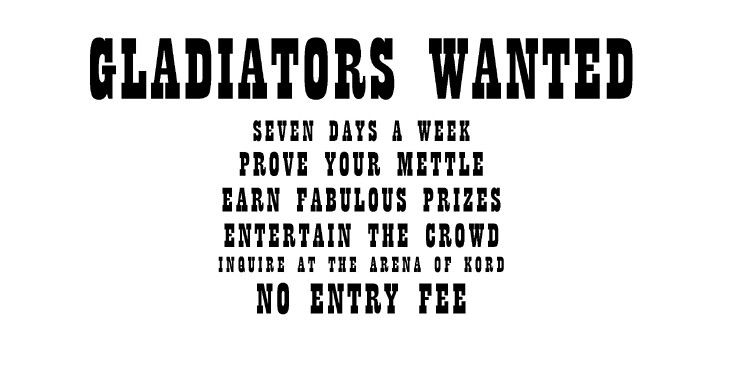
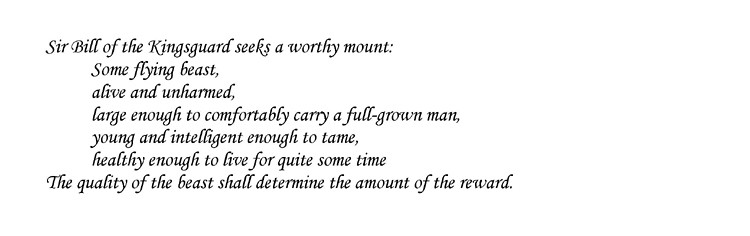
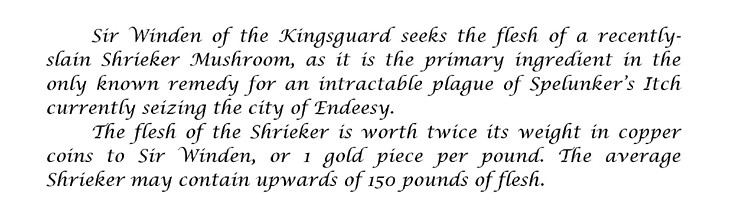
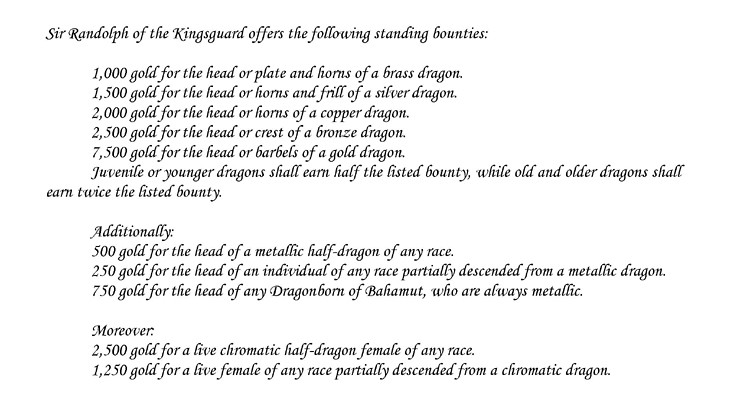
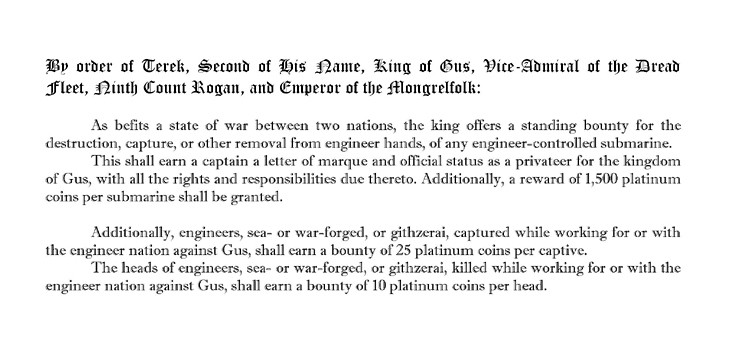
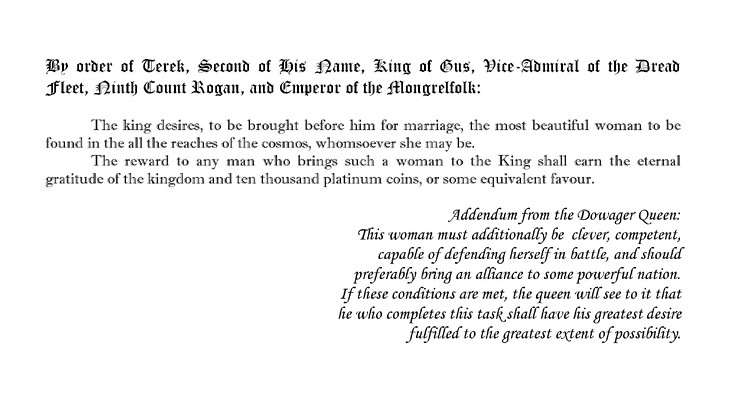
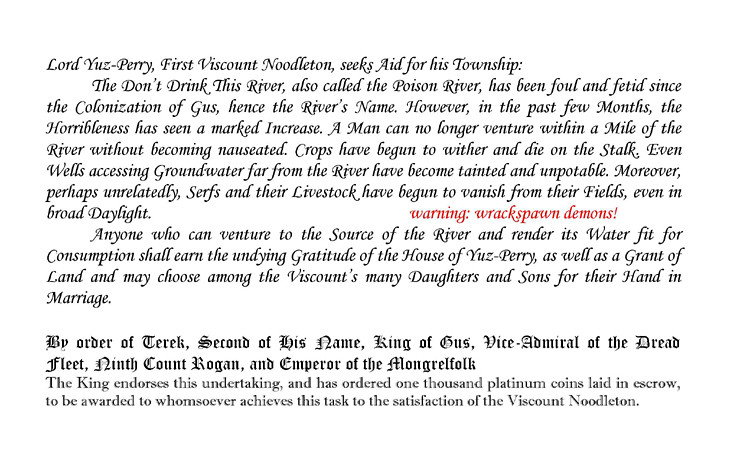
Bounties of the Megadungeon
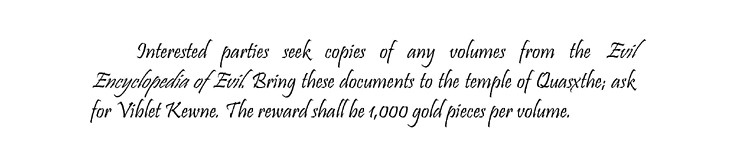
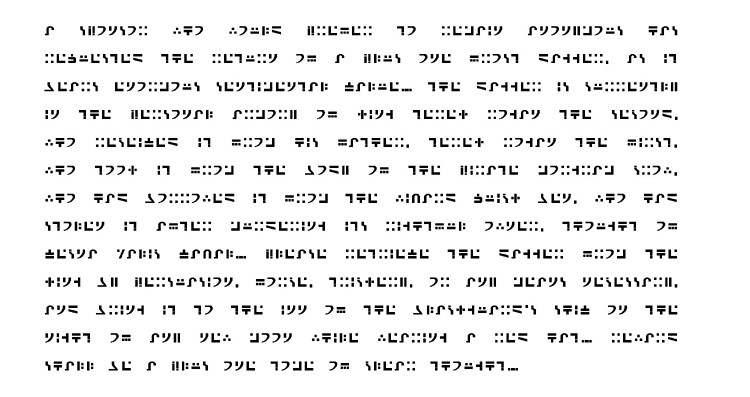
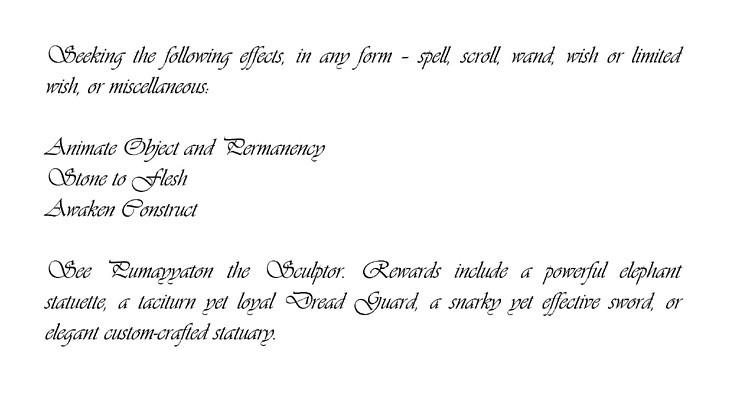
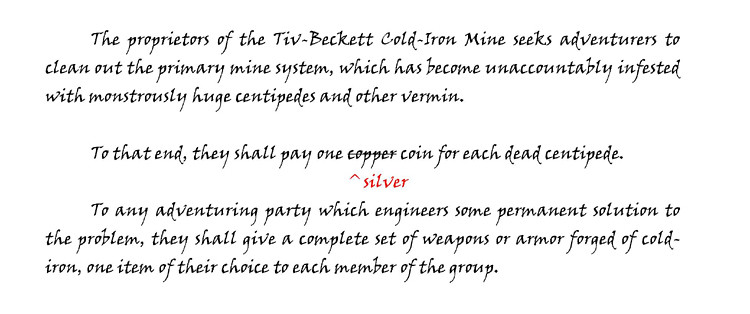
The following is a list of the current bounties offered at my megadungeon open game table, as they are presented to my players. Well, they get everything all nicely printed out on individual half-sheets of paper, but you get the idea. I hope some of them may inspire you for your own games.
Part of this is a lesson I have heard, but not entirely completely internalized: whenever possible, have something physical to hand your players. Tangible objects are supposedly much more interesting to them than mere descriptions in the air. As one hears often in Westeros: words are wind. This particular technique, the bounties on paper, suffer somewhat from still mostly just being words, though if you can interesting them up by trying to get as close as you can to the actual handwritten documents (mostly with creative font choices), that helps.
A side story: one benefit to using LaserTron tokens for mini bases: I had a couple left over (which I did paint on one side, intending to use them for swarms or miscellaneous markers or something), so when my players tried to squeeze money out of a particularly unwealthy viscount, I had five coins on hand to drop on the table and say "This is all the money I can spare".
My next idea to liven things up is to include bounties that are just pictures, no words. Not everyone who wants to post a bounty is literate, after all. Even Sir Bigglesworth counts as literate, if only barely. But this is a major challenge for the DM to try to convey instructions without using words, and to the players to understand.
---


Part of this is a lesson I have heard, but not entirely completely internalized: whenever possible, have something physical to hand your players. Tangible objects are supposedly much more interesting to them than mere descriptions in the air. As one hears often in Westeros: words are wind. This particular technique, the bounties on paper, suffer somewhat from still mostly just being words, though if you can interesting them up by trying to get as close as you can to the actual handwritten documents (mostly with creative font choices), that helps.
A side story: one benefit to using LaserTron tokens for mini bases: I had a couple left over (which I did paint on one side, intending to use them for swarms or miscellaneous markers or something), so when my players tried to squeeze money out of a particularly unwealthy viscount, I had five coins on hand to drop on the table and say "This is all the money I can spare".
My next idea to liven things up is to include bounties that are just pictures, no words. Not everyone who wants to post a bounty is literate, after all. Even Sir Bigglesworth counts as literate, if only barely. But this is a major challenge for the DM to try to convey instructions without using words, and to the players to understand.
---





Subscribe to:
Posts (Atom)