Showing posts with label deities. Show all posts

Monday, October 30, 2023

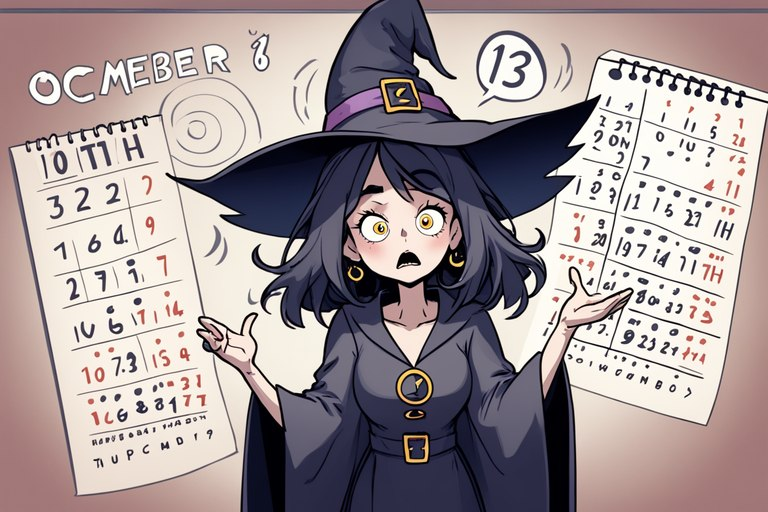
The Year Hoobynoob Unaccountably Contrived to Come on Freday the 13th of Octember

Through some celestial mishap or accounting error, for some reason, Hoobynoob falls on Freday the 13th of Octember, in this, the 47th year of the Subsidence. Normally, of course, Hoobynoob falls on the 30th, the last day of Octember. The 13th of Octember doesn't normally even fall on a Freday -- it is typically a Munday.

This calendrical irregularity is known for certain: all the experts agree on this unusual occurrence -- the astrologers; the astronomers; the druids and rangers of Sequoia (who counts the months and weeks, the planets and stars, under her purview); the calendricians and calendrometers; we even asked the janitor, as they know of these things.
Amongst the populace, once the confusion is overcome -- or at least set aside -- the yearly observance of Hoobynoob proceeds as usual, albeit on the 13th. In Endeesy, capital of Gus: gourds are carved; nuts are harvested; costumes are prepared; candies and sweets are purchased or crafted in bulk in preparation for the traditional mass extortion, on threat of prankery, by children.

The cit of Endeesy in the fog

When the 13th of Octember arrives -- on a Freday, just as (unusually) ordained -- the morning sneaks into Endeesy foggily. The day slugs by: children growing increasingly excited, adults growing increasingly wary of danger, the weather growing increasingly foggy and moist-smelling.
When treat-or-tricking time arrives, it is nigh impossible to find one's way in the fog. But, through some divine Dalyan providence, unusually alert priests of Dalya, and widespread use of the Buddy System, no children are separated from their guardians for long.
The children return to their homes, feast on junk food, and repair engorgedly to their beds. After the foggy day and foggier evening, it looks like it has been another successful Hoobynoob, profitable for the children and fun for all ages! Parents go to bed. Bar crawlers begin the process of acquiring their holiday drunkenness.
Midnight approaches.
The clock tower in the Cathedral of Quasxthe in the Crown District of Endeesy ticks over from 11:59, and the mighty bell begins its twelvefold tolling: BO-o-...
The bell, having tolled half of once, trails off, as if it has forgotten how to bell.
Mournful moans are heard through the increasingly farty-smelling fog.

Zombies!

Zombies! Some of whom are fresh, some of whom are decaying and dirt-encrusted.
Following the trail of zombies leads the party north, to a graveyard in the Resentment Ward. The zombies are discovered to be animated by worms squirming under their skin (a miniboss zombie acts as Spawn of Kyuss).

A graveyard with a mausoleum

A 400-year-old mausoleum, dating to the early centuries of the Inundation, proves to be the resting place of the Mermaid Queen Riefya I Arielid "the Black".

Damaged engraving identifying the tomb

A party member recollects a fact about Riefya "the Black": that she was found, after her death, to have secretly been a cultist of Asya, goddess of all that is disgusting.
The lock on the door, being 400 years old and having been underwater most of that time, has become more of a jam. But somebody has already broken the jam. But somebody subsequently cast an arcane lock on the door. But the rogue breaks the arcane lock.
Within the tomb, reality is distorted. The air is fetid and moist. The stairs down are greasy. The walls are fleshy and moist. It is not a throat, but it desperately wants to be a throat.

Stairs down into a tomb

At the bottom of the stairs, the tomb of Riefya has expanded from a small room to a large acid-lake cavern, as if it wants to be a stomach.
Tomb with a lake of acid

A sarcophagus stands on a raised dais in the middle of the acid lake. A mage stands by the sarcophagus, incanting a ritual.

Ooze mage Vyndoc Hogkt

He is Vyndoc Hogkt, a descendant of the Hogkt family that ruled the Asya-worshipping Plaguelord nation while it existed in the first century before the Inundation. (He is a Mage, with spells swapped out for poison- and acid-related spells.)
His ritual concludes, and an oozely incarnation of Asya possessing the corpse of Queen Riefya joins combat. (She uses the stat of a Black Pudding, except she can throw acid gobbets -- her Pseudopod has a 60' range.)
Oozey Asya incarnated into the corpse of Riefya I

If the party kills Riefya!Asya first, Vyndoc sacrifices himself to regenerate and empower her. If the party kills Vyndoc first, Riefya!Asya eats his corpse and is regenerated and empowered. Either way, it is a two-stage boss fight. (The amalgamation boss has a combination of the abilities of its components, and then some.)
Amalgamated ooze boss monster thing

The party defeats Vyndoc, Riefya, and Asya, and prevents Bad Things from happening.
Time progresses from midnight once they emerge from the tomb.
Hoobynoob did not come on Freday the 13th because of Vyndoc (that's an unsolved mystery), but since it did, and both 13 and Hoobynoob are sacred to Asya, he took it as auspicious to enact his plan.

Monday, January 2, 2023

How the Bonelord Stole Driftmas

On the last day of the year, three Guildmasters of the Endeesy Adventurer's Guild -- Ruthmin Tern the Assassin Rogue, Christopher the Paladin, and Lyra the Stars Druid -- were chilling in the Guildmasters' Lounge when seven driftmas fey popped through a portal, begging for their assistance. It turned out that Saint Usla, in charge of Driftmas, had been kidnapped by fire creatures.

The Guildmasters tracked the scorch-trail from the Driftmas Demiplane, to the Transitory Holiday Demiplane, to the Hoobynoob Demiplane.

They found (and broke into) a laboratory guarded by salamanders, where Saint Usla had recently been, but she (and the Professor, one of Hoobynoob's people) had already been stolen by disgusting creatures.

In the laboratory greenhouse, they found a construct named Sam, who was very concerned that Jaq the Gourd Duke, in charge of Hoobynoob, had been acting very strangely, including with this peculiar plan for Saint Usla.

They went to Jaq's mansion, where they were hired by Jaq to recover the Professor. Jaq's theory was that Neepkag the Bogeyperson, who had been in charge of Hangadh-Buain-Noiche before the Burning Hate took it from Asya and put Jaq in charge as the Incandescent Bonelord of Heckbound Night (long before Dalya took over, renamed it to Hoobynoob, and made Jaq the Gourd Duke), wanted to carry out Jaq's own plan, but to their own benefit.

(Jaq's plan was to split his two personalities -- the Incandescent Bonelord following the Burning Hate, and the Gourd Duke following Dalya -- putting one into Saint Usla, so that each could be in charge of their own holiday. The Professor had all the details, it involved a plant that had been grafted with black dahlias and orange lilies, which through the laws of similarity could split the two personalities if ungrafted, and then graft the orange lilies onto a sunflower, representing Saint Usla's Numiel.)

The Guildmasters went to the Bogeyperson's cave, defeated them, rescued Usla, and were declared Nice and deserving of many presents by Usla. They returned the Professor to Jaq, who now owes them an unspecified favor.

Monday, February 14, 2022

Arossiel and Lily

In the long ago, in time that was, before the quarrels of today’s centuries: there was a human woman. Her hair was black and short and her skin was pale as teeth, and the name that she was called by her friends, and that we shall call her today, was Lily – the overseers had a different name for her, or more precisely an alphanumeric code, the specifics of which are of little importance and have been lost to us.

The Archbishop of Banor at the time had been raised to her position through promising a tremendous plan to defeat Calabia. Seven times Banor had tried to conquer Calabia, seven times the bloodlords’ military superiority and judicious political alliances had rebuffed the holy wars. Eight is not an auspicious number to the Numielites of Banor, but the Archbishop made grand promises, much grander than the portents allowed for. Her plan was thus: she prayed to Numiel to send angels to free all the food from the stockpens, so that the food might rise in revolt and Banor might sweep in as conquering heroes.

So it was that, as Lily was getting ready for sleep in the stockpen, the celestial angel Arossiel came to her, a frightful whirlwind of wings and eyes, intoning in a terrible and awful voice, “FEAR NOT”.

Utterly disregarding Arossiel’s perfectly clear instruction, Lily gave a terrified squeak and dropped her hairbrush.

The angel did his best to tone down his terrifying affect somewhat, apologizing and begging Lily’s forgiveness. He was between Lily and the door, and there were no windows in the stockpens that one might dive out of, so she could not flee; she could only cower in terror.

Arossiel sensed that his holy mission to free the food and raise them up in revolt was already going poorly, barely having started at all. He shrunk down further, modulated his voice and his apologies, trying to calm Lily.

Eventually, Lily grew less terrified and more curious, just while Arossiel grew more distraught and panicked about how far behind he was already running on his mission. The armies of Banor were thundering towards Calabia, and he hadn’t even freed a single food.

In a few hours, Lily calmed Arossiel with soothing words and gentle touch; in that same time, the angel fell in love with the human, and grew distracted from his mission. If one food needed this much attention before she might act, how much time would myriads of them take? Arossiel decided it could not be done, and stayed with Lily instead. It took some days before Lily returned Arossiel’s feelings, but in time she did.

Battle was soon joined in the fields of Calabia, and the Archbishop’s armies soon lay derelict and ruined. The fate of the eighth Banor invasion of Calabia was decided before it began.

Arossiel the angel fled Calabia with Lily, fled from his duties and from Numiel’s service, fell from grace and lost his wings, and the two wandered the world for at least some decades before falling from the pages of history.

Monday, December 14, 2020

Morozz of Ice and Snow

Morozz is a deity of cold and winter, ice and snow and sadness, once worshipped on the continent of Kryia before the Inundation, now rarely.

Morozz appears as a trinity: a dominant androgynous white bear, and a submissive male gray seal and female black penguin.

Morozz's holy symbol is three triangles, and their favored weapon is any spear. Morozz is Lawful Evil, and their followers wear robes of white, gray, and black.

Morozz is indifferent-to-positive about homosexual relations, but a strict moiety system is enforced among their followers. Every follower of Morozz is a member of either the grayseal or blackpenguin moiety, and members of one moiety may only marry members of the other. Abstract tattoos of the appropriate color are de rigeur.

Any individual is the moiety of their opposite-sex parent: sons of blackpenguin mothers and daughters of blackpenguin fathers are grayseals, while sons of grayseal mothers and daughters of grayseal fathers are blackpenguins.

Children resulting from a same-moiety union are considered abominations and cast out into the cold.

Children that have no opposite-sex parent, or whose parents are both opposite-sex, or who are born intersex, are of a rare and prestigious third moiety, whitebear. Whitebears are permitted only to join an existing blackpenguin-grayseal marriage (this triple marriage being the only situation where nonmonogamy is acceptable to Morozz), and the moiety of all children of such a triple union follow the rules as though the whitebear were not present (even if a female whitebear births a son, the son is of the moiety of the other woman in the triple). Lay leaders and high priests are frequently of the whitebear moiety.

Friday, July 26, 2019

Asya, Goddess of Disgust

Asya is the goddess of everything a reasonable person might find disgusting, formerly a major pantheon member. She is represented as a horrible, corpulent, festeringly tumescent humanoid woman.

Pretty much any bodily fluid or excreta, disease, incest, corpses, maggots, tumors, cannibalism, and mayonnaise are holy to Asya.


In the last century before the Inundation, a nation of plaguelords following Asya arose, but it transpired that lack of personal hygiene, incest, unburied corpses, defecating in the streets, and so on is not, in fact, a social plan with much longevity, and the plaguelord nation collapsed. Soon after, running short on worshippers, Asya found herself demoted from the primary pantheon in the tremendous shakeup following the Inundation and Quasxthe's ascension.

Asya is Chaotic Evil. She lives on the Deathly Plane of Shadow.

Her favored weapon is the bastard sword.

Her holy symbol is an open, infected wound -- usually a literal one the cleric carves open daily with a dirty knife, not a mere facsimile of wood or silver.

Her priests usually wear minimal clothing.

Her holy text is a collection of books with such names as the Book of Pus, the Book of Vomit, the Book of Bile, the Book of Incest, and so on. It is agreed that there are thirteen canonical books, but various priests consider different books canonical or apocryphal.

Her domains include: (3.5) chaos, death, decay, evil, gluttony, lust, pestilence, and slime; (PF) chaos, death, evil (including cannibalism, corruption, or plague), vermin, plant (decay subdomain only), charm (lust subdomain only), animal (insect subdomain only).

Friday, October 24, 2014

Amorphidon the Shapeless One

Although the scro are, by and large, obsessed with rules and obedience, some exiles are found living outside of scro space, on their own or in enclaves such as the grubby asteroid station Texas. Some of these exiles are godless, others still worship the primary scro gods, but many choose to worship Amorphidon, the Shapeless One, whose doctrines are as ambiguous as its form.

Amorphidon is depicted in any number of different ways, frequently as something on the order of an ooze, gibbering mouther, or chaos beast. It is a god of whatever you happen to need a god for at any given moment, but could be more clearly conceptualized as a god of change.

There is no set hierarchy in the church of Amorphidon, though clerics and petitioners often bow to the wisdom of more experienced clerics. Nor are there set dogmas, worship texts, songs, or even method of worship. Amorphidon accepts homage in whatever way one wishes to offer it.

Oozes, blobs, jellies, and anything formless and shapeless are sacred to Amorphidon.

Amorphidon is chaotic neutral. Its clerics may be any chaotic, but they may also be true neutral (despite the normal restriction that prohibits clerics from being neutral unless their deity is neutral).

Amorphidon has no set favored weapon. A cleric of Amorphidon may choose any weapon as a favored weapon.

Amorphidon's holy symbol is an irregular, blobular shape, no two holy symbols the same.

Amorphidon's primary domains include chaos, decay, liberation, madness, slime, and trickery. A cleric of Amorphidon must choose one domain from that list, but her other domain may be chosen from any available to a cleric of her alignment.

Amorphidon allows its clerics to change, much as it has been known to changes itself:

  • Every three cleric levels (at 3rd, 6th, 9th, etc.), a cleric of Amorphidon may change their choice of favored weapon.
  • Every four cleric levels (at 4th, 8th, 12th, etc.), a cleric of Amorphidon may change a single choice of domain, while still obeying the rule that at least one domain must come from Amorphidon's list.
  • Every five cleric levels (at 5th, 10th, 15th, etc.), a neutral or chaotic neutral cleric of Amorphidon may change their choice of whether to channel positive energy and spontaneously cast cure spells or channel negative energy and spontaneously cast inflict spells.

Tuesday, July 16, 2013

Why Peacock Has Cyclops's Eyes

In the olden days, cyclopes, favored by (and probably descended from) the Burning Hate, had half a hundred eyes each, all over their heads. Peacocks, favored by Sequoia, had only the regular two.

But once upon a time, there was a huge battle between priests loyal to the god Numiel, defending a town under their protection, against a huge band of marauding cyclopes.

Things looked grim for the defenders; the cyclopes came close to victory.

But then a flock of passing peacocks, who had a preëxisting grudge against the cyclopes (who were in the habit of raiding nests, not for food, but to smash the eggs out of pure malice), joined in, and turned the tide of battle.

The defenders defeated and drove off the cyclopes, and the town was saved.

As penalty for their wicked ways, Numiel struck all but one eye from each cyclops. As a reward for their assistance, he bestowed all the eyes upon the peacocks, instead.

This is why cyclopes only have one eye, why peacocks have many extra eyes on their tails, and why peacocks are among the creatures sacred to Numiel.

---

What prompted this revelation? Well, it all has to do with the Reaper Bones kickstarter. (I was one of the silly few who didn't spend the whole $100, because I knew I wouldn't have the patience or sticktoitiveness to paint all hundred gazillion minis. Instead, I spent somewhat less, for a much worse value. Oh well!)

In particular, it has to do with this guy. (No human being can paint that intricately. Their examples are obviously painted by unseelie creatures of fey.) I took one look at him, and decided he's a paladin. And, of course, in my world, paladin means Numiel. (Even though Sequoia, Urmaggr, and Dalya are also compatible with paladinhood.)

But what's that on the back? A peacock? ...obviously, since this is a paladin of Numiel, peacocks must be sacred to Numiel. Done. But why? And so a little story struck me. So here you go.

And the moral of the story is: no matter how little and silly and nonsensical an idea might seem, add it to your campaign setting as soon as it strikes you. Campaign settings often seem generic and boring and soulless, and seemingly incongruous little details like this are a good way to combat that tendency.

Monday, May 14, 2012

Custom Pantheon 4: Probably Not Final Thoughts


After I "finished" the new pantheon, I had one god for each alignment, with two exceptions: I had no Chaotic Neutral, because it's the dumbest alignment known to man and screw you if you want to be CN or worship a CN god; and I had two NEs, because of Inglip.

Inglip was problematic. I didn't want to just merge him with Mirk, because then the Mind Flayers and Aboleths would be worshipping the same thing. I didn't want to just make Inglip more of a monstrous aberration, as that would start treading more upon the schtick of the Burning Hate. I didn't want to make Inglip more mysterious, as that would infringe upon the schtick of the Exciting Mystery God.

Then, after some hemming and hawing, I decided upon a solution: Inglip can be the Chaotic Neutral god. To wit: I adapted some of the actual teachings of the church of Inglip, in particular the bit about interpreting cryptic messages in captchas things like candle wax, tea leaves, and fire ashes. I'm aiming for a bit of ambiguity between "not actually meaningful", "meaningful but with no long-term plan", and "meaningful and with a long-term plan which is incomprehensible to mortals".

Side note: I've never been entirely clear how to map Blue and Orange Morality onto the D&D alignments. Depends on how you do the blue and orange morality, I suppose. Could be just about anywhere. Even Good: imagine a hypothetical celestial who simply has no comprehension that something so terrible as killing is even possible. It draws a spectrum of morality between the ultimate good of standing there swaying slightly to the music of the spheres, and the ultimate evil of, say, jaywalking. Clearly good (depending on what it thinks the proper punishment for jaywalkers is. "Killing jaywalkers" is pretty evil, but if it has no comprehension of killing, then the proper punishment for jaywalkers is probably something like "more jaywalking").

Anyhow, Inglip's morality is Blue and Orange, and his plan is not knowable to mortals. The best a mortal can do is interpret each individual edict to the best of his ability, which winds up with inconsistent and probably occasionally psychopathic behaviour. If Inglip tells you "overthrow toronto", you overthrow Toronto. If Inglip tells you "watch Pony", you watch My Little Pony. There's a balance between good and evil, is what I'm saying. (Yes, yes, obvious joke that "kill bieber" is an even more Good thing to do than "watch Pony". But I try not to advocate killing real people, even in jest.) The Chronic Backstabbing Disorder this gives you is the kind of thing that earlier editions called True Neutral, but that's one reason we don't play earlier editions. And yes, an argument can be made that following Inglip's commands to the letter is Lawful, but when those commands are so Chaotic and lead to such gibberish behaviour, I think it's at best Neutral.

---

Also, Magg and Mirk start with the same letter and have the same number of letters and syllables. That's no good, no player will be able to keep them straight. It's as confusing as Ehlonna and Erythnul, or Vecna and Valkur, or Sauron and Saruman, or Tywin and Tyrion, or Asha and Osha, or Jesus, Judas, James, and John, or Eli, Elijah and Elisha, or... you get the idea.

Despite the fact that there are so many aversions in so many well-respected works of fiction, this is actually a really good rule to pay attention to. Never have two characters with similar names, or even names which start with the same letter, if you can help it.

So, let's rename one of them. I kind of like Mirk, and I'm okay with Magg losing touch with its acronym origins entirely. As I was walking home from D&D just before writing this bit, I turned over a bunch of variations in my head. Not Kromagg. Robot-Magg? No, though that just gave me the brilliant idea that maybe he's a Construct, not an Outsider. (Numiel and the Burning Hate are Dragons; Mirk is Undead; the others are pretty much Outsiders. Construct is pretty weak, though; their main selling point is their laundry list of immunities, which mostly overlaps with the immunities that deities get by virtue of having divine rank. Oh well.) Then I was rolling something like Earth-Magg around in my head, and came upon Urmagg. Even though "ur-" indicates something original or prototypical, and this god's one of the newer ones. Hm. It's still missing some touch. Urmaggr? Yes, there we go, I think I like Urmaggr.

---

Also, the domains were all crazy. Some gods had like seven domains and some had like thirty. I evened them out so every god has the same number of domains. 26 is probably definitely kind of a lot for one deity, but there are a lot of domains and I want to cover all of them. I guess if a player really wants a combination of domains not offered, they can just be a cleric of the entire pantheon, so I could have trimmed each list even more, but meh, whatever.

Wednesday, May 2, 2012

Creation of a Custom Pantheon 3: The Gods Themselves 2


So I've already pretty much got MAGG. He needs to be fiddled with, though. I'll start by pretending his name isn't an acronym.

Magg
Magg is the  god of machines, scientific knowledge, progress, and the engineer race.
The engineers are a pragmatic people, and have little use for religion, manufacturing their own good fortune out of metal and skill. Perhaps more importantly, there is little space for shrines in the cramped confines of the submarines. Some few traditionalist engineers still worship the old gods of their dwarven and gnomish ancestors, but those that do generally worship the two in conjunction with one another, as Magg, god of machines.
Early in engineer history, soon after the invention of the sapient seaforged, a special temple to the two gods was constructed and populated with specially-programmed constructs which came to be known as templeforged. These templeforged were instructed to worship their gods in whatever way they saw fit, to keep the gods strong and the engineers in their favour, allowing the engineers themselves to do more important work. What reaction the gods had to this blasphemy is unknown, though it is possible that they had been so weakened by the Inundation that there was little they could do about it if they wanted to.
The ever-efficient templeforged, given free reign to worship as they wished, soon combined each worship and prayer session directed to one god or the other into one joint session directed to both at once. Eventually, the conceptual lines between the two deities became blurred, and by the present time the two gods are considered nothing more than two aspects of one greater deity, known as Magg, even their names all but forgotten.
Magg is lawful neutral. His holy symbol is a gleaming golden hammer. Clerics of Magg can choose between the battleaxe and warhammer as their favoured weapon. The domains associated with MAGG are Protection, Earth, Law, Metal, and Mechanus.
Followers of MAGG are frequently artificers (Eberron Campaign Setting), hammers of Moradin (Player’s Guide to Faerun), dwarf paragons (Unearthed Arcana), dwarven defenders (Dungeon Master’s Guide), battlesmiths (Races of Stone), gnome paragons (Unearthed Arcana), or divine pranksters (Races of Stone).

---

Now, to combine Dalya (already a repurposed Yondalla) and Olidammara!


Dalya
With the resettlement of land, a popular cult, worshipping the beautiful goddess Dalya her as the goddess of agriculture, fertility, and wisdom, has arisen. Dalya is tricksy, though, and isn't afraid to resort to underhanded methods to support her followers.
Dalya is Chaotic Good. Clerics of Dalya may choose from the Chaos, Family, Feast, Halfling, Joy, Luck, Lust, Plant, Summer, or Trickery domains.
For her favored weapon, a cleric of Dalya may choose between the sickle and the scythe. Dalya's holy symbol is a cornucopia (horn of plenty).
Followers of Dalya are frequently bards, rogues, halfling paragons (Unearthed Arcana), halfling outriders (Complete Warrior), temple raiders of Olidammara (Complete Divine), or divine pranksters (Races of Stone).

---


What of the god of secrets, magic, death, and fustiness? We're combining a bunch of not entirely related gods. I kind of want to call him "The Shadow", but that would lead to endless quotations of this. So that's probably a no go. "The Darkness" has similar problems. The... Creeping Gloom? The Lugubrious Murk? Ooh, "Mirk" is an archaic spelling of "murk". Mirk, the Lugubrious One. Excellent.

Presumably Mirk is an old man in a black cloak, that seems standard. Or else a giant brain, Ilsensine has been depicted in canon that way. Yes, perhaps we can combine these.

So:

Mirk
Mirk, the Lugubrious One, is god of secrets, magic, death, and long-forgotten knowledge. He is worshipped by many who seek magical power, particularly for nefarious ends, including sorcerers, wizards, drow, and mind flayers. He is usually depicted as an unsupported, floating nervous system, brain and eyes and nerves, draped in a black cloak, though occasionally he is represented simply as a giant brain.
Mirk is neutral evil.
Clerics of Mirk may choose between the Death, Destiny, Domination, Dream, Evil, Inquisition, Knowledge, Madness, Magic, Mind, Oracle, Trickery, and Tyranny domains.
Mirk's favored weapon is the dagger.
Followers of Mirk are frequently wizards, archivists (Heroes of Horror), ninjas (Complete Adventurer), dread necromancers (Heroes of Horror), paladins of tyranny (Unearthed Arcana), blackguards (Dungeon Master’s Guide), true necromancers (Libris Mortis), necrocarnates (Magic of Incarnum), masters of shrouds (Libris Mortis), ruby knight vindicators (Tome of Battle), divine oracles (Complete Divine), mindbenders (Complete Arcane), assassins (Dungeon Master’s Guide), pale masters (Libris Mortis), nightcloaks (web enhancement), mystic theurges (Dungeon Master’s Guide), or loremasters (Dungeon Master’s Guide).

---


Now for the god of senseless violence and horrible monsters! Woo! Al-Ishtus, Erythnul, Gruumsh, Lolth, Maglubiyet, the Great Mother, Kurtulmak, Tiamat, and the Burning Hate.

Let's call it the Burning Hate. That's not exactly my intellectual property, but it's not exactly anybody else's, either.

I started writing, and it wound up more like Echidna, Mother of All Monsters, than I was expecting. I'm completely okay with that.

The Burning Hate
The Burning Hate is a horrible chimeric monster that exists only to destroy all that is good. It loves to breed and to subsume horrible things within itself, creating and absorbing evil in equal measure. Demons, orcs, goblins, harpies, beholders, oozes, chimeras, vermin, hydras, chromatic dragons, all are thought to ultimately draw their ancestry back to the Burning Hate.
The Burning Hate does not plan or subjugate or rule; it leaves those trifles to its followers. The Burning Hate only destroys.
The Burning Hate is chaotic evil. Its holy symbol is fire, and its favored weapon is the dire flail.
The domains associated with the Burning Hate are Animal, Chaos, Death, Destruction, Dragon, Evil, Fire, Greed, Madness, Orc, Pestilence, Scalykind, Spider, Strength, War.
Followers of the Burning Hate are frequently barbarians, sorcerers, kobold paragons (web enhancement), orc paragons (Unearthed Arcana), combat trapsmiths (Complete Scoundrel), talons of Tiamat (Draconomicon), unholy ravagers of Tiamat (Draconomicon), orc warlords (Races of Faerun), eyes of Gruumsh (Complete Warrior), blesseds of Gruumsh (Dragon Compendium), ocular adepts (Faiths and Pantheons), ravagers (Complete Warrior), frenzied berserkers (Complete Warrior), or Vermin Lords (Book of Vile Darkness).

---

So that was fun. Now Inglip! Already mostly done, just have to add in a touch of Blibdoolpoolp:


Inglip
Inglip, an eldritch abomination from beyond time and space, is thought to be older and mightier than the traditional “gods”. It is respected, though not exactly worshiped, by some aboleths, mind flayers, grell, and kuo-toas.
Priests of Inglip are called gropagas, and the church itself is referred to as dectrip.
Inglip is neutral evil, and its holy symbol is the weedaula.
Inglip's favored weapon is the falchion.
Clerics of Inglip may choose from the Destiny, Dream, Fate, Madness, Oracle, Slime, Sloth, and Time domains.
Followers of Inglip are frequently psions, alienists (Complete Arcane), archivists (Heroes of Horror), fleshwarpers (Lords of Madness), or cancer mages (Book of Vile Darkness), inquisitors of the drowning goddess (Underdark), or sea mother whips (Underdark).

---

And, last but not least, the shiny golden god of heroism!

What shall his name be? Hm. Unfortunately, "platinum" just translates to "platinum" or something very similar in almost every language. I think I want this guy to be named in Celestial. Which is to say, Latin, but with "-iel" on the end. Oo, "numen", a local god. Source of our word "numinous". Numiel?

Alternate etymology: trim "platinum" enough that it's not recognizably "platinum". Can't trim the end, "plat" sticks out like a sore thumb, so trim the beginning. "Num" isn't much of a thing, but Numiel still sounds okay.

Numiel

Numiel is the god of valor, heroism, justice, metallic dragons, and the sun. He appears as a platinum warrior with a slightly draconic mien, longsword in hand, invariably smiting something. He's popular in Romus, Shell, and among adventurers. His archnemesis is Mirk, god of darkness and the undead, though he is none too fond of Quasxthe or the Burning Hate, either.
Numiel is Lawful Good, and his holy symbol is a gleaming golden longsword.
His favored weapon is the longsword.
Numiel's domains are Courage, Destruction, Dragon, Glory, Good, Healing, Inquisition, Law, Nobility, Protection, Purification, Strength, Sun, and War.
Followers of Numiel are frequently paladins, platinum knights (Draconomicon), sacred warders of Bahamut Draconomicon), vassals of Bahamut (Book of Exalted Deeds), shining blades of Heironeous (Complete Divine), justiciars (Complete Warrior), consecrated harriers (Complete Divine), warpriests (Complete Divine), pious templars (Complete Divine), or reaping maulers (Complete Warrior), radiant servants of Pelor (Complete Divine), or church inquisitors (Complete Divine).

---

Now, finishing touches? Let's make sure every domain is associated with a deity (other than polytheism). (I won't go back and add these to the above summaries, but I'll fix them in the final product.) Aaand... we're good.


Thursday, April 26, 2012

Creation of a Custom Pantheon 2: The Gods Themselves

Okay, so now we're going to put some gods together.

For some of them, I've already got the text written up:

---


Pantheon
Some clerics and monks worship all gods equally, good and evil.
Clerics of all gods may choose any domains, may be of any alignment, and may choose any one favored weapon.
Followers of all gods are frequently sovereign speakers (Faiths of Eberron).


Ancestor Spirits
The nobility of the Omorashi Empire sometimes worship foreign deities. However, the common people usually worship the departed spirits of their own ancestors.
Clerics of the ancestor spirits may be of any alignment, and may choose from the Community, Destiny, Family, Nobility, and Protection domains. Their favored weapon is the naginata (glaive).
Followers of the ancestor spirits are frequently shugenjas (Complete Divine), spirit shamans (Complete Divine), or wu jens (Complete Arcane).


Antitheism
There is a secretive, yet increasingly popular, organization dedicated to the eradication of all gods. The organization is currently led by a master vampire wizard known as Ben.
Antitheists are never clerics or paladins and rarely druids. They are frequently ur-priests (Complete Divine) or defiants (Planar Handbook).

---

Quasxthe is going to shift slightly and become the one god of evil ocean. There were already several gods filling this niche, so I originally had a note saying "Quasxthe is neutral, but clerics of Quasxthe cannot be good, and they always rebuke or command undead and spontaneously cast Inflict spells as evil clerics". This was because Quasxthe is actually Lawful Evil, he was just pretending to be more neutral. But if the evil ocean god niche isn't filled by anybody else, he can just be straightforwardly Lawful Evil now. And as long as we're merging him with other deities, let's make sure to give him any domain any of his constituent deities have that makes sense.

Quasxthe originally had Blackwater, Ocean, Water, and Slime.

Blibdoolpoolp has Destruction, Evil, Water, Chaos, Madness, Mysticism, and Oracle. Yeathan has Destruction and Evil. Procan has Animal, Chaos, Luck, Travel, Water, and Windstorm. Sekolah has Evil, Law, Strength, War, Competition, Mysticism, Tyranny, and Water.

Let's add, oh, let's say, Destruction, Evil, Law, Windstorm, and Tyranny.

And I had the note that "Followers of Quasxthe are frequently lords of tides (Sandstorm) or sea witches (Stormwrack)." (Side note: Quasxthe's followers are frequently lords of tides because Quasxthe himself is a cleric/lord of tides.)

Blibdoolpoolp's followers notes are Kuo-Toa-specific, so we'll save her for Inglip. Yeathan's followers are frequently scarlet corsairs (Stormwrack) or sea witches (Stormwrack). Procan's followers are frequently stormlords (Complete Divine) or stormcasters (Stormwrack). Sekolah's followers are frequently thunder guides (Explorer’s Handbook). We'll merge these together.

So:


Quasxthe
Quasxthe, usually depicted as a monstrous, tentacled humanoid of the deep, is considered the god of evil depths, as well as the Inundation, which he is believed to have been responsible for. All the races which naturally dwell in the sea respect him, and anyone who considers themselves better off in the world of near-omnipresent ocean pays some honor to him. Even many mongrelfolk admit that the histories hold that the world is much more peaceful than before the Inundation, with various savage and evil races largely eliminated; worship of Quasxthe is the official religion of Gus. Only the elves universally oppose Quasxthe; their longer generations mean that their culture can more easily recall the time of continents, and they oppose all mucking about with the natural order of things on principle, deific intervention or no deific intervention.
Quasxthe is lawful evil.
Clerics of Quasxthe may choose from the Blackwater, Destruction, Evil, Law, Ocean, Tyranny, Slime, Storm, Water, or Windstorm domains. His favored weapon is the tentacle or whip.
Followers of Quasxthe are frequently lords of tides (Sandstorm), sea witches (Stormwrack), scarlet corsairs (Stormwrack), stormlords (Complete Divine), stormcasters (Stormwrack), or thunder guides (Explorer’s Handbook).


---

Good ocean/commerce: Valkur, Eadro, Ishtishia, the Leviathan God, Fharlanghn. The Leviathan God is the one that's original to my campaign world, so let's go with him. I hate the name, though. I kind of want to call him the avanc, which is not a word invented by China Miéville, but his usage of it as meaning "a leviathan, but bigger" is, so I won't go with that. Other possibilities: Aspidochelone? Hafgufa? Lyngbakr? Actually, I like Hafgufa, let's go with that.


The domains I had the Leviathan God offering were Animal, Blackwater, Ocean, and Water. Valkur offers Air, Chaos, Good, Ocean, and Protection. Eadro offers Animal, Protection, Water, Community, and Summoner. Ishtishia offers Destruction, Ocean, Storm, Travel, and Water. Fharlanghn offers Luck, Protection, Travel, Celerity, and Weather. Merging these.

Then merging the "followers of" sections, take out some of the more specific ones like Fharlanghn's monks and bloodhounds.


Hafgufa
Hafgufa, god of water, also called the avanc, the leviathan god, Lyngbakr, and Aspidochelone, is thought to be the ancestor of all cetaceans and the creator of merfolk, tritons, and locathath. It is worshipped by those races (each of whom considers themselves the epitome of seafolk, the final and most-well-crafted version of the divinely-designed template) and by sailors and others who trade on the sea, and those who fear the wrath of leviathans, whom they believe are sent by Hafgufa to punish those who displease it. It also demands tolls of any who pass over the water, rewarding those who offer pleasing sacrifices (usually of land-dwelling animals, charred and pitched into the sea) with fair winds and prosperity in trade and commerce.
Clerics of Hafgufa are welcome on any human or mongrelfolk ship.
His favoured weapon is the paddle or oar (greatclub).
Hafgufa is neutral.
Clerics of Hafgufa may choose from the Air, Animal, Blackwater, Celerity, Destruction, Ocean, Protection, Storm, Travel, and Water domains.
Followers of Hafgufa are frequently rangers, swashbucklers (Complete Warrior), wavekeepers (Stormwrack), legendary captains (Stormwrack), elemental warriors of water (Planar Handbook), elemental savants of water (Complete Arcane), or horizon walkers (Dungeon Master’s Guide).

---


Now, the god of non-evil animals and plants, and elves! How will we combine Corellon Larethian, Deep Sashelas, Ehlonna, and Obad-Hai? Well, we're combining two dudes, a unicorn, and an old tree guy. I'd consider a girl, but that might run into redudancy with Dalya, the fertility goddess. Although Artemis/Diana might not be that bad a model to follow. Hmmm... yes, let's blatantly rip off Artemis, the whole Huntress theme. Also she can be the goddess of the moon(s?).

Let's not call her Artemis, though. Or even The Huntress, I think I'd like to shy away from too many descriptive deity names. What other things is Artemis called? According to Wikipedia: Aeginaea, Aetole, Kourotrophos, Locheia, Amarynthia, Phoebe. Amarynthia gives me an idea. To the list of flowers!

My first instinct is Alyssa, but I have a friend with that name and it could be weird. Adianta, after the maidenhair fern? Halesia, after the silverbell? Amaryllis? Sequoia?

I like Sequoia, let's go with that.

She's... neutral good, probably, that sounds good. The god of savagery will also fill in the nature god rôle a bit, we don't really need a true neutral nature god, especially because Hafgufa is true neutral.

Sequoia
Sequoia, the Huntress, is depicted as a beautiful elven woman clad in leathers, with a mighty longbow. She is the goddess of nature, elves, and the moon. Some clerics of the Huntress claim that it was she who gave the elven druids the knowledge to create the first mangals, and to gather up all the animals for preservation for 500 years.
Sequoia is neutral good, and her favored weapon is the longbow. Her holy symbol is a green hawk.
Sequoia's domains are Animal, Creation, Elf, Earth, Good, Liberation, Moon, Plant, Protection, and Summer.
Followers of Sequoia are frequently druids, rangers, elf paragons (Unearthed Arcana), arcane hierophants (Races of the Wild), champions of Corellon Larethian (Races of the Wild), verdant lords (Masters of the Wild), queens of the wild (Masters of the Wild), fleet runners of Ehlonna (Dragon Compendium), nature’s warriors (Complete Warrior), or forest masters (Faiths & Pantheons).

---

I think that's enough for now, yes? We shall finish later.


Sunday, April 22, 2012

Creation of a Custom Pantheon

Okay, so, to the task of consolidating deities! The first thing I have done has been to preliminarily sort the existing deities of my pantheon into categories of related deities (deities marked with a ? are ones I'm not sure where I want to put):
  • antitheism: Ben
  • dragons: Ancestor Spirits, Bahamut, Tiamat, Kurtulmak?
  • evil ocean: Quasxthe, Blibdoolpoolp?, Yeathan, Procan, Sekolah?
  • good ocean: Valkur, Eadro, Ishtishia, the Leviathan God, Fharlanghn?
  • Elves/nature: Corellon Larethian, Deep Sashelas, Ehlonna, Obad-Hai
  • Engineers/machines: MAGG
  • harvest/fertility/tricksiness: Dalya, Olidammara, Fharlanghn?
  • knowledge/secrets/magic/death: Boccob, Wee Jas, Vecna, Nerull, Ilsensine?
  • monsters/senseless violence: Al-Ishtus, Erythnul, Gruumsh, Lolth, Maglubiyet, the Great Mother?, Kurtulmak?, Blibdoolpoolp?, Sekolah?
  • Lovecraftian horrors from beyond time and space: Inglip, Ilsensine?, Elder Evils, the Great Mother?, An Exciting Mystery God?
  • heroism/do-goodery: Heironeous, Kord, Pelor, St. Cuthbert
  • tyranny: Hextor, the Burning Hate
  • the whole pantheon at once
Lesser demons, devils, angels, and other Outsiders will still exist. I don't think I'll use any of the established ones. Not even Pazuzu, though I may coöpt Pazuzu's methodology for somebody. Mr. Happypants showed up in one game, but he won't be promoted to devil lord; he's only middle management, and also half a joke, and also not my intellectual property.

On the one hand, I want a deity for every major nation. Easy enough, it seems at first: MAGG for the Engineers, whoever the nature god winds up being for the Elves, whoever the heroism god winds up being for Romus and Shell, the Ancestor Spirits for the Omorashi Empire, and Quasxthe for Gus. But! There are major nations under the sea, too.

The Tritons, Merfolk, and Locathah can all worship whoever the good ocean deity winds up being, they're pretty much all Eadro already. The Subsidence was already established to have trashed the mainstream Sekolah-worshipping cities and left the Quasxthe-worshipping cult largely intact, so we can just say Quasxthe's cult won. And the Kuo-Toa are established as mostly already working for the Aboleths, so they can just worship whomever the Aboleths wind up worshipping. Probably Inglip.

Which leaves the Mind Flayers. Spoilers (so if any of my players read this, try to keep it firmly under your hats): as it stands now, they're split up into three camps. Most of them worship Ilsensine, which it's probably okay to merge into the knowledge gods. A majority of the remainder follow Quasxthe. (In my first campaign, Vecna was the arch-enemy of Quasxthe. I had some astoundingly great reasoning for this, which I have since forgotten. But "they're competing over followers" is probably just as good a reason.) And then there's a tiny cult of Mind Flayers that worship a new and even more bizarre entity.

So I don't actually want to merge Inglip with said new and even more bizarre entity (which we shall call  An Exciting Mystery God ), as it would make it probably the second-most-popular deity in the world, worshipped by Aboleths, Kuo-Toa, a minority of Mind Flayers, some Grell... which goes against the "who the gzortaplex is An Exciting Mystery God?" Plus, Inglip is kind of jokey, I want An Exciting Mystery God to be srs bsns. So Inglip and An Exciting Mystery God will not be the same individual, and that leaves me still lacking a thing to actually call An Exciting Mystery God (I'm thinking it'll wind up being something with no vowels).

Hmm. There's a bestial, senseless violence category, and there's a death and knowledge category. Does there need to be a tyranny category? Violence with purpose behind it can go under death and knowledge, violence with no purpose behind it can go in the senseless violence category.

And it occurs to me that I'm not entirely sure if I want knowledge to be confined to an evil deity. That's exactly the kind of anti-knowledge prejudice I don't want to be encouraging. So let's spread that love out a little bit. We can make Dalya a bit more of an Athena ripoff, give her the wisdom portfolio. MAGG is a natural fit for progress and scientific knowledge. The evil god can retain secrets and the kind of fusty hidebound rote book knowledge I'm okay with discriminating against.

Kurtulmak is kind of dragony, but he's also kind of not-dragony. He's the god of kobolds, which are themselves kind of dragony but also kind of not-dragony. I guess I can just ignore him, it doesn't really matter what category he goes into. I do want there to still be a good dragon and an evil dragon; Sir Randolph the White of the Kingsguard is unsubtly doing Tiamat's work, and he's unsubtly working against Bahamut. But it also doesn't really make sense for him to be worshipping or working against part of the Omorashi pantheon. (As it stands now, the Omorashi people worship their ancestors and also sometimes Bahamut and Tiamat, you see.) Let's split them up after all, and make one of the evil gods and one of the good gods explicitly draconic.

Fharlanghn's thing is wandering, and the good ocean deity's thing will wind up being, in part, sailors. That's more wandering-y than the harvest goddess, so let's add him and the commerce portfolio to the good ocean god.

So that gives us:
  • antitheism: Ben
  • Omorashi Empire: Ancestor Spirits
  • evil ocean: Quasxthe, Blibdoolpoolp, Yeathan, Procan, Sekolah
  • good ocean/commerce: Valkur, Eadro, Ishtishia, the Leviathan God, Fharlanghn
  • Elves/nature: Corellon Larethian, Deep Sashelas, Ehlonna, Obad-Hai
  • Engineers/machines/science/progress: MAGG
  • harvest/fertility/tricksiness/wisdom: Dalya, Olidammara
  • secrets/magic/death/fustiness: Boccob, Wee Jas, Vecna, Nerull, Ilsensine, Hextor
  • monsters/senseless violence/evil dragons: Al-Ishtus, Erythnul, Gruumsh, Lolth, Maglubiyet, the Great Mother, Kurtulmak, Tiamat, the Burning Hate
  • Lovecraftian horrors from beyond time and space: Inglip, Elder Evils
  • heroism/do-goodery/good dragons: Heironeous, Kord, Pelor, St. Cuthbert, Bahamut
  • the whole pantheon at once
  • An Exciting Mystery God
So that's 13. Of which two (antitheism and polytheism) are eminently straightforward, and one (An Exciting Mystery God) will remain as mysterious as possible until information about it is dug up by characters in-game. I'm satisfied with that. Ten is as close to nine as we're gonna get.

Saturday, April 14, 2012

Default Pantheons vs Custom Pantheons

Speaking of deities, I've been considering my setting's pantheon. At the moment, my homebrew setting's pantheon of deities is kind of a mess. Some base Greyhawk deities (Boccob, Corellon Larethian, Ehlonna, Heironeous, Hextor, Kord, Obad-Hai, Olidammara, Pelor, St. Cuthbert, Vecna), half of which are nigh-extinct (Erythnul, Fharlanghn, Gruumsh, Nerull, Wee Jas). Some from monster gods (Bahamut, Blibdoolpoolp, Eadro, the Great Mother, Ilsensine, Kurtulmak, Lolth, Maglubiyet, Sekolah, Tiamat) and gods from splatbooks (Al-Ishtus, Deep Sashelas, Ishtishia, Procan, Valkur, Yeathan). Some completely custom (Quasxthe, the Leviathan God, Inglip, antitheism, the Ancestor Spirits, the entire pantheon), some who are reappropriated Greyhawk deities (Dalya) or multiple Greyhawk deities merged into one (MAGG). So, because it is such a mess, I've been considering the merits of a completely new, custom pantheon, versus trimming some of the fat from this one and sticking with it.

Merits of the Default Pantheon:
  • Most experienced players are likely to be familiar with it
  • The main ones are in the Player's Handbook, so new players should't need much input or help figuring them out
  • The pantheon is, in theory, professionally edited so as to make some modicum of sense, making DM fallibility less of a problem (Not that most other DMs are necessarily as fallible as I am)
  • Creating a whole new pantheon is a lot of extra work
  • Variety: if you can think of a concept, there's probably a deity in some WotC-published work that fits it pretty closely. It's like Rule 34, but for deities!
Merits of a custom pantheon:
  • You can craft them specifically to evoke the mood you want them to evoke, to exemplify the world you want to run, to tell the story you want to tell
  • The pantheons for most settings, including Greyhawk, are not Open Game Content, so you have to be careful if anything ever expands to media beyond just you and your players (e.g., if you want to put your setting up on the Internet...)
  • You never wind up with the kind of confusing, muddled, multi-sourced mess that you do if you use the Greyhawk pantheon and then add or subtract some
  • Creating a whole new pantheon is a lot of extra fun
  • You can keep the numbers down and less confusing (if you allow every WotC-published deity, archdemon and archdevil, and Lovecraftian horror from beyond time and space, you'll swiftly wind up with an unwieldy mess of scores or hundreds of deities)
I asked the Playground, and a surprisingly large number of DMs use custom pantheons. I say "surprisingly large" because I've never actually played in a game with anything but the Greyhawk pantheon, except for one game that didn't go past one session where the very premise was "all the gods have vanished, go figure out what happened".

So now I'm inclined to craft a custom pantheon. Or, more accurately, to remake my current pantheon into a custom one. Some basic guidelines to guide us in as we think over this endeavour:

  • It's okay if some of the deities betray their roots as published deities, though ideally they should be different enough from their origins as to constitute original intellectual property.
  • I'd like to keep all the custom ones I've already devised, and ideally disrupt existing canon as little as possible in terms of Greyhawk deities that have featured prominently in the campaign (primarily Kord and Vecna).
  • We'll try to minimize the number of deities, to maximize the probability that any players will give a crap; one suggestion in that thread is to keep it below 9, which is excellent advice, but I don't know if I'll actually be able get it below at least 14, given the previous guideline.
  • Try to get at least one god of every alignment, and try to get every concept and domain covered at least once. (It's okay if we have some deities with weird and nonsensical portfolios, like Athena/Minerva, whose portfolio includes courage, inspiration, wisdom, civilization, law and justice, just warfare, medicine, commerce, mathematics, strength, strategy, the arts and poetry, crafts and weaving, skill, magic, owls, and the cities of Athens and Bath, among others. Actually, it's better than "okay"; we like realism, so that's actually great. We should make sure every deity has at least one nonsensical concept in their portfolio.)

Tune in a few posts from now when we actually embark upon this task!

Sunday, April 8, 2012

And We Wonder Why People Think D&D Is Satanic


The joke that always goes around this time of year is that Jesus is a zombie and will eat your brains. But if you actually read the Gospels, you'll notice that Jesus does many things a zombie cannot do. He continues to speak, cast spells, fly, lead followers, and do all sorts of crazy things. Jesus is clearly not a zombie. Jesus is clearly a lich.

---

To qualify for lich, Jesus needs to have been caster level 11, which is pretty ludicrously high, so we'll assume he's level 11 and no higher.

Of course, to cast Raise Dead (as he does in Matthew 9, Luke 7, and, most famously, John 11) he'd have to be at least a level 9 cleric (or archivist or favored soul) anyway, so at least that fits.

He should have only been able to use Create Food and Water to feed 33 people per casting, then. Maybe he managed to get it up to 5,000 (as he does in all four Gospels, and then to 4,000 again in Mark 8 and Matthew 15) with some sort of crazy metamagic shenanigans, or maybe he homebrewed a higher-level version of the spell.

At first, I thought the spell Jesus casts in Matthew 21:19 is clearly Blight, a druid/sor/wiz spell which Jesus, as a cleric, wouldn't be able to cast -- unless he has the Decay domain (or is an archivist, or took some obscure feat just to get this spell, neither of which seems very likely). Except, while the tree "withers", the wording of the passage leaves open the possibility that it isn't actually dead, and will simply "never bear fruit again". Which is to say, he might have cast Bestow Curse -- except that Bestow Curse targets a creature. Trees are living objects, not creatures. So unless it was secretly a fig treant, this was probably Blight, and YHWH offers the Decay domain -- which is, of course, completely in keeping with YHWH's personality, albeit not quite so much with Jesus's.

Jesus heals oodles of blind people, deaf people, mute people, lepers, dropsy, withered hands, paralysis, and so on. It seems to be his very favourite thing to do. Luckily, Remove Blindness/Deafness, Remove Disease, Neutralize Poison, Restoration, Remove Paralysis, and so on, are all perfectly within his capacity to cast as a cleric 11. Not to mention the entire Cure line, which he can cast up through Mass Cure Moderate Wounds. He can even do so spontaneously, if you think he's Good or the nicer side of Neutral; but even if he isn't, he can still prepare them just fine.

And he drives out a number of demons. Dismissal serves this purpose just fine, though he does have the capacity to cast the higher level Banishment for the tougher demonic infestations.

One of Jesus's most famous spells, of course, is Water Walk. No problem there.

He calms a storm in Mark, Luke, and Matthew. Uh-oh: Control Weather is a level 7 spell! Jesus would have to be level 13 to cast it, which is just not within the realm of reason. So he must have done it with the lower-level Control Winds! As a storm god, it's perfectly reasonable for YHWH to offer the Air domain, so obviously that's how he did it. (The Air domain also gives Air Walk, explaining any situations in which Jesus flies. Not that he needs the domain to cast the spell, it's also a basic cleric 4 spell. But what's he going to prepare in that domain slot instead, Enervation?)

So that's that: Jesus is probably a level 11 cleric with the Air and Decay domains (and, of course, the lich template).

---

Notice that Jesus was, of course, not high enough to actually cast Miracle. None of his so-called "miracles" were actually Miracles, nor, as I have shown, did they need to have been. Jesus could cast every spell he is shown to have cast without resorting to Miracle. Indeed, just preparing Miracle every day and using it for every purpose would have been less impressive than showing the foresight involved in preparing the right spells on the days he'd need them. (Not to mention, the things Jesus did were pretty weaksauce and unimpressive if we postulate access to 9th-level spells. This is the spell level at which casters can start creating their own mini-universes. Withering fig trees and multiplying bread and fishes is a little impressive for a level 11 cleric, a trifling waste of time for a level 17 cleric. But this is getting a little bit into the "handicap argument".)

Obviously Jesus has the Leadership feat. Or else he's a Thrallherd, which would be more plausible except a psion can't do most of what Jesus did. So leadership it is. Probably chained leadership, even, his cohort had leadership, too, as did the cohort's cohort, etc. That's relatively unproblematic.

Ah, but when he actually became a lich, all the dead came out of their graves and started wandering around. Animate Dead is single-target. I thought for a moment Summon Undead was a possibility, but the whole line is limited to at most four at once. I seem to recall a spell in some obscure book that animates every body within a radius and can be extended or persisted, but that'd be an awfully high-level spell. So I guess I dunno about this one.

The obvious, burning question: what is Jesus's phylactery? And the equally obvious, burning answer: the Holy Grail.

Obviously, Jesus turned the Grail into his phylactery either at the Last Supper or while he was on the cross, depending on which version of the myth you go with (i.e., whether the Holy Grail is the same artifact as the Holy Chalice).

Which explains how Jesus "escaped" from the cave in which he was interred: his original body just disintegrated, and a new body formed next to his phylactery. It's so obvious!

This also throws Arthurian legend into a new light: rather than seeking the Holy Grail for glory or because their deity told them to, Arthur and his knights sought it to destroy it, so that the world could finally be rid of the menace of the lich-god Jesus.

I leave as an exercise for the reader the consideration of whether the Knights of the Round Table succeeded or failed.