1 magic mirror lies to men but not to women
2 A goblin key which will lock (but not unlock) any door
3 a forgotten account of dwarven history. Anyone familiar with dwarven history who studies this text will find references to a king who has apparently been excised from the modern records
4 A statue of a gargoyle with an open mouth with a switch at the very back of the mouth, just within reach of a Medium creature reaching his arm all the way in. the switch closes the mouth, severing the arm (reflex DC15 reduces to elbow, 20 reduces to hand, 25 pulls completely out in time)
5 Partial and crappy dungeon map (To simulate it, any player is allowed to look at the DM's map for a number of seconds equal to their PC's intelligence divided by 2)
6 mosaic sacred to the god of trickery, figures attempt to steal gold (sleight of hand +10) from anyone who comes within 5'
7 valuable but obscene tapestries
8 safe room: Glowing orb, Monsters will not enter (DC20 Will save negates)
9 A tiny figurine of the goddess of fertility, carved from a rare, fist-sized pearl. For two weeks after it is picked up any woman touching the figurine will become pregnant with a half-celestial child. After the two week period has expired, the figurine will never work again
10 Rotating wall bisects a round room (rotates 45 degrees each round; if it moves you, Balance DC10 or fall prone)
11 Small altar to god of ocean depths. If any [darkness] spell is cast on the altar, the spell energy is absorbed (the effect of the spell doesn't happen) and the caster gains darkvision 60' (or their existing darkvision increases by 60') for a number of days equal to the spell's level. If any [water] spell is cast on the altar, the caster gains the amphibious quality for a number of days equal to the spell's level. If any [evil] or [lawful] spell is cast on the altar, the caster is protected by protection from good or protection from chaos (respectively) for a number of days equal to the spell level
12 a shirt of the leech (MIC) which also attracts 1d4 leech swarms (stormwrack) every time the wearer enters water
13 You feel like you're being watched
14 1d12 human eyeballs in a jar
15 North wall strong magnet, attracts all metals
16 Ring of Extra Ring (magic ring allows you to wear one more ring than normal)
17 barrel, rolling endlessly around the perimeter of the room
18 greater helm of opposite alignment (as helm of opposite alignment but functions 1d10 times before running out of charges and save DC is 17)
19 automagic broom (starts sweeping the area automatically when stood upright)
20 Staff which, when stood on end, balances indefinitely
21 Seeking dagger (Stab it into one of your own body parts and the next time you throw it it will unerringly seek the corresponding body part of the enemy. Works once for each user. Runes on it explain it fairly well in Abyssal.)
22 like a butterfly collection, but not of butterflies
23 +1 dwarven waraxe (2330 gp) which, once drawn, can't be dropped, put away, or exchanged for another item until it has scored a hit
24 A belt of growth (MIC) that makes you grow, but none of your items grow with you. Any armor and clothes worn (except magic items) are destroyed, and your weapon still does its original damage
25 brazier of endless fire that yells obscenities and insults (FOR ME TO POOP ON) at all passersby
26 Huge sphere of sandstone (which is slightly magnetic, having a magnetic core)
27 long-dead humanoid corpse contorted in agony
28 Oak tree which teleports to the surface during the day and remains in the safety of the cave at night or when danger threatens
29 statues of the PCs
30 Little bell and a hammer and a sign that says "Please do not ring this bell"; If bell is rung a huge fire elemental appears and attacks (works 1/day)
31 Insane beholder runs underground trade post with success
32 Ceiling collapses (as cave-in) when anyone steps in the middle of the room. Ceiling is restored (and will do it again) if doors are closed when nobody is inside
33 A loose stone (search DC23), when pushed, reveals a small obsidian altar to the deity of secrets. Sealed to the altar is a book of thousands of secrets, most of which are useless to the reader. However, at the end of the secrets are blank lines. If a characer writes a secret (known only to them and up to 100 other people) into the book, the secret is permanently removed from their mind and replaced with a useful secret (treat as a Commune spell). A character can use the book as many times as they wish, losing a secret and gaining a new one each time.
34 a small granite pebble which registers faintly to detect magic and similar spells but which is otherwise wholly unremarkable
35 Ring of Eyes (when worn, user sees what the ring sees)
36 A tablet of pure gold, inscribed with the core rites and beliefs of the church of the deity of the sun. Careful study of this tablet, however, will reveal subtle – but important – differences between these ancient practices and the current practices of the church
37 a black pudding sealed in a Large stone urn
38 Fountain that permanently swaps the gender of anyone who drinks from it (but only once), DC20 Fort negates
39 Room with three pedestals made from the same rock as the room: on the extreme right an orchid in a small pot; in the center a goblet containing red wine; on the left cake
40 everything spoken in this room comes out backwards
41 1'-tall bronze idol of the god of death that ages anyone who touches it by 1d10 years (fort DC15 negates)
42 succubus (with Mindsight instead of Mobility) takes human form, sets up a trap by summoning a vrock and telling it to eat her. when the PCs rescue her, she befriends them, then tries to seduce them the next night.
43 Speaking stone statue of the god of secrets. Answers questions. All lies.
44 complete set of 7 dice
45 A large signet ring of gold, worked with a unicorn crest. Any commoner who dons the ring will suddenly discover its metal heated to unbearable levels – causing one hit point of damage per round. However, anyone with noble blood (however slight) who does the same will suffer only a momentary flash of pain (with an accompanying 1 hp of damage): They will find that the unicorn crest has reshaped itself to their own heraldry, which has also been branded in miniature form upon the back of their finger. From this point forward, they can put on or remove the ring at will without any further ill effects
46 pile of severed ears
47 pile of severed hands
48 You know what? Just pick a body part. Pile of severed that body part. Skulls? Feet? Intestines? Spleens? Go nuts.
Saturday, February 20, 2016

Sunday, February 14, 2016
81 Things To Populate Your Dungeon
Since I've benefited from many such lists in the past, I figured I'd pay it forward and provide a list culled from my personal Big List Of Stuff. Some of these things are stolen from others, I don't remember which.
1 exposed vein of [pick a mineral];
2 room hates a certain group (such as elves or divine casters) so they need to make a Reflex save or Strength check or be forcibly ejected from the room
3 coin-operated door that opens to a donation of at least a certain value
4 a potted fern
5 Potion of Grow Facial Hair (The imbiber grows a random style of facial hair)
6 Illusion of broken bridge. Actually fine to cross.
7 metal cabinet full of bottles of every emotion, carefully labeled
8 Nice rug, it really ties the room together.
9 graffiti
10 steam emitting from vents in the ground
11 Blindfold of Sight (allows you to see like you normally would)
12 +1 Undead-Bane Outsider(evil)-Bane Heavy Mace (glows blue in the presence of evil outsiders, red in the presence of undead, purple in the presence of both)
13 something smells like
14 chasm spanned by an illusory bridge. The first ten feet of the bridge are real.
15 Approximately bed-sized altar to the deity of fertility. If carnal acts are willingly performed on the altar, everyone involved gains a permanent +1 morale bonus to all charisma-based checks. If at least 10gp worth of fine alcoholic beverages are poured on the altar, it immediately sprouts a heroes' feast.
16 gravity is altered in this room -- down is some direction other than down
17 A field where flowers grow to the size of small trees. Watch out for the giant bees.
18 19 zombies perpetually headbutting floor. Mostly oblivious.
19 Chute trap that empties into a higher location in the dungeon
20 portal that leaves the user behind but teleports their clothes and items to a specific location for a local greedy monster to collect at their leisure
21 +1 Dragon-Bane Throwing Axe (glows in the presence of dragons with the dragon's colour)
22 Aggressive door approaches you. Desires to be opened.
23 horn of chickens: a large spiral goat's horn: if you blow into the horn (as a standard action) a chicken appears
24 Huge stone hand projecting from the ground. If somebody puts an item on the hand, it sinks into the ground, then reëmerges 1d6 days later with an enchantment on the item
25 Grandfather Plaque (Dragon Compendium p207) whom the local creatures revere as a god: cr7 offerings in treasure lie in a heap nearby
26 ancient Flesh To Stone'd princess on a bier
27 A locked chest containing nothing but its own key
28 hobnail. Pound into goblin's head to produce hobgoblin
29 magic circle which removes one subtype (such as [evil]) and adds the opposing subtype (such as [good])
30 Magic Coin (When targeted by the spell Detect Magic or similar effect, this coin detects as magical. That is its magical property.)
31 Amulet of anti-gravity (As soon as you put it on it (and only it) immediately falls upward off your neck)
32 Evil greataxe that hungers for souls. Whenever you kill someone with it it traps their soul and gains a +1 attack/damage bonus for 24 hours (max +5). After 24 hours, the soul is digested and you need wish/miracle/truerez to rez them.
33 A complex clockwork mechanism which close inspection reveals to be an altar to the god of machines. If you lay a construct or machine on the altar, then place at least ten pounds of metal into a receptacle, the altar begins complex apparatusing, taking 1d10 minutes to complete its work. Some of the metal is used to repair the construct, bringing it to full HP. The rest is used to upgrade or decorate the construct, with effects depending on the metal and the construct involved (e.g., cold iron grants the Cold Iron Tracery feat). The altar works 1/day
34 garment that always fits perfectly no matter who wears it but has no other magical properties
35 Ring of Friendship (if you wear one, you know there's another in the world. If you wear both, you know where both of them are)
36 special magic weapon or armor that has sockets for more than one augment crystal (Magic Item Compendium)
37 a splendiferous garment of gorgeous many-colored silk, visible only to people with INT or WIS scores higher than 16
38 It's a hose- You put one end on a magic item and the other end against another, and it swaps their effects.
39 tube that makes change between one kind of coin and another (e.g., put one platinum in, get 10 gold out)
40 Door that reverses the gravity for anybody who passes through it in either direction
41 nest of monster eggs
42 Staff of Rings (permanently sacrifice one finger and the ability to wear rings on your hands; can wear and benefit from up to 10 rings on the staff as long as you're holding it)
43 Machete "Untetherer" (+1 Undead-Bane short sword. If it hits any controlled undead, the controller must make a DC18 Will save or the undead is no longer controlled. If wielded by a character who can turn undead, the machete grants 1 extra turn attempt per day.)
44 you feel like you're being watched
45 wonderfully attractive many-colored garment turns invisible out of shame if anyone with a CHA of 14 or lower wears it
46 a Huge iron magical idol of the deity of secrets. those who are faithful to this deity can ask one question and receive a true yet cryptic answer, once in a lifetime
47 wand of identify that works fine, but any item it's used on turns permanently bright pink
48 divine scroll of Planar Ally, keyed to a specific deity -- DC20 UMD check to cast it to a different deity
49 Indestructible Ring (the ring is indestructable. it does not bestow this property on the wearer)
50 whispering plant -- an ancient king whispered an earth-shattering secret into a hole in the ground. From this hole grew a plant which has muttered the secret ever since
51 door that opens on someplace completely different in the dungeon
52 This area appears to be rather neat and tidy, almost as if somebody has been sweeping
53 Decanter of Endless Slaughter (as Decanter of Endless Water, but blood instead of water)
54 you thought the dungeon continued on here, but it's simply a clever painting on the wall
55 garment that automatically mends itself
56 Giant stone nose sniffs passersby.
57 A room full of corpses frozen in prayer position -- some have treasure, but one is a very patient wight
58 Tapestry depicts party members murdering one another horribly.
59 A plain mirror with a frame of pale ashwood. Whenever someone looks in the mirror, however, they perceive an elven face in place of their own.
60 perfectly healthy rosebush - plucked roses instantly wilt
61 unexplained sound of
62 Lair of a gynosphinx, who says "You've intruded upon my territory. But I will give you the choice of how you are to die: If the next words one of you speaks are true, I will simply maul you to death. If your words are false, I will activate the Symbol of Death hidden somewhere in this room". If they utter a sentence with no truth value (such as "you will activate the Symbol of Death"), she chortles and lets the PCs go
63 a gargantuan faintly glowing millstone, sacred to the deity of agriculture. the hole in the middle is Small; any individual who passes through the hole feels unusually vigorous and gains a +4 divine bonus on saving throws vs disease for the rest of their life
64 Bag of Holding Type III containing 1d4 Shadows for safekeeping
65 Cloak of Gray Tomorrow (1/day invisibility for up to an hour, but once you turn it off you're blind for exactly as long as you were invisible for)
66 A locked chest (DC25) containing nothing but its own key
67 Bag of Infinite Chalk
68 Small, bloodstained, ash-covered altar to the deity of anger. A burnt offering of a sapient creature (intelligence score of at least 3) grants everyone in the room the ability to rage as a level 1 barbarian 1/day (or increases their effective barbarian level by 1 for rage-related purposes if they already have the ability to rage) for a year and a day
69 Summoning circle, brimstone smell, dead wizard.
70 Bag of Infinite Muffins
71 monster, spread open and staked to wall, partially vivisected. Knows secrets.
72 Small altar to the deity of the sun, hallowed with a daylight effect. If a devoted worshipper of the deity or any creature with good dragon heritage touches the altar, they are immediately blessed with cure disease, remove curse, break enchantment, remove paralysis, neutralize poison, and lesser restoration. If a cleric of the deity casts atonement within radius of the altar, the altar pays the XP cost for the spell.
73 you have a good (or bad) feeling when you enter the room
74 Beheadad elves branded with fae rune for "boring"
75 Bag of Holding Type II containing a Noble Djinn who already gave two wishes to the bag's last owner (thus owing only one more to whomever next owns the bag)
76 a shrine to the pantheon, littered with gold and gem offerings. If the PCs present an offering, something good happens; if the PCs steal the offerings, something bad happens
77 door with a face of the deity of trickery with a knocker through their nose -- if you use the knocker, or knock with your hands, or cast Knock, or manifest Psionic Knock, or say "Knock, Knock", the door asks, "Who's there?" If you give it any knock-knock joke, even a terribly unfunny one, it lets you through. If you fail to give it a knock-knock joke, it hits you with a ray of shimmering light (ranged touch +7 tohit, 5d6 untyped damage))
78 A sealed door which can only be unsealed by simultaneously casting Knock and manifesting Psionic Knock -- "Knock Twice To Enter" is written in Draconic and Gith on the door
79 Small altar to the deity of the sea. If seawater is poured on the altar, everyone in the room immediately feels refreshed, as if they had gotten a good night's sleep, and all movement speeds they already have are increased by 5 feet for 24 hours.
80 A small altar to the deity of nature. If at least a pound of fresh dirt is sprinkled on the altar, a small basket full of 1d100 random seeds (wild plants, bushes, and trees) appears. This works 1/day
1 exposed vein of [pick a mineral];
2 room hates a certain group (such as elves or divine casters) so they need to make a Reflex save or Strength check or be forcibly ejected from the room
3 coin-operated door that opens to a donation of at least a certain value
4 a potted fern
5 Potion of Grow Facial Hair (The imbiber grows a random style of facial hair)
6 Illusion of broken bridge. Actually fine to cross.
7 metal cabinet full of bottles of every emotion, carefully labeled
8 Nice rug, it really ties the room together.
9 graffiti
10 steam emitting from vents in the ground
11 Blindfold of Sight (allows you to see like you normally would)
12 +1 Undead-Bane Outsider(evil)-Bane Heavy Mace (glows blue in the presence of evil outsiders, red in the presence of undead, purple in the presence of both)
13 something smells like
14 chasm spanned by an illusory bridge. The first ten feet of the bridge are real.
15 Approximately bed-sized altar to the deity of fertility. If carnal acts are willingly performed on the altar, everyone involved gains a permanent +1 morale bonus to all charisma-based checks. If at least 10gp worth of fine alcoholic beverages are poured on the altar, it immediately sprouts a heroes' feast.
16 gravity is altered in this room -- down is some direction other than down
17 A field where flowers grow to the size of small trees. Watch out for the giant bees.
18 19 zombies perpetually headbutting floor. Mostly oblivious.
19 Chute trap that empties into a higher location in the dungeon
20 portal that leaves the user behind but teleports their clothes and items to a specific location for a local greedy monster to collect at their leisure
21 +1 Dragon-Bane Throwing Axe (glows in the presence of dragons with the dragon's colour)
22 Aggressive door approaches you. Desires to be opened.
23 horn of chickens: a large spiral goat's horn: if you blow into the horn (as a standard action) a chicken appears
24 Huge stone hand projecting from the ground. If somebody puts an item on the hand, it sinks into the ground, then reëmerges 1d6 days later with an enchantment on the item
25 Grandfather Plaque (Dragon Compendium p207) whom the local creatures revere as a god: cr7 offerings in treasure lie in a heap nearby
26 ancient Flesh To Stone'd princess on a bier
27 A locked chest containing nothing but its own key
28 hobnail. Pound into goblin's head to produce hobgoblin
29 magic circle which removes one subtype (such as [evil]) and adds the opposing subtype (such as [good])
30 Magic Coin (When targeted by the spell Detect Magic or similar effect, this coin detects as magical. That is its magical property.)
31 Amulet of anti-gravity (As soon as you put it on it (and only it) immediately falls upward off your neck)
32 Evil greataxe that hungers for souls. Whenever you kill someone with it it traps their soul and gains a +1 attack/damage bonus for 24 hours (max +5). After 24 hours, the soul is digested and you need wish/miracle/truerez to rez them.
33 A complex clockwork mechanism which close inspection reveals to be an altar to the god of machines. If you lay a construct or machine on the altar, then place at least ten pounds of metal into a receptacle, the altar begins complex apparatusing, taking 1d10 minutes to complete its work. Some of the metal is used to repair the construct, bringing it to full HP. The rest is used to upgrade or decorate the construct, with effects depending on the metal and the construct involved (e.g., cold iron grants the Cold Iron Tracery feat). The altar works 1/day
34 garment that always fits perfectly no matter who wears it but has no other magical properties
35 Ring of Friendship (if you wear one, you know there's another in the world. If you wear both, you know where both of them are)
36 special magic weapon or armor that has sockets for more than one augment crystal (Magic Item Compendium)
37 a splendiferous garment of gorgeous many-colored silk, visible only to people with INT or WIS scores higher than 16
38 It's a hose- You put one end on a magic item and the other end against another, and it swaps their effects.
39 tube that makes change between one kind of coin and another (e.g., put one platinum in, get 10 gold out)
40 Door that reverses the gravity for anybody who passes through it in either direction
41 nest of monster eggs
42 Staff of Rings (permanently sacrifice one finger and the ability to wear rings on your hands; can wear and benefit from up to 10 rings on the staff as long as you're holding it)
43 Machete "Untetherer" (+1 Undead-Bane short sword. If it hits any controlled undead, the controller must make a DC18 Will save or the undead is no longer controlled. If wielded by a character who can turn undead, the machete grants 1 extra turn attempt per day.)
44 you feel like you're being watched
45 wonderfully attractive many-colored garment turns invisible out of shame if anyone with a CHA of 14 or lower wears it
46 a Huge iron magical idol of the deity of secrets. those who are faithful to this deity can ask one question and receive a true yet cryptic answer, once in a lifetime
47 wand of identify that works fine, but any item it's used on turns permanently bright pink
48 divine scroll of Planar Ally, keyed to a specific deity -- DC20 UMD check to cast it to a different deity
49 Indestructible Ring (the ring is indestructable. it does not bestow this property on the wearer)
50 whispering plant -- an ancient king whispered an earth-shattering secret into a hole in the ground. From this hole grew a plant which has muttered the secret ever since
51 door that opens on someplace completely different in the dungeon
52 This area appears to be rather neat and tidy, almost as if somebody has been sweeping
53 Decanter of Endless Slaughter (as Decanter of Endless Water, but blood instead of water)
54 you thought the dungeon continued on here, but it's simply a clever painting on the wall
55 garment that automatically mends itself
56 Giant stone nose sniffs passersby.
57 A room full of corpses frozen in prayer position -- some have treasure, but one is a very patient wight
58 Tapestry depicts party members murdering one another horribly.
59 A plain mirror with a frame of pale ashwood. Whenever someone looks in the mirror, however, they perceive an elven face in place of their own.
60 perfectly healthy rosebush - plucked roses instantly wilt
61 unexplained sound of
62 Lair of a gynosphinx, who says "You've intruded upon my territory. But I will give you the choice of how you are to die: If the next words one of you speaks are true, I will simply maul you to death. If your words are false, I will activate the Symbol of Death hidden somewhere in this room". If they utter a sentence with no truth value (such as "you will activate the Symbol of Death"), she chortles and lets the PCs go
63 a gargantuan faintly glowing millstone, sacred to the deity of agriculture. the hole in the middle is Small; any individual who passes through the hole feels unusually vigorous and gains a +4 divine bonus on saving throws vs disease for the rest of their life
64 Bag of Holding Type III containing 1d4 Shadows for safekeeping
65 Cloak of Gray Tomorrow (1/day invisibility for up to an hour, but once you turn it off you're blind for exactly as long as you were invisible for)
66 A locked chest (DC25) containing nothing but its own key
67 Bag of Infinite Chalk
68 Small, bloodstained, ash-covered altar to the deity of anger. A burnt offering of a sapient creature (intelligence score of at least 3) grants everyone in the room the ability to rage as a level 1 barbarian 1/day (or increases their effective barbarian level by 1 for rage-related purposes if they already have the ability to rage) for a year and a day
69 Summoning circle, brimstone smell, dead wizard.
70 Bag of Infinite Muffins
71 monster, spread open and staked to wall, partially vivisected. Knows secrets.
72 Small altar to the deity of the sun, hallowed with a daylight effect. If a devoted worshipper of the deity or any creature with good dragon heritage touches the altar, they are immediately blessed with cure disease, remove curse, break enchantment, remove paralysis, neutralize poison, and lesser restoration. If a cleric of the deity casts atonement within radius of the altar, the altar pays the XP cost for the spell.
73 you have a good (or bad) feeling when you enter the room
74 Beheadad elves branded with fae rune for "boring"
75 Bag of Holding Type II containing a Noble Djinn who already gave two wishes to the bag's last owner (thus owing only one more to whomever next owns the bag)
76 a shrine to the pantheon, littered with gold and gem offerings. If the PCs present an offering, something good happens; if the PCs steal the offerings, something bad happens
77 door with a face of the deity of trickery with a knocker through their nose -- if you use the knocker, or knock with your hands, or cast Knock, or manifest Psionic Knock, or say "Knock, Knock", the door asks, "Who's there?" If you give it any knock-knock joke, even a terribly unfunny one, it lets you through. If you fail to give it a knock-knock joke, it hits you with a ray of shimmering light (ranged touch +7 tohit, 5d6 untyped damage))
78 A sealed door which can only be unsealed by simultaneously casting Knock and manifesting Psionic Knock -- "Knock Twice To Enter" is written in Draconic and Gith on the door
79 Small altar to the deity of the sea. If seawater is poured on the altar, everyone in the room immediately feels refreshed, as if they had gotten a good night's sleep, and all movement speeds they already have are increased by 5 feet for 24 hours.
80 A small altar to the deity of nature. If at least a pound of fresh dirt is sprinkled on the altar, a small basket full of 1d100 random seeds (wild plants, bushes, and trees) appears. This works 1/day
81 A single random card from the Deck of Many Things
Saturday, September 12, 2015
Non-Human Animals in D&D 3.5e
This post is aimed primarily at a lay audience, and therefore I'll be defining a lot of terms that many of my readers will already be familiar with and take for granted.
In this post, I will default to the style of capitalizing in-game terms with defined meanings. This is most relevant example is the difference between animals (the normal scientific real-world definition of "members of the animal kingdom") and Animals (the D&D 3.5e definition of "members of the Animal Type").
--- Introduction
In Dungeons and Dragons, one rarely encounters actual living animals, except when a local cat elects to leap up on the table to play with the dice and miniatures. However, the game's treatment of fictional animals reflects our thoughts about real animals, and is thus worth contemplating.
--- Animals and Types
In D&D 3.5, all nouns are either Creatures, Objects, or Conditions. (There's some debate as to which category some things fall into and whether a thing can be both -- for example, it's not entirely clear whether a corpse is an Object or simply a Creature with the Dead condition. While it is clear that Intelligent Items are Creatures, it's not clear whether or not they are also Objects.) Note that the Creature/Object dichotomy is not the same as the Living/Nonliving dichotomy -- there are nonliving Creatures (such as zombies and golems), and there are living Objects (such as trees and bushes). A Creature is defined as anything with a Wisdom and Charisma score. A Condition is something that affects a Creature or Object, such as Paralysis or Disease.
Of the fifteen Types in D&D (Aberration, Animal, Construct, Dragon, Elemental, Fey, Giant, Humanoid, Magical Beast, Monstrous Humanoid, Ooze, Outsider, Plant, Undead, and Vermin), all real-world animals, past and present, are distributed between three: Animal, Humanoid, and Vermin.
The only real-world animals with the Humanoid Type are humans and neanderthals (Neanderthals are treated as somewhat of an afterthought in the D&D canon, mentioned only in one of many supplements, so I will mostly treat them as an afterthought as well). Other Humanoids include elves, orcs, dwarves (which are distinct from dwarfs), gnomes, halflings, and so on.
Vermin comprise, more or less, invertebrates. Most Vermin species are fictional, including such varieties as spiders, centipedes, and scorpions ranging from Tiny (the size of cats, just this side of realistic for some examples) to Colossal (the size of a smallish house). Vermin are often Mindless, which means they have no Intelligence score. More on that later.
The Animal type comprises, more or less, all real-world non-human animals, past or present. There are a few fictional species in the Animal type, mostly limited to the Dire Animal category (Dire Animals being creatures that are larger and stronger than their regular counterparts, but which still have the traits and features of Animals). From cats, dogs, and horses to apes, sharks, elephants, squids, and so on, the Animal type is what I will mostly be concentrating on today.
There are some animals that might not be considered Creatures at all. Tapeworms, for example, are not (to the best of my knowledge) given statistics or game effects anywhere in published materials, but if they were, I would lay at least even odds that it would be treated as a Disease (i.e., a Condition) and not a Creature.
The most salient trait of the Animal type is "Intelligence score of 1 or 2 (no Creature with an Intelligence score of 3 or higher can be an Animal)." (I could also run with "Alignment: Always Neutral", but that would make for a much more ethics-heavy post.)
--- Animals and Intelligence
In D&D 3.5, every creature has six Ability Scores: Strength, Dexterity, Constitution, Intelligence, Wisdom, and Charisma. The most morally salient of these scores is Intelligence (and, to a lesser extent, Wisdom), so this is what I will be concentrating on.
"Intelligence determines how well your character learns and reasons." It also determines how many languages you know (a Creature with an Intelligence of 2 or lower knows no languages; most Creatures with an Intelligence of 12 or higher knows more than one language.)
"Wisdom describes a character’s willpower, common sense, perception, and intuition. While Intelligence represents one’s ability to analyze information, Wisdom represents being in tune with and aware of one’s surroundings. [...] If you want your character to have acute senses, put a high score in Wisdom. Every creature has a Wisdom score."
Humans have ability scores ranging in a bell curve from 3 (abysmal) to 18 (just this side of superhuman), with the mode, median, and and mean being 10. The most common method for generating ability scores for normal humans is to roll 3d6 -- which is to say, roll three 6-sided dice and add the results together. This approximates the given range and average. (Exceptional humans -- such as most player characters -- use other methods. Non-humans use the above method and then add Racial Modifiers to some Abilities and subract Racial Modifiers from others. For example, an elf adds 2 to their Dexterity but subtracts 2 from their Constitution, so an elf would have 5-20 Dexterity but 1-16 Constitution.) (Intelligence, being a range with a bell curve, can be mapped to IQ, but doing so is beyond the scope of this post.)
A Creature can have a Nonability in some score, which is usually indicated by "--" or "Ø". A Creature that cannot move, for example, has a nonability in Dexterity and Strength. A Creature that is not alive (such as a zombie) has no Constitution. A Creature that cannot think and is as an automaton has an Intelligence nonability. (Note that this is distinct from having 0 in an Ability. A Creature never naturally has 0 in an Ability, but it can have its Abilities reduced to 0 through Ability Damage or Ability Drain -- in which case it is paralyzed, unconscious, or dead, depending on the Ability affected.)
Which brings me back to "Intelligence score of 1 or 2 (no Creature with an Intelligence score of 3 or higher can be an Animal)." If an Animal should gain Intelligence of 3 or higher by any means (usually magic), it ceases to be an Animal (the rules are unclear on what it becomes, but many players hold the interpretation that it becomes a Magical Beast). Similarly, Vermin are usually Mindless (they techniacally can have Intelligence scores, and can even have Intelligence in excess of 2, but all published Vermin have a nonability in Intelligence), meaning they are no better than automatons.
This means two things with which I intend to take issue: First, that the most intelligent Animal is considered less intelligent than the least intelligent human; second, that the wide range of animal intellects is confined to the range of --, 1, and 2, whereas the (perhaps relatively narrow) range of human intellects is given the broader numerical range of 3-18.
Dogs, octopuses, corvids, parrots, monkeys and apes, elephants, dolphins, and rats are all widely considered very intelligent, capable of tool use, complex communication, and problem solving -- quite probably more intelligent than many very young or severely handicapped humans. And yet these creatures are all considered to have the absurdly low Intelligence score of 2.
Bees are hardly automatons, being capable of complex "dance" to communicate the precise location of desirable food sources. Other eusocial insects, such as ants, termites, and some wasps, are similarly gifted in organization. Some spiders are capable of weaving complex webs in unlikely places, or of lying in ambush. A defense of the "Vermin are Mindless" school of thought might be to observe that these behaviors are instinctual, preprogrammed into these animals by evolution, and not learned -- which is probably fair, and I don't know that I have a strong position on the subject one way or the other.
The numerical range of --, 1, and 2 is much narrower than the numerical range of 3-18. The game's focus is, naturally, on playable characters, so it makes sense that the range of human experience would be given finer degrees of distinction than the range of animal experience, but I would argue that the difference between the least intelligent human and the most intelligent human is less great than the difference in intellect between, say, a leech and an elephant.
The Wisdom of published animals, on the other hand, ranges from 8 to 17 (with an average of just over 13), so the general consensus at Wizards of the Coast appears to be that the average Animal is wiser than the average Human (though the wisest human is slightly wiser than the wisest Animal). This undoubtedly has something to do with Wisdom's connection to the senses -- many animals certainly have a variety of keener senses than humans do. It likely also reflects the perception that animals are more "in tune" with nature than most humans are (Wisdom is the primary ability score for Druids and Rangers, the two classes designed around being in tune with nature).
--- Animals as Trade Goods and Carrying Capacity
Animals also appear in the section Wealth and Money, under Trade Goods. In the same chart as "one pound of wheat", "one square yard of linen" and "one pound of platinum" are entries such as "one chicken", "one pig", and "one ox". This serves to emphasize the use of animals as objects, rather than subjects.
Similarly, it is possible to buy a mule to carry your loot. With a carrying capacity of up to 690 pounds and a cost of only 8 gold pieces (less than a pound of saffron or a flask of acid), mules are among the best methods to carry stuff around (until you start picking up extradimensional storage space like Bags of Holding and Portable Holes). This reflects their use for this purpose in the real world, but barely acknowledges their status as living beings, much less their status as beings of moral concern.
--- Animal Companions, Special Mounts, and Familiars
Some Classes gain a companion animal as a class feature. Druids and Rangers gain Animal Companions, Paladins gain Special Mounts, and Sorcerers and Wizards gain Familiars. These all begin as regular Animals but gain features as the character with which they are associated levels up.
Animal Companions are drawn from a list of Animals including wolves, owls, badgers, snakes, and so on, and never gain intelligence, though they gain strength in other ways.
Special Mounts begin as warhorses or warponies, but they are treated as Magical Beasts instead of Animals.
Familiars begin as animals such as bats, cats, owls, ravens, and weasels, but they become Magical Beasts when they become Familiars, and they gain, in addition to other abilities, Intelligence. This means that, at very high level, the Wizard's or Sorcerer's Familiar might wind up being among the most intelligent creatures in the party. And yet, despite being the most intelligent creature in the party, the Familiar still tends to be sidelined in favor of the main player characters.
--- Handle Animal and Wild Empathy
In this post, I will default to the style of capitalizing in-game terms with defined meanings. This is most relevant example is the difference between animals (the normal scientific real-world definition of "members of the animal kingdom") and Animals (the D&D 3.5e definition of "members of the Animal Type").
--- Introduction
In Dungeons and Dragons, one rarely encounters actual living animals, except when a local cat elects to leap up on the table to play with the dice and miniatures. However, the game's treatment of fictional animals reflects our thoughts about real animals, and is thus worth contemplating.
--- Animals and Types
In D&D 3.5, all nouns are either Creatures, Objects, or Conditions. (There's some debate as to which category some things fall into and whether a thing can be both -- for example, it's not entirely clear whether a corpse is an Object or simply a Creature with the Dead condition. While it is clear that Intelligent Items are Creatures, it's not clear whether or not they are also Objects.) Note that the Creature/Object dichotomy is not the same as the Living/Nonliving dichotomy -- there are nonliving Creatures (such as zombies and golems), and there are living Objects (such as trees and bushes). A Creature is defined as anything with a Wisdom and Charisma score. A Condition is something that affects a Creature or Object, such as Paralysis or Disease.
Of the fifteen Types in D&D (Aberration, Animal, Construct, Dragon, Elemental, Fey, Giant, Humanoid, Magical Beast, Monstrous Humanoid, Ooze, Outsider, Plant, Undead, and Vermin), all real-world animals, past and present, are distributed between three: Animal, Humanoid, and Vermin.
The only real-world animals with the Humanoid Type are humans and neanderthals (Neanderthals are treated as somewhat of an afterthought in the D&D canon, mentioned only in one of many supplements, so I will mostly treat them as an afterthought as well). Other Humanoids include elves, orcs, dwarves (which are distinct from dwarfs), gnomes, halflings, and so on.
Vermin comprise, more or less, invertebrates. Most Vermin species are fictional, including such varieties as spiders, centipedes, and scorpions ranging from Tiny (the size of cats, just this side of realistic for some examples) to Colossal (the size of a smallish house). Vermin are often Mindless, which means they have no Intelligence score. More on that later.
The Animal type comprises, more or less, all real-world non-human animals, past or present. There are a few fictional species in the Animal type, mostly limited to the Dire Animal category (Dire Animals being creatures that are larger and stronger than their regular counterparts, but which still have the traits and features of Animals). From cats, dogs, and horses to apes, sharks, elephants, squids, and so on, the Animal type is what I will mostly be concentrating on today.
There are some animals that might not be considered Creatures at all. Tapeworms, for example, are not (to the best of my knowledge) given statistics or game effects anywhere in published materials, but if they were, I would lay at least even odds that it would be treated as a Disease (i.e., a Condition) and not a Creature.
The most salient trait of the Animal type is "Intelligence score of 1 or 2 (no Creature with an Intelligence score of 3 or higher can be an Animal)." (I could also run with "Alignment: Always Neutral", but that would make for a much more ethics-heavy post.)
--- Animals and Intelligence
In D&D 3.5, every creature has six Ability Scores: Strength, Dexterity, Constitution, Intelligence, Wisdom, and Charisma. The most morally salient of these scores is Intelligence (and, to a lesser extent, Wisdom), so this is what I will be concentrating on.
"Intelligence determines how well your character learns and reasons." It also determines how many languages you know (a Creature with an Intelligence of 2 or lower knows no languages; most Creatures with an Intelligence of 12 or higher knows more than one language.)
"Wisdom describes a character’s willpower, common sense, perception, and intuition. While Intelligence represents one’s ability to analyze information, Wisdom represents being in tune with and aware of one’s surroundings. [...] If you want your character to have acute senses, put a high score in Wisdom. Every creature has a Wisdom score."
Humans have ability scores ranging in a bell curve from 3 (abysmal) to 18 (just this side of superhuman), with the mode, median, and and mean being 10. The most common method for generating ability scores for normal humans is to roll 3d6 -- which is to say, roll three 6-sided dice and add the results together. This approximates the given range and average. (Exceptional humans -- such as most player characters -- use other methods. Non-humans use the above method and then add Racial Modifiers to some Abilities and subract Racial Modifiers from others. For example, an elf adds 2 to their Dexterity but subtracts 2 from their Constitution, so an elf would have 5-20 Dexterity but 1-16 Constitution.) (Intelligence, being a range with a bell curve, can be mapped to IQ, but doing so is beyond the scope of this post.)
A Creature can have a Nonability in some score, which is usually indicated by "--" or "Ø". A Creature that cannot move, for example, has a nonability in Dexterity and Strength. A Creature that is not alive (such as a zombie) has no Constitution. A Creature that cannot think and is as an automaton has an Intelligence nonability. (Note that this is distinct from having 0 in an Ability. A Creature never naturally has 0 in an Ability, but it can have its Abilities reduced to 0 through Ability Damage or Ability Drain -- in which case it is paralyzed, unconscious, or dead, depending on the Ability affected.)
Which brings me back to "Intelligence score of 1 or 2 (no Creature with an Intelligence score of 3 or higher can be an Animal)." If an Animal should gain Intelligence of 3 or higher by any means (usually magic), it ceases to be an Animal (the rules are unclear on what it becomes, but many players hold the interpretation that it becomes a Magical Beast). Similarly, Vermin are usually Mindless (they techniacally can have Intelligence scores, and can even have Intelligence in excess of 2, but all published Vermin have a nonability in Intelligence), meaning they are no better than automatons.
This means two things with which I intend to take issue: First, that the most intelligent Animal is considered less intelligent than the least intelligent human; second, that the wide range of animal intellects is confined to the range of --, 1, and 2, whereas the (perhaps relatively narrow) range of human intellects is given the broader numerical range of 3-18.
Dogs, octopuses, corvids, parrots, monkeys and apes, elephants, dolphins, and rats are all widely considered very intelligent, capable of tool use, complex communication, and problem solving -- quite probably more intelligent than many very young or severely handicapped humans. And yet these creatures are all considered to have the absurdly low Intelligence score of 2.
Bees are hardly automatons, being capable of complex "dance" to communicate the precise location of desirable food sources. Other eusocial insects, such as ants, termites, and some wasps, are similarly gifted in organization. Some spiders are capable of weaving complex webs in unlikely places, or of lying in ambush. A defense of the "Vermin are Mindless" school of thought might be to observe that these behaviors are instinctual, preprogrammed into these animals by evolution, and not learned -- which is probably fair, and I don't know that I have a strong position on the subject one way or the other.
The numerical range of --, 1, and 2 is much narrower than the numerical range of 3-18. The game's focus is, naturally, on playable characters, so it makes sense that the range of human experience would be given finer degrees of distinction than the range of animal experience, but I would argue that the difference between the least intelligent human and the most intelligent human is less great than the difference in intellect between, say, a leech and an elephant.
The Wisdom of published animals, on the other hand, ranges from 8 to 17 (with an average of just over 13), so the general consensus at Wizards of the Coast appears to be that the average Animal is wiser than the average Human (though the wisest human is slightly wiser than the wisest Animal). This undoubtedly has something to do with Wisdom's connection to the senses -- many animals certainly have a variety of keener senses than humans do. It likely also reflects the perception that animals are more "in tune" with nature than most humans are (Wisdom is the primary ability score for Druids and Rangers, the two classes designed around being in tune with nature).
--- Animals as Trade Goods and Carrying Capacity
Animals also appear in the section Wealth and Money, under Trade Goods. In the same chart as "one pound of wheat", "one square yard of linen" and "one pound of platinum" are entries such as "one chicken", "one pig", and "one ox". This serves to emphasize the use of animals as objects, rather than subjects.
Similarly, it is possible to buy a mule to carry your loot. With a carrying capacity of up to 690 pounds and a cost of only 8 gold pieces (less than a pound of saffron or a flask of acid), mules are among the best methods to carry stuff around (until you start picking up extradimensional storage space like Bags of Holding and Portable Holes). This reflects their use for this purpose in the real world, but barely acknowledges their status as living beings, much less their status as beings of moral concern.
--- Animal Companions, Special Mounts, and Familiars
Some Classes gain a companion animal as a class feature. Druids and Rangers gain Animal Companions, Paladins gain Special Mounts, and Sorcerers and Wizards gain Familiars. These all begin as regular Animals but gain features as the character with which they are associated levels up.
Animal Companions are drawn from a list of Animals including wolves, owls, badgers, snakes, and so on, and never gain intelligence, though they gain strength in other ways.
Special Mounts begin as warhorses or warponies, but they are treated as Magical Beasts instead of Animals.
Familiars begin as animals such as bats, cats, owls, ravens, and weasels, but they become Magical Beasts when they become Familiars, and they gain, in addition to other abilities, Intelligence. This means that, at very high level, the Wizard's or Sorcerer's Familiar might wind up being among the most intelligent creatures in the party. And yet, despite being the most intelligent creature in the party, the Familiar still tends to be sidelined in favor of the main player characters.
--- Handle Animal and Wild Empathy
There are two main ways of interacting with Animals.
Most characters use the Handle Animal skill, which deals primarily with training animals to do Tricks (such as "Attack", "Heel", or "Track") and "pushing" them to do Tricks they don't know.
Druids and Rangers, on the other hand, can use their Wild Empathy class feature, which allows them to improve the disposition of Animals towards them, for example to make a Hostile Animal Friendly. This functions in the same way as the Diplomacy skill works on creatures with an Intelligence of 3 or higher.
Saturday, January 10, 2015
XP in Pathfinder
I'm on the record (more than once) as thinking that D&D 3.5e's experience system is "a work of sublime genius", and I stand by that. But I don't think that this carries over to Pathfinder.
You see, the main genius about experience is that it catches people up when they fall behind. 3.5e provides many ways to fall behind: death (and being resurrected by any means other than true resurrection), spending XP on crafting magic items, casting powerful spells with an XP component, being level drained, and the obvious missing a session.
But in Pathfinder, only one of those applies. They changed level drain so you just keep a permanent negative level instead of ever losing a level. They changed death so that it just gives you permanent negative levels instead of taking away a level. They changed crafting and spells so they cost more gold and never cost XP. The only one that applies is missing a session (and I'm lucky enough to be in a group where people hardly ever miss sessions, and if one person is going to miss a session, we don't play Pathfinder, though sometimes we'll play something else).
This is why, when called upon to run a Pathfinder game some time ago, I decided -- blasphemously! -- not to use the experience system at all. Which happened to be what the group was used to -- we'd just played through Rise of the Runelords without experience, leveling up only when the adventure path said we should, and it worked out fine.
How, then, do I determine when the players ought to level up? Well, I take as my baseline the line from 3.5e's Dungeon Master's Guide (page 41, Behind the Curtain: Experience Points sidebar) that experience "is based on the concept that 13.33 encounters of an EL equal to the player characters' level allow them to gain a level". So if I'm stripping out XP, I can just go straight back to that baseline. (I don't know what Pathfinder's experience guidelines are based on, especially because there's three different experience tracks to muddy the issue, is why I go back to 3.5.) To wit: players should level up once every 13.33 encounters.
Except I round up to 14, which more readily divides in two. It's become my habit to prepare 7 encounters at a time, which the party generally gets through in one or two sessions, leading them to level up once every 2 or 3 sessions. You can, of course, use a higher or lower number than 14 if you want your players to level up more or less frequently.
You can get fancy -- a particularly easy encounter counts as 1/2 an encounter, a particularly difficult encounter as two. You can choose to count encounters that the party bypasses entirely, or not count them, or count them as half. What matters is you pick an "every X encounters, the party levels up" and then mostly give them encounters appropriate to their level.
You see, the main genius about experience is that it catches people up when they fall behind. 3.5e provides many ways to fall behind: death (and being resurrected by any means other than true resurrection), spending XP on crafting magic items, casting powerful spells with an XP component, being level drained, and the obvious missing a session.
But in Pathfinder, only one of those applies. They changed level drain so you just keep a permanent negative level instead of ever losing a level. They changed death so that it just gives you permanent negative levels instead of taking away a level. They changed crafting and spells so they cost more gold and never cost XP. The only one that applies is missing a session (and I'm lucky enough to be in a group where people hardly ever miss sessions, and if one person is going to miss a session, we don't play Pathfinder, though sometimes we'll play something else).
This is why, when called upon to run a Pathfinder game some time ago, I decided -- blasphemously! -- not to use the experience system at all. Which happened to be what the group was used to -- we'd just played through Rise of the Runelords without experience, leveling up only when the adventure path said we should, and it worked out fine.
How, then, do I determine when the players ought to level up? Well, I take as my baseline the line from 3.5e's Dungeon Master's Guide (page 41, Behind the Curtain: Experience Points sidebar) that experience "is based on the concept that 13.33 encounters of an EL equal to the player characters' level allow them to gain a level". So if I'm stripping out XP, I can just go straight back to that baseline. (I don't know what Pathfinder's experience guidelines are based on, especially because there's three different experience tracks to muddy the issue, is why I go back to 3.5.) To wit: players should level up once every 13.33 encounters.
Except I round up to 14, which more readily divides in two. It's become my habit to prepare 7 encounters at a time, which the party generally gets through in one or two sessions, leading them to level up once every 2 or 3 sessions. You can, of course, use a higher or lower number than 14 if you want your players to level up more or less frequently.
You can get fancy -- a particularly easy encounter counts as 1/2 an encounter, a particularly difficult encounter as two. You can choose to count encounters that the party bypasses entirely, or not count them, or count them as half. What matters is you pick an "every X encounters, the party levels up" and then mostly give them encounters appropriate to their level.
Thursday, January 8, 2015
Leveling Up Without A Rest
So most tables I've played at use the house/variant rule that you can't level up in the middle of a dungeon; you only level up if you get a proper 8-hour rest. This is so common at tables I've played with that I don't think people realize it isn't the standard rule. And it just sort of makes intuitive sense, at least to me (perhaps because it's how I first learned to play).
But I've come to the position that there's not really any reason to use this rule after all.
Realism? Is it really so much more realistic to be suddenly better at whatever it is you're doing after an 8-hour rest than in the middle of doing it?
It's a holdover from the way some video games work? One can probably name as many video games where you level up immediately when you have enough XP (e.g. Angband) as games where you need to return to town to do so (e.g. Mordor/Demise). (And some, like City of Heroes, where you immediately get some benefits of leveling up but have to visit a trainer to get the rest of them.)
Confusion over whether you have your new hit points and prepared spells? That's easy enough to answer: yes, you immediately gain your new hit points. Your new spell slots can be filled if you take the requisite 15-minute downtime for filling empty slots if you're aprepared caster wizard; you immediately get your new spells per day if you're a spontaneous caster. (Your existing depleted HP and used spells aren't restored.)
Don't want to spend half the gaming session leveling up characters? Especially in the middle of a fight? That's fine, just hold off on delivering XP until the end of the session, and certainly never deliver XP in the middle of a fight. (I've still got some players who, in their own words, "can't be assed" to level up in the week between sessions, and spend the first few minutes of some sessions leveling up, but that's fine, I like to give plenty of time at the beginning of a session for players to settle down and settle in anyway.)
Further discussion can be found here.
But I've come to the position that there's not really any reason to use this rule after all.
Realism? Is it really so much more realistic to be suddenly better at whatever it is you're doing after an 8-hour rest than in the middle of doing it?
It's a holdover from the way some video games work? One can probably name as many video games where you level up immediately when you have enough XP (e.g. Angband) as games where you need to return to town to do so (e.g. Mordor/Demise). (And some, like City of Heroes, where you immediately get some benefits of leveling up but have to visit a trainer to get the rest of them.)
Confusion over whether you have your new hit points and prepared spells? That's easy enough to answer: yes, you immediately gain your new hit points. Your new spell slots can be filled if you take the requisite 15-minute downtime for filling empty slots if you're a
Don't want to spend half the gaming session leveling up characters? Especially in the middle of a fight? That's fine, just hold off on delivering XP until the end of the session, and certainly never deliver XP in the middle of a fight. (I've still got some players who, in their own words, "can't be assed" to level up in the week between sessions, and spend the first few minutes of some sessions leveling up, but that's fine, I like to give plenty of time at the beginning of a session for players to settle down and settle in anyway.)
Further discussion can be found here.
Sunday, November 16, 2014
The World of Dryspace
The world of Dryspace is several days journey from the Orange Expanse and the asteroid station of Texas in one direction and the worlds of Golarion, Greyspace, and the Dracosphere in the other. Dryspace is, as the name implies, a world almost entirely composed of various desert, pocked only by the occasional oasis. Sandy desert, cactus desert, cold desert to the far north and far south.
Two nations rule this world, both human (there are no non-humans here), in a constant state of cold war. The Malikid Sultanate and the Latifid Emirate are more alike than they are different. Both have absolute sexual equality. Both frown on sex outside of marriage, but both polygamy and gay marriage are perfectly accepted. In both civilizations, all people wear tagelmusts when not in private dwellings.
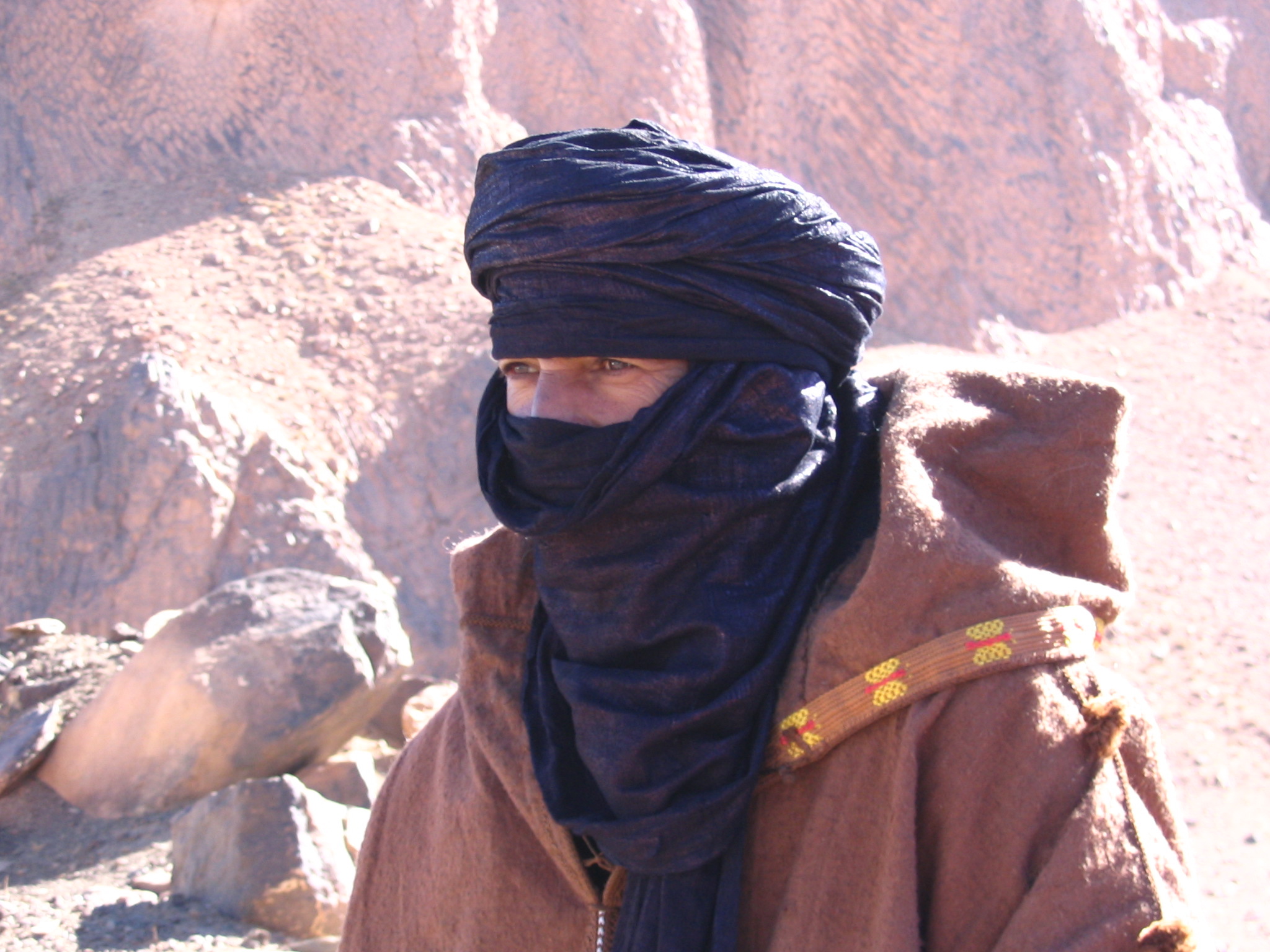
The people of the Malikid Sultanate, ruled from the capital of Kemmet by Sultan Malik X, worship the hippopotamus goddess Tem-Et-Nu. Their uniforms are purple, and their weapons are bronze.
In the Latifid Emirate, ruled from Qarya by Emira Duqa IV, worships the sun god Aurifar, and their uniforms are orange. They have a slight edge in the war, for their weapons are iron.
---
Countless centuries ago, before the desert came, there were two civilizations, also at war with one another. But one of these civilizations devised a terrible superweapon, a scroll of great power, which scoured the world of their foes, but also made the world unbearably hot and dry, crumbling the civilization into dust.
After the war's end, two factions arose: one which thought the scroll was too dangerous to ever be used again, and wanted it destroyed; and the other, which thought the scroll should be held in reserve in case some terrible threat should appear.
As a compromise, the scroll was torn in two. Half of it was destroyed, the other half stored in a tomb protected by many traps and curses. The scroll is unusable in this state, but a team of science-mages could potentially reverse-engineer the rest, given years of study.
Centuries later, these two factions are now known as the Latifid Emirate and the Malikid Sultanate.
---
My players, although initially on a mission to retrieve the weapon for Sultan Malik, decided in the end to destroy it so neither side could recreate it and use it, effectively siding with the Latifids. (The detail that the two factions of the ruined civilization eventually became the two modern nations was one that the players filled in themselves: it hadn't occurred to me, but it made so much sense that I ran with it.)
Two nations rule this world, both human (there are no non-humans here), in a constant state of cold war. The Malikid Sultanate and the Latifid Emirate are more alike than they are different. Both have absolute sexual equality. Both frown on sex outside of marriage, but both polygamy and gay marriage are perfectly accepted. In both civilizations, all people wear tagelmusts when not in private dwellings.
The people of the Malikid Sultanate, ruled from the capital of Kemmet by Sultan Malik X, worship the hippopotamus goddess Tem-Et-Nu. Their uniforms are purple, and their weapons are bronze.
In the Latifid Emirate, ruled from Qarya by Emira Duqa IV, worships the sun god Aurifar, and their uniforms are orange. They have a slight edge in the war, for their weapons are iron.
---
Countless centuries ago, before the desert came, there were two civilizations, also at war with one another. But one of these civilizations devised a terrible superweapon, a scroll of great power, which scoured the world of their foes, but also made the world unbearably hot and dry, crumbling the civilization into dust.
After the war's end, two factions arose: one which thought the scroll was too dangerous to ever be used again, and wanted it destroyed; and the other, which thought the scroll should be held in reserve in case some terrible threat should appear.
As a compromise, the scroll was torn in two. Half of it was destroyed, the other half stored in a tomb protected by many traps and curses. The scroll is unusable in this state, but a team of science-mages could potentially reverse-engineer the rest, given years of study.
Centuries later, these two factions are now known as the Latifid Emirate and the Malikid Sultanate.
---
My players, although initially on a mission to retrieve the weapon for Sultan Malik, decided in the end to destroy it so neither side could recreate it and use it, effectively siding with the Latifids. (The detail that the two factions of the ruined civilization eventually became the two modern nations was one that the players filled in themselves: it hadn't occurred to me, but it made so much sense that I ran with it.)
Friday, October 24, 2014
Amorphidon the Shapeless One
Although the scro are, by and large, obsessed with rules and obedience, some exiles are found living outside of scro space, on their own or in enclaves such as the grubby asteroid station Texas. Some of these exiles are godless, others still worship the primary scro gods, but many choose to worship Amorphidon, the Shapeless One, whose doctrines are as ambiguous as its form.
Amorphidon is depicted in any number of different ways, frequently as something on the order of an ooze, gibbering mouther, or chaos beast. It is a god of whatever you happen to need a god for at any given moment, but could be more clearly conceptualized as a god of change.
There is no set hierarchy in the church of Amorphidon, though clerics and petitioners often bow to the wisdom of more experienced clerics. Nor are there set dogmas, worship texts, songs, or even method of worship. Amorphidon accepts homage in whatever way one wishes to offer it.
Oozes, blobs, jellies, and anything formless and shapeless are sacred to Amorphidon.
Amorphidon is chaotic neutral. Its clerics may be any chaotic, but they may also be true neutral (despite the normal restriction that prohibits clerics from being neutral unless their deity is neutral).
Amorphidon has no set favored weapon. A cleric of Amorphidon may choose any weapon as a favored weapon.
Amorphidon's holy symbol is an irregular, blobular shape, no two holy symbols the same.
Amorphidon's primary domains include chaos, decay, liberation, madness, slime, and trickery. A cleric of Amorphidon must choose one domain from that list, but her other domain may be chosen from any available to a cleric of her alignment.
Amorphidon allows its clerics to change, much as it has been known to changes itself:
Amorphidon is depicted in any number of different ways, frequently as something on the order of an ooze, gibbering mouther, or chaos beast. It is a god of whatever you happen to need a god for at any given moment, but could be more clearly conceptualized as a god of change.
There is no set hierarchy in the church of Amorphidon, though clerics and petitioners often bow to the wisdom of more experienced clerics. Nor are there set dogmas, worship texts, songs, or even method of worship. Amorphidon accepts homage in whatever way one wishes to offer it.
Oozes, blobs, jellies, and anything formless and shapeless are sacred to Amorphidon.
Amorphidon is chaotic neutral. Its clerics may be any chaotic, but they may also be true neutral (despite the normal restriction that prohibits clerics from being neutral unless their deity is neutral).
Amorphidon has no set favored weapon. A cleric of Amorphidon may choose any weapon as a favored weapon.
Amorphidon's holy symbol is an irregular, blobular shape, no two holy symbols the same.
Amorphidon's primary domains include chaos, decay, liberation, madness, slime, and trickery. A cleric of Amorphidon must choose one domain from that list, but her other domain may be chosen from any available to a cleric of her alignment.
Amorphidon allows its clerics to change, much as it has been known to changes itself:
- Every three cleric levels (at 3rd, 6th, 9th, etc.), a cleric of Amorphidon may change their choice of favored weapon.
- Every four cleric levels (at 4th, 8th, 12th, etc.), a cleric of Amorphidon may change a single choice of domain, while still obeying the rule that at least one domain must come from Amorphidon's list.
- Every five cleric levels (at 5th, 10th, 15th, etc.), a neutral or chaotic neutral cleric of Amorphidon may change their choice of whether to channel positive energy and spontaneously cast cure spells or channel negative energy and spontaneously cast inflict spells.
Monday, August 4, 2014
DM as Provider of Information
When a player asks, "What do I see?", the average DM finds this a perfectly reasonable question, and attempts to answer the question (unless it's dark, or the relevant character is blinded, or whatever). Same with "What do I hear?" These are your standard-issue primary human senses, how we get most of our information about the world, and thus naturally how the DM conveys most of the information about the characters' world to the players. The DM might reasonably call for a Search/Spot/Listen/Perception check, if there's information that would be available only to particularly observant characters.
When a player asks, "What do I smell?", "How does it taste?", or "How does it feel?", the DM might be a little taken aback, as these are unusual questions, but will generally still attempt to answer the question. Again, perhaps with a Perception check, though one might be at a bit of a loss for what skill to use in 3.5 -- probably a basic Wisdom check. It's been said before (probably by me, among many others) that a decent DM will volunteer sight and sound data, while a masterful DM will neglect no senses when giving information. (This can be overdone -- nobody wants to hear a full discourse about how the air feels and tastes on every room their characters enter -- but underdoing it is a much bigger risk in practice.)
I leave as an exercise to the reader coming up with situations in which lesser-known senses, such as proprioception, might come up in play.
But when a player says "I cast detect magic", the common DM reaction is frustration or annoyance. Especially in Pathfinder, where cantrips/orisons like detect magic are at-will, so players have been known to "spam" them. The ubiquity of detect magic is, in fact, quite a common complaint I hear about Pathfinder. (To a lesser extent, the same goes for paladins and detect evil, even in 3.5.)
I've seen more than one DM frequently resort to "The area in general is so powerfully magical it gives you a headache and you can't pick out individual magic effects." This is may be a legit technique for lending particularly epic or eldritch locations an extra element of "you're dealing with things you can't understand", but, if you use it, you should definitely reserve it for, say, the final dungeon of the campaign, where you're walking into the lair of a physical god. (But even then, if you're high enough level where you're a reasonable challenge to said physical god, one would think your techniques for casting detect magic would have advanced along with everything else on your sheet, so even in the presence of supremely powerful magic, you can still pick out details.) Fun fact: There are, in fact, rules for detecting "Overwhelming" auras with detect magic, but they're limited to epic-level spells and artifacts.
And if you do that, you should do it for other senses, too. A mission to the elemental plane of light, where everything is so bright that it gives you a headache even if you keep your eyes closed and there's no way to pick out visual details. Or the plane of darkness, where no light sources function. A cacophonous factory floor, where you can't discern individual sounds. Perhaps even your sense of proprioception fails when you come in contact with stuff of the Far Realm. The one such example that I have seen DMs use fairly often in practice: stenches so strong they make you gag.
As with most DM sins, I've been (partially) guilty of this one myself. I have been known to say "This entire area is permeated with an ambient aura of evil", in the case of an area proximate to a permanent portal to the Abyss, when paladins were using detect evil. But! This is a case of more information, not less: the ambient evil didn't render them unable to pick out finer details of evil. When there was a demon in the next room, they could still pick out the demon's evil aura from the dungeon's ambient evil aura. And meanwhile, they had the information that there's something so evil that's been here for so long that the evil has soaked into and permeated the very stones themselves.
Anyhow: why is the DM reaction to "What do I see?" so different from the DM reaction to "I cast detect magic"? They're both usage of the character's defined abilities to gather information about the world. Perhaps it's that the rules for detect magic are slightly complicated and the DM doesn't feel like dealing with them. Perhaps it's that detect magic, unlike sight/taste/proprioception/etc, is not a standard-issue primary human sense in the real world, so it seems more legit to deny characters the full use of detect magic than it would to deny them the full use of their other senses.
As I alluded to two paragraphs ago, it's about information. As I see it, one of the DM's primary roles is to provide information to the party. (There's also some business with deciding what information is available, and under what circumstances, and of course deciding what the information consists of in the first place, but the primary business, for the purpose of this post anyway, is providing the information to the party.) Any situation where the party requests specific exposition (that their characters would reasonably have access to) is an opportunity for the DM to maximally fulfil this role.
So whenever a player asks for information, it warms my withered black heart, because it's an opportunity to provide exposition (and, often, to come up with information on the fly, which I enjoy and am decent at). Some DMs will try to restrict the flow of information, either because they think it increases the challenge or because they're just not good at or don't enjoy coming up with new information on the fly. I don't have much to say about the second thing, but I'll digress for a paragraph on the first:
Security through obscurity can make for an interesting fight, if used sparingly. Trial and error can make for an interesting battle. The minionry of Dr. Blelyj once fought a monster that, unbeknownst to us, was made more powerful when it was subjected to magic missile. Many lulz were had at the expense of the poor sorcerer who'd thought his magic missile was a sure thing. There are many clever monsters of this sort: albino red dragons, those gas spore monsters that look like beholders, mimics (and the general venerable and well-populated genre to which they belong, "monsters that look like harmless objects"), shambling mounds ("oh, it's a tree monster, trees usually get wrecked by lightning, right?"), and so on. Withholding one key piece of information can be a fun lark. (If you do this much, you should also make sure that your monsters don't always act as though they have complete information about the party.) But many players (myself included) don't care for every battle to be trial and error. Usually we just want to deploy our tactical abilities against the monsters' tactical abilities, and prefer to have more complete information rather than less (and sometimes invest substantial character options into perception and knowledge abilities, and it's generally not a good idea to deny players the fruits of their character building without a good reason).
Which brings me to knowledge skills! There are rules for knowledge skills, which you would do well not to ignore. The rule of thumb is "one piece of information for a DC of 10 + the monster's HD, and an additional piece of information every 5 thereafter". You don't need to indulge player requests for specific bits of information ("What kind of DR does it have?", or even "Any major weaknesses?"), but it never hurts.
My main beef with the knowledge system (in fact, one of my beefs with d20 in general) is that knowledge skills can't be used untrained. My beef with this is threefold: one, it restricts me as a DM from being able to give out information, and I always love giving out information; two, it restricts me as a player from acquiring information, and I usually love acquiring information; three, it forces me as a DM into a position where I have to say "no", which is Bad. I keep thinking of instituting a "you can use trained-only skills untrained at a -10 penalty" houserule. Other DMs I've played with have dealt with this by expanding (usually on the fly) the list of relevant knowledge skills for a piece of information: to identify a given undead creature, you might be allowed to use Knowledge(dungeoneering) or Knowledge(arcana) if you don't have Knowledge(religion), for example.
Anyway, I generally encourage players to invest points in and use the Knowledge skills, because I enjoy providing exposition and it's a good tool for that. And yes, like everything, it can be overused -- I play with a druid who tends to ask if she can use Knowledge(nature) to identify everything she encounters, no matter how obviously non-natural. But, in general, allowing players to roll Knowledge checks is generally better than not allowing it.
Do note that "Knowledge" isn't just book-larnin'. It isn't always "I read about this in a book once" (though for some characters it might be). It's a combination of that, practical knowledge ("I encountered something like this once"), observation and extrapolation ("Look, it's got flattened teeth, it's probably an herbivore, though that doesn't mean it's necessarily harmless"). So think twice before using the "Nobody has seen one of these for centuries, you can't make a knowledge check" line. (Nobody's seen the Others for centuries, but people still figured out they have DR/dragonglass or Valyrian steel, through practical observation and also it was in at least one ancient book.) Actually, that's a general principle: a thing being difficult means you should pile circumstance modifiers on to increase the difficulty, not "you can't do it". If you can swim up a waterfall with a high enough Swim check, you can deduce the properties of an ancient monster with a high enough Knowledge check. "Don't even bother to roll" is if it's too easy to fail, not if it's too hard to succeed.
When a player asks, "What do I smell?", "How does it taste?", or "How does it feel?", the DM might be a little taken aback, as these are unusual questions, but will generally still attempt to answer the question. Again, perhaps with a Perception check, though one might be at a bit of a loss for what skill to use in 3.5 -- probably a basic Wisdom check. It's been said before (probably by me, among many others) that a decent DM will volunteer sight and sound data, while a masterful DM will neglect no senses when giving information. (This can be overdone -- nobody wants to hear a full discourse about how the air feels and tastes on every room their characters enter -- but underdoing it is a much bigger risk in practice.)
I leave as an exercise to the reader coming up with situations in which lesser-known senses, such as proprioception, might come up in play.
But when a player says "I cast detect magic", the common DM reaction is frustration or annoyance. Especially in Pathfinder, where cantrips/orisons like detect magic are at-will, so players have been known to "spam" them. The ubiquity of detect magic is, in fact, quite a common complaint I hear about Pathfinder. (To a lesser extent, the same goes for paladins and detect evil, even in 3.5.)
I've seen more than one DM frequently resort to "The area in general is so powerfully magical it gives you a headache and you can't pick out individual magic effects." This is may be a legit technique for lending particularly epic or eldritch locations an extra element of "you're dealing with things you can't understand", but, if you use it, you should definitely reserve it for, say, the final dungeon of the campaign, where you're walking into the lair of a physical god. (But even then, if you're high enough level where you're a reasonable challenge to said physical god, one would think your techniques for casting detect magic would have advanced along with everything else on your sheet, so even in the presence of supremely powerful magic, you can still pick out details.) Fun fact: There are, in fact, rules for detecting "Overwhelming" auras with detect magic, but they're limited to epic-level spells and artifacts.
And if you do that, you should do it for other senses, too. A mission to the elemental plane of light, where everything is so bright that it gives you a headache even if you keep your eyes closed and there's no way to pick out visual details. Or the plane of darkness, where no light sources function. A cacophonous factory floor, where you can't discern individual sounds. Perhaps even your sense of proprioception fails when you come in contact with stuff of the Far Realm. The one such example that I have seen DMs use fairly often in practice: stenches so strong they make you gag.
As with most DM sins, I've been (partially) guilty of this one myself. I have been known to say "This entire area is permeated with an ambient aura of evil", in the case of an area proximate to a permanent portal to the Abyss, when paladins were using detect evil. But! This is a case of more information, not less: the ambient evil didn't render them unable to pick out finer details of evil. When there was a demon in the next room, they could still pick out the demon's evil aura from the dungeon's ambient evil aura. And meanwhile, they had the information that there's something so evil that's been here for so long that the evil has soaked into and permeated the very stones themselves.
Anyhow: why is the DM reaction to "What do I see?" so different from the DM reaction to "I cast detect magic"? They're both usage of the character's defined abilities to gather information about the world. Perhaps it's that the rules for detect magic are slightly complicated and the DM doesn't feel like dealing with them. Perhaps it's that detect magic, unlike sight/taste/proprioception/etc, is not a standard-issue primary human sense in the real world, so it seems more legit to deny characters the full use of detect magic than it would to deny them the full use of their other senses.
As I alluded to two paragraphs ago, it's about information. As I see it, one of the DM's primary roles is to provide information to the party. (There's also some business with deciding what information is available, and under what circumstances, and of course deciding what the information consists of in the first place, but the primary business, for the purpose of this post anyway, is providing the information to the party.) Any situation where the party requests specific exposition (that their characters would reasonably have access to) is an opportunity for the DM to maximally fulfil this role.
So whenever a player asks for information, it warms my withered black heart, because it's an opportunity to provide exposition (and, often, to come up with information on the fly, which I enjoy and am decent at). Some DMs will try to restrict the flow of information, either because they think it increases the challenge or because they're just not good at or don't enjoy coming up with new information on the fly. I don't have much to say about the second thing, but I'll digress for a paragraph on the first:
Security through obscurity can make for an interesting fight, if used sparingly. Trial and error can make for an interesting battle. The minionry of Dr. Blelyj once fought a monster that, unbeknownst to us, was made more powerful when it was subjected to magic missile. Many lulz were had at the expense of the poor sorcerer who'd thought his magic missile was a sure thing. There are many clever monsters of this sort: albino red dragons, those gas spore monsters that look like beholders, mimics (and the general venerable and well-populated genre to which they belong, "monsters that look like harmless objects"), shambling mounds ("oh, it's a tree monster, trees usually get wrecked by lightning, right?"), and so on. Withholding one key piece of information can be a fun lark. (If you do this much, you should also make sure that your monsters don't always act as though they have complete information about the party.) But many players (myself included) don't care for every battle to be trial and error. Usually we just want to deploy our tactical abilities against the monsters' tactical abilities, and prefer to have more complete information rather than less (and sometimes invest substantial character options into perception and knowledge abilities, and it's generally not a good idea to deny players the fruits of their character building without a good reason).
Which brings me to knowledge skills! There are rules for knowledge skills, which you would do well not to ignore. The rule of thumb is "one piece of information for a DC of 10 + the monster's HD, and an additional piece of information every 5 thereafter". You don't need to indulge player requests for specific bits of information ("What kind of DR does it have?", or even "Any major weaknesses?"), but it never hurts.
My main beef with the knowledge system (in fact, one of my beefs with d20 in general) is that knowledge skills can't be used untrained. My beef with this is threefold: one, it restricts me as a DM from being able to give out information, and I always love giving out information; two, it restricts me as a player from acquiring information, and I usually love acquiring information; three, it forces me as a DM into a position where I have to say "no", which is Bad. I keep thinking of instituting a "you can use trained-only skills untrained at a -10 penalty" houserule. Other DMs I've played with have dealt with this by expanding (usually on the fly) the list of relevant knowledge skills for a piece of information: to identify a given undead creature, you might be allowed to use Knowledge(dungeoneering) or Knowledge(arcana) if you don't have Knowledge(religion), for example.
Anyway, I generally encourage players to invest points in and use the Knowledge skills, because I enjoy providing exposition and it's a good tool for that. And yes, like everything, it can be overused -- I play with a druid who tends to ask if she can use Knowledge(nature) to identify everything she encounters, no matter how obviously non-natural. But, in general, allowing players to roll Knowledge checks is generally better than not allowing it.
Do note that "Knowledge" isn't just book-larnin'. It isn't always "I read about this in a book once" (though for some characters it might be). It's a combination of that, practical knowledge ("I encountered something like this once"), observation and extrapolation ("Look, it's got flattened teeth, it's probably an herbivore, though that doesn't mean it's necessarily harmless"). So think twice before using the "Nobody has seen one of these for centuries, you can't make a knowledge check" line. (Nobody's seen the Others for centuries, but people still figured out they have DR/dragonglass or Valyrian steel, through practical observation and also it was in at least one ancient book.) Actually, that's a general principle: a thing being difficult means you should pile circumstance modifiers on to increase the difficulty, not "you can't do it". If you can swim up a waterfall with a high enough Swim check, you can deduce the properties of an ancient monster with a high enough Knowledge check. "Don't even bother to roll" is if it's too easy to fail, not if it's too hard to succeed.
Tuesday, February 4, 2014
Giant Space Hamsters
So I was doing a bit of research into running a possible Spelljammer one-shot or campaign, and I came across this:
 "[Giant Space] Hamsters are domesticated, used as both pets and livestock, and are also used to power gnome sidewheelers, an inefficient form of space ship that is powered by a series of gigantic hamster wheels."
"Characteristically, the tinker gnomes did not stop there, and continued to breed many forms of hamster, including the sabre-toothed giant space hamster, the carnivorous flying giant space hamster ("a regrettable if understandable line of inquiry"), the fire-breathing phase doppelganger giant space hamster, and the miniature giant space hamster (a dwarf variant, indistinguishable from ordinary hamsters)."
"The most infamous (and to gnomes, most feared) giant space hamster was 'Wooly Rupert,' the Tyrannohamstersaurus of Ill Omen."
This is among the most wonderfully preposterous things I have ever encountered, and I no longer understand why anybody would ever not play Spelljammer.
"Characteristically, the tinker gnomes did not stop there, and continued to breed many forms of hamster, including the sabre-toothed giant space hamster, the carnivorous flying giant space hamster ("a regrettable if understandable line of inquiry"), the fire-breathing phase doppelganger giant space hamster, and the miniature giant space hamster (a dwarf variant, indistinguishable from ordinary hamsters)."
"The most infamous (and to gnomes, most feared) giant space hamster was 'Wooly Rupert,' the Tyrannohamstersaurus of Ill Omen."
This is among the most wonderfully preposterous things I have ever encountered, and I no longer understand why anybody would ever not play Spelljammer.
Sunday, August 4, 2013
The Book of Perfectly Acceptable Latin
Much of the online D&D community refers to Libris Mortis as "The Book of Bad Latin". This is because they are not in the intersection between the set of people who know Latin and the set of people who have read the introduction to Libris Mortis -- an intersection that seems to consist solely of me.
The community assumes that the title is supposed to translate to "The Book of the Dead" -- a not entirely unreasonable assumption. If this were the intended title, then it's true, it should be Liber Mortis, not Libris Mortis. Nominative.
But it just isn't so. Open your copy of Libris Mortis to Page 4, the very first page with actual content. Look at the bottomof the page, where it says "This book takes its name from a set of tomes penned in a dialect of Celestial [...] Roughly translated, it means 'From the Books of Dead'". This is interesting for two reasons: 1.) the title isn't in Latin, it's in (possibly bastardized) Celestial -- which is to say, Celestial is Latin, which I've taken as canon for my games -- and 2.) it's intended to mean "From the Books of the Dead", not "The Book of the Dead".
Now, if I were to try to translate "from the books of the dead", I'd say something like "ex libris mortis". But the ablative form "libris" already implies "from", so the preposition "ex" isn't, strictly speaking, necessary. Of course, "mortis" is singular genitive of "mors", so it means something more like "of the corpse" or "of death", but that's still pretty close.
So the title Libris Mortis means just about exactly what it's intended to mean. It's the Book of Perfectly Acceptable Latin. It's the Book Of At Worst Slightly Idiosyncratic Latin. Now you can look down your nose and feel more educated than anybody who utters the phrase "Book of Bad Latin".
The community assumes that the title is supposed to translate to "The Book of the Dead" -- a not entirely unreasonable assumption. If this were the intended title, then it's true, it should be Liber Mortis, not Libris Mortis. Nominative.
But it just isn't so. Open your copy of Libris Mortis to Page 4, the very first page with actual content. Look at the bottomof the page, where it says "This book takes its name from a set of tomes penned in a dialect of Celestial [...] Roughly translated, it means 'From the Books of Dead'". This is interesting for two reasons: 1.) the title isn't in Latin, it's in (possibly bastardized) Celestial -- which is to say, Celestial is Latin, which I've taken as canon for my games -- and 2.) it's intended to mean "From the Books of the Dead", not "The Book of the Dead".
Now, if I were to try to translate "from the books of the dead", I'd say something like "ex libris mortis". But the ablative form "libris" already implies "from", so the preposition "ex" isn't, strictly speaking, necessary. Of course, "mortis" is singular genitive of "mors", so it means something more like "of the corpse" or "of death", but that's still pretty close.
So the title Libris Mortis means just about exactly what it's intended to mean. It's the Book of Perfectly Acceptable Latin. It's the Book Of At Worst Slightly Idiosyncratic Latin. Now you can look down your nose and feel more educated than anybody who utters the phrase "Book of Bad Latin".
Subscribe to:
Posts (Atom)