Showing posts with label OGT. Show all posts

Thursday, November 10, 2022

Old Bounties

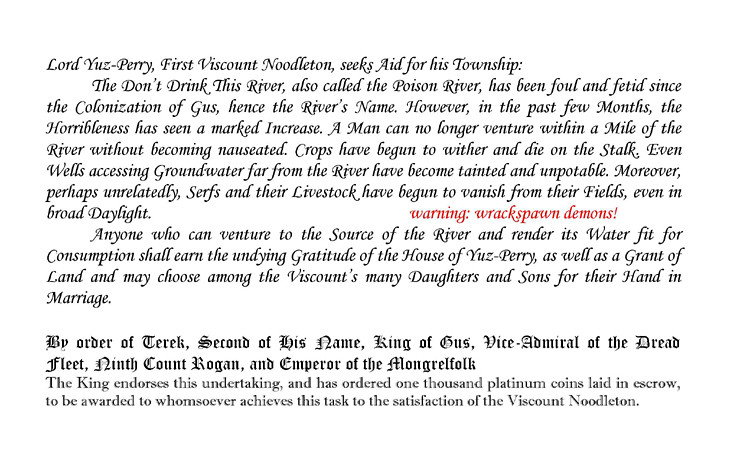
 Currently posted on the corkboard in the Adventurer's Guild, the glorified tavern near the heart of the wretched hive of scum and villainy that is Endeesy, there is a map and a number of notes (in order from oldest to newest):


---


Map


PLEASE DO NOT TAKE THIS MAP, IT IS PROVIDED AS A COURTESY TO ALL OUR CUSTOMERS


---


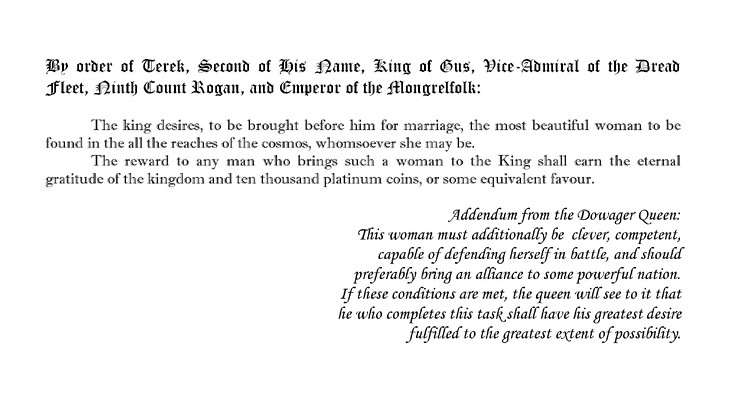
A Bride For The King

By order of His Royal Majesty Terek, Second of His Name, King of Gus, Vice-Admiral of the Dread Fleet, Ninth Count Rogan, and Emperor of the Mongrelfolk:


The king desires, to be brought before him for marriage, the most beautiful woman to be found in the all the reaches of the cosmos, whomsoever she may be. The reward to any man who brings such a woman to the King shall earn the eternal gratitude of the kingdom and ten thousand platinum coins, or some equivalent favour.


Addendum from the Dowager Queen: This woman must additionally be clever, competent, capable of defending herself in battle, and should preferably bring an alliance to some powerful nation. If these conditions are met, the queen will see to it that he who completes this task shall have his greatest desire fulfilled to the greatest extent of possibility.


---


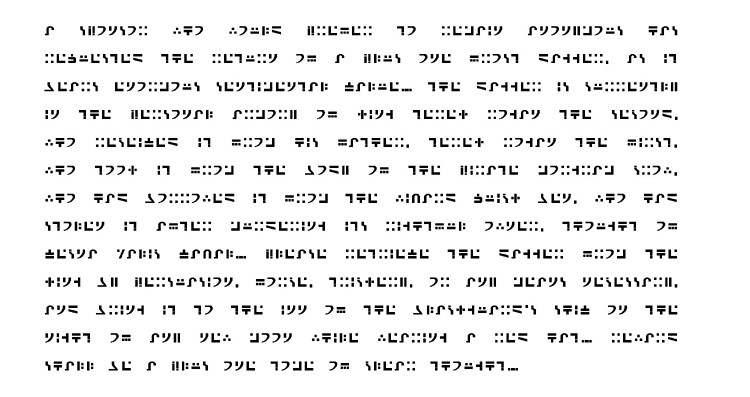
Coded Message


---


Dragon Hunt

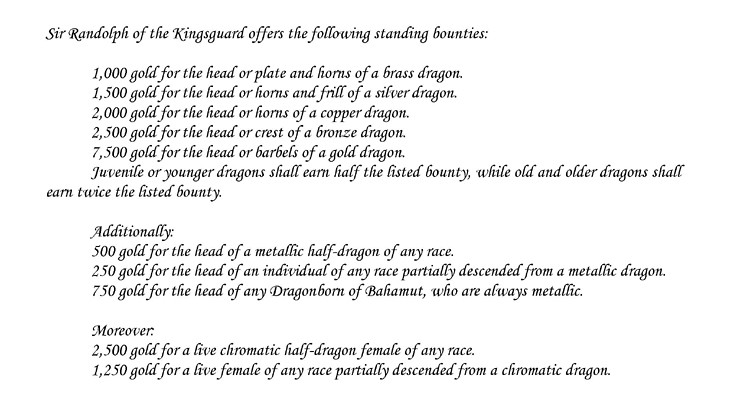
Sir Randolph of the Kingsguard offers the following standing bounties:


1,000 gold for the head or plate and horns of a brass dragon.

1,500 gold for the head or horns and frill of a silver dragon.

2,000 gold for the head or horns of a copper dragon.

2,500 gold for the head or crest of a bronze dragon.

7,500 gold for the head or barbels of a gold dragon.

Juvenile or younger dragons shall earn half the listed bounty, while old and older dragons shall earn twice the listed bounty. Additionally:


500 gold for the head of a metallic half-dragon of any race.

250 gold for the head of an individual of any race partially descended from a metallic dragon.

750 gold for the head of any Dragonborn of Numiel, who are always metallic.

Moreover:


2,500 gold for a live chromatic half-dragon individual of any race.

1,250 gold for a live individual of any race partially descended from a chromatic dragon.

ADDENDUM: By order of His Royal Majesty Terek, Second of His Name, King of Gus, Vice-Admiral of the Dread Fleet, Ninth Count Rogan, and Emperor of the Mongrelfolk:


The Dragonborn known as Scarecrow is to be left alone, and not targeted for this bounty.


---


Engineer Headhunting

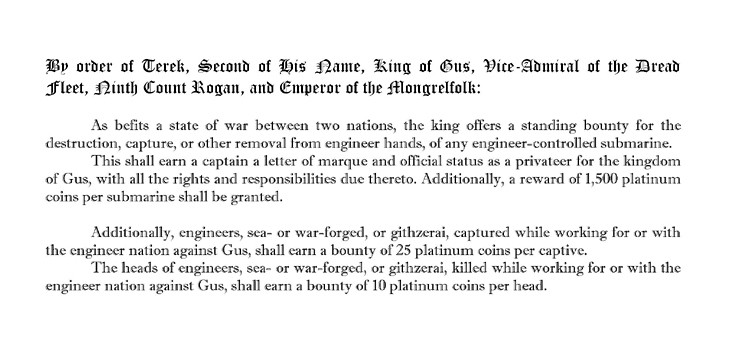
By order of His Royal Majesty Terek, Second of His Name, King of Gus, Vice-Admiral of the Dread Fleet, Ninth Count Rogan, and Emperor of the Mongrelfolk:


As befits a state of war between two nations, the king offers a standing bounty for the destruction, capture, or other removal from engineer hands, of any engineer-controlled submarine.


This shall earn a captain a letter of marque and official status as a privateer for the kingdom of Gus, with all the rights and responsibilities due thereto. Additionally, a reward of 1,500 platinum coins per submarine shall be granted. Additionally, engineers, sea- or war-forged, or githzerai, captured while working for or with the engineer nation against Gus, shall earn a bounty of 25 platinum coins per captive. The heads of engineers, sea- or war-forged, or githzerai, killed while working for or with the engineer nation against Gus, shall earn a bounty of 10 platinum coins per head.


---


Oliphaunt Snax


---


Demon Infestation

As many may already be aware, the countryside has been plagued by foul and fiendish beasts, issuing forth from the caves and mines of Mount Dis. As a protector of the Realm, I feel it my duty to investigate, but other duties keep me occupied between N.D.C. and the Omorashi border. As such, I issue the following bounties:


For concrete, verifiable information regarding the ultimate source of the infestation: 2,500 gold

For a detailed map leading from the surface to the ultimate source of the infestation: 5,000 gold

For the temporary or permanent stoppage of the infestation, by any means: 50,000 gold

Bounty posted by Sir Nakazawa of the Kingsguard


---


Pumayyaton's Statue

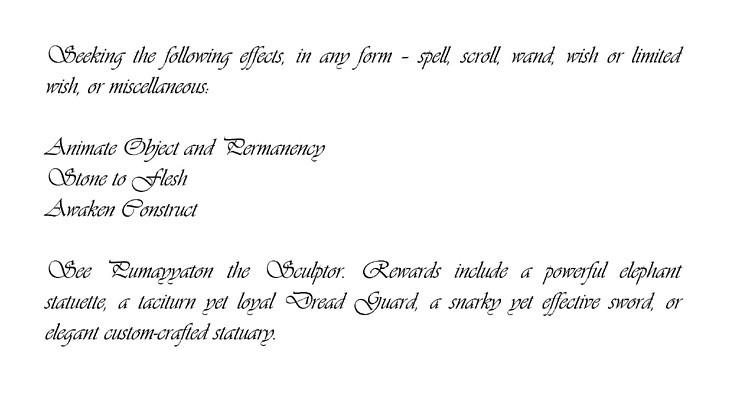
Seeking the following effects, in any form – spell, scroll, wand, wish or limited wish, or miscellaneous:


Animate Object

Permanency

Stone to Flesh

Awaken Construct

See Pumayyaton the Sculptor. Rewards include a powerful elephant statuette, a taciturn yet loyal Dread Guard, a snarky yet effective sword, or elegant custom-crafted statuary.


---


Justice For Prior Trakis

REWARD:


Information sought leading to the whereabouts of a band of evil adventurers who broke into the monastery on Perch Hill, terrorized the monks, and murdered Prior Trakis, a paladin of the faith. See Abbot Waxter at the Monastery with any information. Be on the lookout for a group consisting of:


an orc-descended man, in possession of a horse

an engineer man

an Omorashi human woman

an elf by the name of Aramil Silverleaf, with a scar over one eye

two additional human or elf men

Be warned: these individuals are armed and extremely dangerous. They may be in league with an evil erinyes devil – this creature is very powerful and should not be engaged without proper training.


They may also be in possession of copies of several volumes of the Evil Encyclopedia of Evil – if found, these books should not be read and may be returned to the Monastery for an additional reward of 250 gold pieces each.


Authorized by Numiel’s Archbishop of Shell, Jov Sauart


---


The Evil Encyclopedia of Evil

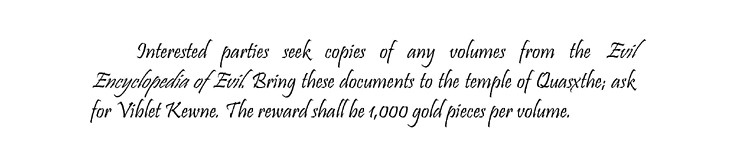
Interested parties seek copies of any volumes from the Evil Encyclopedia of Evil. Bring these documents to the Cathedral of Quasxthe; ask for Viblet Kewne. The reward shall be 1,000 gold pieces per volume.


---


Ruins in the Mines

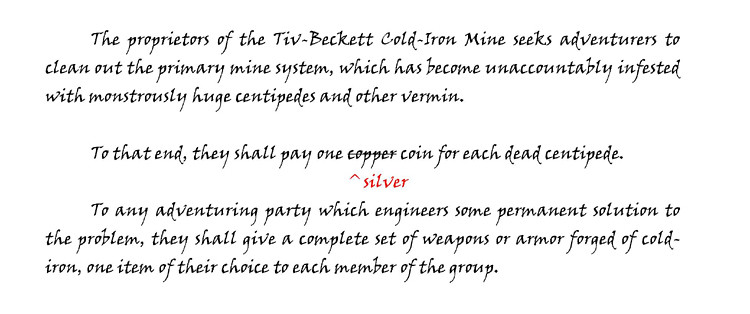
The proprietors of the Tiv-Beckett Cold-Iron Mine no longer need the mines cleansed of centipedes, as they have been thoroughly dealt with. However, as a notice to the public, we have struck ancient ruins of an underground civilization in our digging. We offer no reward for exploring these ruins, but adventurous types may choose to investigate nonetheless.


---


Join The Adventurer's Guild

Becoming a Member of the Adventurer’s Guild carries a flat fee of 25gp. Among other benefits, Members get a 50% discount on rooms, food, and drinks at the Guild, and may request rescue party insurance for each mission they undertake.


A member of the Adventurer’s Guild may become a Journeyman if he finds and returns one of the five Journeyman’s Keys, hidden somewhere in the caves and dungeons of Mount Dis. Among other benefits, Journeymen get free room and food at the Guild, and receive a 5% discount at participating adventurer supply stores.


A Journeyman may become a Guild Master upon completion of some special quest for the Guild Masters. Among other benefits, the discount at participating adventurer supply stores increases to 10% for a Master.


Members of all levels must pay dues of 5gp per month.


---


Join The Mage's Guild

Levethixi, vorastrixi, vur lyrik xiekivi svaust klae wer suiaerl auneli, usv tikilvi sweekmonir ekess xkhat mishun: siofme voranir ekess wer hertan di hewi. Drekim vin kamati persvek wer hertan ui aaiovew aurix vur asildk aurix rinovup welun. Nezcaubolic re vi cuaili sva wer hertan, zadl ekess shio yorir ini hertan ankini, zadl ekess wer kivan korshim ihk tija kirmipri, vur zadl ekess kemir vur vdri cuailiri.


Translation for characters who can read Draconic: <Wizards, Sorcerers, and other Wielders of the arcane Arts, or any One seeking to become Such: consider joining the Mage’s Guild. Apprenticeship in the Guild is 50gp plus 10gp per Month. Benefits include a Room at the Guild, Access to all Lectures by Guild Teachers, Access to the vending Machine for material Components, and Access to Training and Meditation Rooms.>


---


Mad Druidry

The Mad Druid Seye Ipivi demands components for a mad ritual of his own devising:


the spleen of a seven-horned sheep

seven leaves from seven treants

the acidic saliva of a green dragon

seven vials of anarchic water

seven ears from seven elves

a topaz, a sapphire, a ruby, a pearl, an opal, a diamond, and an aquamarine

The Mad Druid shall well reward bringers of these things, to the tune of 100 gold for each individual item!


---


Rename the Endeesy Five

On a bounty board in an inn in Noodleton:


For Sale: Right to the Name of this Fab Five, formerly known as 'Endeesey Five'. You can purchase and we'll call our group in the name of your choice! Justine's Justice League? Noodleton Noodlers? You pay the money, you pick the name! Contact the Man in Red for more info.


---


Slay Sewer Monsters

By Order of Sir Nelson of the Kingsguard:


To increase safety for the workers in the sewers, the Crown offers 1 platinum coin for every destroyed monster in the sewers under the Crown District.


---


Ingredients for Sir Winden

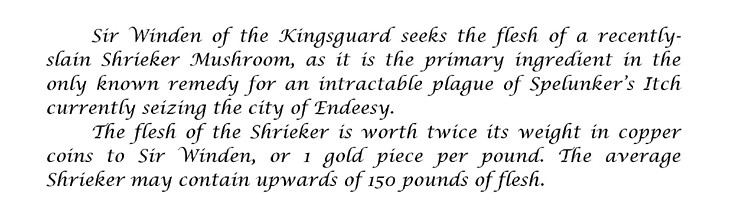
Sir Winden of the Kingsguard will pay one thousand gold pieces for a live troll, which he seeks for medical experiments.


Additionally, he requires at least one vial of the blood of some petrifying creature -- a medusa, cockatrice, basilisk, or the like. For this he will pay five hundred gold pieces.


---


Retrieve Wizard’s Familiar

A Mage of the Mage’s Guild, Dr. Paul Wal-Dover, has lost his beloved cat familiar, Papageno. He suspects he was kidnapped for the exotic menagerie of Wang Port in the Omorashi Empire. He can afford to pay with his half-expended Staff of the Woodlands if Papageno is returned to him.


While you’re at it, bringing Dr. Wal-Dover any interesting live magical beasts from the menagerie for study would be rewarded with gratitude, though he cannot afford to pay for this service.


---


Vigilante Justice

By Order of Sheriff Clarissa Ten-Jones:


An individual known as the Violet Shadow has been gruesomely and extrajudicially killing criminals and stringing them up in public places. Pay no attention to the popular esteem for this vigilante; her executions are not the justice of the Crown, and a stop must be put to them.


REWARD


For information leading to the arrest of the Violet Shadow: 1,000gp

For the death of the Violet Shadow: 2,500gp

For bringing the Violet Shadow in alive for trial: 5,000gp


---


Protect an Eladrin from an Inevitable

I, Sir Joseph of the Kingsguard, have taken under my protection a tiny Coure Eladrin. This poor celestial creature, having inadvertently violated ancient pacts and natural laws in her fight against Evil, finds herself on the run from a Zelekhut Inevitable bent on enforcing the Law.


For the defeat of this Inevitable, or otherwise helping me to protect this Eladrin from it, I offer up to 5,000 gold.


---


Supplies for Repair

The crew of the Mango Mango, a [scribbled out] ship, currently parked in Worchestershire, seeks supplies to repair their [scribbled out]


We seek:


boots of levitation, winged boots, broom of flying, or carpet of flying, 7000gp

a fan feather token, 250gp

an anchor feather token, 40gp

salve of slipperiness, 900gp

sovereign glue, 2000gp

universal solvent, 40gp

some small chunks of elementum, (keyed to any element is fine) or dragonshards, 5000gp


---


Koprulu Invasion of Romus

News has filtered in from Romus that the Fylkir of Inglip, Latya Koprulu, having received mysterious instructions from her god, has gathered an army of gropagas (priests) and slaads (Outsiders from the Chaotic Plane of Air) and launched an invasion of eastern Romus.


Numiel's Archbishop of Shell and the local Abbot of the Monastery of Numiel at Perch Hill have sent out word that all true Numielites are encouraged to join the fight against the forces of chaos.


Contrariwise, the local gropagas of Inglip at the Inglip Temple and Arena Complex have sent out word that all followers of Inglip are encouraged to join the fight on the side of chaos.


---


Slay the Enormous Bententacled Monstrosity

Sir Nelson has been told that at the center of the top level of dwarven ruins under Mount Dis dwells trapped an enormous betentacled undead monstrosity of truly prodigious size. Though trapped, this creature remains a dangerous menace to all life. Destroy this creature and I am authorized to grant a reward of a single book or scroll of your choice from the Royal Library or a single article of your choice from the Royal Armory.


---


A Bride for Viscount Appleton

Mardero Haight, the Viscount Appleton desires the affections of a certain Kathleen, wench at the Hungry Owlbear tavern in Appleton, but she has thus far spurned him. If anyone were to coerce her to return the Viscount's affections, by any means necessary, he would reward them with a fully functioning and profitable apple orchard, complete with servants and workers, recently seized for non-payment of taxes.


If anyone brings up this bounty in the presence of anybody prone to gossip, one discovers that the Viscount Appleton is a man of fearsome reputation, his appearance and appetites described as each more terrible than the other. No telling what truth there is to these rumors.


---


Ask Your Cleric About Nerzohexoate

Do you feel sad sometimes? Do you suffer from angst? Does unbearable existential dread get you down? Are you plagued by a persistent feeling of doom or despair? Ask your cleric if Nerzohexoate is right for you!


(Side-effects of Nerzohexoate may include, but are not limited to: light sensitivity, erectile dysfunction, inflammation of the splanch, constipation, anal leakage, polydactylism, sneezing, eructation, projectile vomiting, hypochondria, thirst, sinus or ear infection, mild electrocution, albinism, dizziness, nymphomania, sensory overload, cardiac arrest, and death.)


---


Billiam & Billiam, Attys at Law

Hurt by adventurers? Adventurer-related medical bills piling up? Victim of theft or robbery by adventurers? Had your perfectly legal business or religious practices disrupted by adventurers?


Contact Billiam and Billiam, Attorneys at Law, Licensed Knave's Guild Affiliates!


---


Put Down Peasant Revolt

By order of His Royal Majesty Terek, Second of His Name, King of Gus, Vice-Admiral of the Dread Fleet, Ninth Count Rogan, and Emperor of the Mongrelfolk:


It has come to our attention that an insurrectionist known to the people as Milla Hillthorn has been rallying the peasants of the Northeast in revolt. When the guards of Reachham seek her, she is nowhere to be found, perhaps warned of her pursuers in advance.


REWARD


For information leading to the arrest of Milla Hillthorn: 1,500gp

For the death of Milla Hillthorn: 3,000gp

For bringing Milla Hillthorn in alive for public punishment: 6,000gp

Wednesday, July 4, 2012

On Flux Storms

If you recall, one of my primary motivations for giving up on regular campaigns and running an Open Gaming Table was that people kept failing to show up.

It's enormously irritating to come up with some justification for why a character wasn't there one week, when he was there the previous week and the next week. I seem to recall Playing D&D With Porn Stars once came up with a great chart (which I cannot now find) to roll on to determine what your character was doing (and what happened to him) during the session you missed, but that still required sessions to end in town or someplace else where it's convenient for a character to slip out. And if that happens, you can just use the "personal business" handwave. But what happens when you end the session in the middle of a dungeon? Or when one session lasts several weeks of in-game time and the next lasts only a few hours?

So I came up with a new justification, and made it the centerpiece of my campaign. Enter the flux storm.

In the first session, the characters all met on a ship. They were all sailing from various places to the ports of Wang and Endeesy. Suddenly, they sighted what looked like a brilliantly iridescent thunderstorm! The rogue elected to steer the boat straight into the thunderstorm, where it was struck by a bolt of freaky sparkly lightning, which made everyone on board feel all tingly for a few seconds.

Then the half-elf NPC passenger Ned explained that he thought it was what's called a flux storm, and everyone on board was affected by the flux.

What is the flux, you ask? It's basically a time hop effect, except it happens at random, can last any length of time, and you are affected with no saves or checks.

If a player isn't there for a session? Their character vanishes, and reappears next session with no memory of the intervening time.

If a player steps out to use the bathroom or get a drink? Their character vanishes, and reappears when their player returns. (Unless they're in the middle of combat, in which case the character vanishes if vanishing would be harmful for them but fails to vanish if vanishing would be beneficial. If you're about to be hit by the ogre or bleed to death, you can't avoid it by your player ducking out of the room. If you're flanking with the rogue, you vanish if your player ducks out of the room. Leaving the table is sometimes necessary, but to be discouraged. (Do try to take a 5-10 minute break every hour or two, though; human beings can't concentrate on one thing for that long.))

If a player makes a terrible, painfully bad pun? Their character vanishes, and reappears a minute later. (A half-decent alternative to docking people 1 or 10 XP at a time for horrible puns, as long as it's all in good fun. If the response is "I deserved that", you're doing it right. If the response is irritation or outrage, you're doing it wrong.)

If a character dies? A previously-unnoticed character (played by the player whose character just died) who had been on the boat but had been vanished for all the intervening weeks appears.

The basic rule I use, which it took the players a couple sessions to figure out (well, I wound up just telling them), is that you don't just reappear where you vanished: you reappear with whomever you were with when you vanished. So if the party moves on to the next town while you're vanished, you're not left behind or anything.

Wednesday, July 20, 2011

Bounties of the Megadungeon

The following is a list of the current bounties offered at my megadungeon open game table, as they are presented to my players. Well, they get everything all nicely printed out on individual half-sheets of paper, but you get the idea. I hope some of them may inspire you for your own games.

Part of this is a lesson I have heard, but not entirely completely internalized: whenever possible, have something physical to hand your players. Tangible objects are supposedly much more interesting to them than mere descriptions in the air. As one hears often in Westeros: words are wind. This particular technique, the bounties on paper, suffer somewhat from still mostly just being words, though if you can interesting them up by trying to get as close as you can to the actual handwritten documents (mostly with creative font choices), that helps.

A side story: one benefit to using LaserTron tokens for mini bases: I had a couple left over (which I did paint on one side, intending to use them for swarms or miscellaneous markers or something), so when my players tried to squeeze money out of a particularly unwealthy viscount, I had five coins on hand to drop on the table and say "This is all the money I can spare".

My next idea to liven things up is to include bounties that are just pictures, no words. Not everyone who wants to post a bounty is literate, after all. Even Sir Bigglesworth counts as literate, if only barely. But this is a major challenge for the DM to try to convey instructions without using words, and to the players to understand.

---


Tuesday, July 12, 2011

Monster PCs in the Open Game Table

So it was established that the best way to handle experience in the open gaming table is to just start everybody off at 0 and go from there, it sorts itself out.

But, I fool that I am, thought to myself, "But this kind of makes players unable to play characters with level adjustments or racial hit dice." Sure, there are various monster class progressions (and if you want to play a character that doesn't have a published monster class progression, I can just make one). But what of +1LA or +2LA? It would be awfully silly to make a one-level 0HD class progression, I'm not even sure how it would work (start with a racial hit die and then once you've completed the monster class progression you can switch it out for a class level? Inelegant).

And it's not great to just say you can start at 0XP with +1 or +2LA, because then you're stronger than the other characters for free and there's no reason not to do that, unless you don't want to deal with LA later on.

So I decided on this compromise: if you've got a character to level n, you may make a new character at 0XP but at level n, as long as n-1 of those levels are racial hit dice or level adjustment.

Sounds reasonable, right? Nope! Of the two players who have decided to take advantage of this offer so far, neither got it right. One missed the second part and made a character with two class levels (which I provisionally allowed because they were cleric and barbarian, so the character wasn't really actually much stronger than a level 1 character). The other made a character with a monster class level and a regular class level (which I'm allowing, as long as your monster levels are equal to or greater than your class levels, until you finish the monster progression), but didn't actually have a level 2 character in the first place (which I allowed, but the character conveniently died and was resurrected in the first session in which he was played). This is, uh, not auspicious. I'm going to call this policy a failed experiment and do away with it.

What to replace it with? Maybe nothing. Or maybe I'll do what Vaxia did (with pretty much great success) and say that, if you choose to permanently retire a character (e.g., if the character dies, or you grow so bored of them you know you'll never play them again) you can transfer 75% of their experience to a brand-new character. (In Vaxia, you could also transfer the experience to an existing character, but only in the form of banked XP that you had to work off through RP in order to earn. D&D doesn't really have a mechanic like that, so I'd just say brand-new characters only.)

Thursday, June 30, 2011

A One-Session Delve in the Open Gaming Table

Interested parties have learned that the secluded monastery of Pelor on Perch Hill has acquired copies of several* volumes from the Evil Encyclopedia of Evil. Retrieve these documents by any means necessary and bring them to the temple of Quasxthe; ask for Viblet Kewne.**
* we suspect five, though the exact number is not known
** 1,000gp per volume


I mentioned in an earlier article that I created the Evil Encyclopedia of Evil to serve as a handy evil macguffin whenever I need it. This was the first thing I used it on (and indeed, I created the EEoE for this scenario).

Because I didn't ban it, most people were making evil characters. So I figured, okay, here, have an evil bounty (moreover, an easily-accomplished evil bounty, unlike the already-established "find merfolk to feed to Sir Bigglesworth's pet elephant" and "bounty for dead metallic dragons").

I don't think it was quite a conscious decision on my part, but it did wind up being completable in only one session. Which goes slightly against some of the originally-stated intentions of the open gaming table (among other things, "squeeze as much playtime out of as little material as possible"), but it worked out okay.

---

So, my first task: come up with a map for the monastery. After some searching for "monastery" and "temple" and "temple of Pelor" and so on, I found the Covenant of the Hallowed Doctrine Monastery, on page 111 of Heroes of Horror, and adapted it to my use.

Monastery of Pelor battlemap
1 entryway
a cloakroom (some bright yellow cloaks)
b weapon storage for guests (empty)
2 cleansing/purification room
3 dining room
4 dish room
5 kitchen
6 changing room
7 training room
8 arsenal (a few maces, one or two of some other things)
9 communal sleeping room
10 abbot's chambers
11 chapel, sacred vessel (BoED 37) on altar
12 greenhouse
13 smokehouse
14 gardening shed
15 stables
16 guest quarters
(light blue) duck pond
T tree
S stairs down

Randomly distributed around the grounds: 6 generic mongrelfolk (i.e., monks without monk levels, who I will henceforth call cenobites, which I'm sure is the name of some obscure prestige class, but that's okay). There was also a lantern archon in the chapel because lantern archons are neat, and Abbot Waxter (a cleric) and Prior Trakis (a paladin) in various places. (When the PCs actually got there, I discovered that I couldn't effectively open more than one character in Heroforge at once without slightly more effort than I wanted to go into in the middle of a session, so Waxter happened to be elsewhere at the time, probably ministering to Endeesy or one of the villages.)

So the players decided to take on this bounty. They somehow convinced the Lawful Good monk that it was a corrupted temple (I'm sad that nobody brought up Pelor, the Burning Hate).

So off they went! When they got to the monastery, the PCs came upon a peaceful cenobite weeding the garden, and after a brief conversation, promptly bludgeoned him into unconsciousness. Then, noticing some stables, the monk went to free the horses to cause a distraction, and came upon another cenobite tending the horses. There was a scuffle, and the cover was blown.

The rest of the party barged into the monastery itself, and bluffed most of the cenobites they found into going after the monk. They came upon Prior Trakis in the training room and the lantern archon in the chapel, and these two individuals would have none of it.

After a fair amount of battle, one of the cenobites had gathered up some injured others and escaped, the lantern archon teleported away to find Abbot Waxter, and Prior Trakis had been killed and his body looted (he had keys to all the doors in the place).

Then they went downstairs!

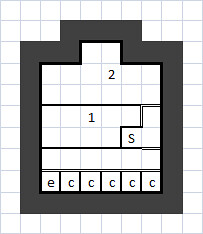
Monastery battlemap basement
1 confiscated objects room (iron door)
2 empty crypt (the monastery was too new to have anybody to put here, though I'm sure Prior Trakis is there now)
S stairs up
c cell (iron door with small window)

In the confiscated objects room, the party discovered copies of the Book of Blight, Compendium of Corruption, Opuscule of Offensiveness, Report of Wrath, and Volume of Villainy, which they divvied up amongst the party members. They also discovered a male erinyes in antimagic shackles trapped in the furthest cell. The erinyes promised to do each of them a favour if they released him. They released him. Some of the party tried to get the erinyes's true name out of him by threatening him with holy water, and he was filled with glee and mirth and applauded this diabolical effort, but denied it with the "no wishing for more wishes" exemption. (The erinyes told them to call him Feathers, instead.) They then arranged for following the favours:
1.) never hurt any of them
2.) tell them everything he knows about the Evil Encyclopedia of Evil (which basically turned out to be everything in the item entry on the subject)
3.) never use any of the Evil Encyclopedia of Evil
4.) steal the volumes of the EEoE from Viblet Kewne once they cash in the bounty, and never tell anybody (not even the party) where he put them
5-6.) the erinyes just gave each party member a feather and told them to break it when they want to cash in the last favours
(3 and 4 might have been merged together, and Feathers owes them three, I can't quite perfectly remember, though I'm sure I wrote it down somewhere...)

Then they returned to the city and Viblet Kewne was just as slimy as they expected. The engineer dragon shaman pretended not to have one of the books so he could keep it, but they cashed in the other four for a cool 4,000gp. Then they went to a tavern, and after a bit, Feathers popped in to report that he had successfully reacquired the books.

I gently suggested that everybody should probably move one step closer to evil based on the events of the session, though it was only a suggestion rather than a command and I don't think anybody did (one evil mission might just be temporary misguidedness, plus they still wound up keeping the books out of the hands of the slimy Viblet Kewne and in the hands of an erinyes who has made a verbal contract never to use them (and devils are all about the contracts, so everything should be hunky dory so long as Feathers stays away from Helms of Opposite Alignment, though even then he'd turn Chaotic Good, so they should still be fine)).

All the same, an evil job well done!

---

...at least until next session, when they'll discover the following bounty added to the list:

REWARD:
Information sought leading to the whereabouts of a band of evil adventurers who broke into the monastery on Perch Hill, terrorized the monks, and murdered Prior Trakis, a paladin of the faith. See Abbot Waxter at the Monastery with any information.
Be on the lookout for a group consisting of:
> an orc-descended man, in possession of a horse
> an engineer man
> an Omorashi human woman
> three additional human or elf men
Be warned: these individuals are armed and extremely dangerous. They may be in league with an evil erinyes devil – this creature is very powerful and should not be engaged without proper training. They may also be in possession of copies of several volumes of the Evil Encyclopedia of Evil – if found, these books should not be read and may be returned to the Monastery for an additional reward.
Authorized by Pelor’s Archbishop of Shell, Jov Sauart

Wednesday, June 22, 2011

Dynamic Random Encounter Tables

For the Open Gaming Table, I've always used custom random encounter tables. For each region, I painstakingly constructed a custom table.

For example, the random encounter table for the Cave of Burning included every demon below a certain CR, every creature with the [fire] subtype below a certain CR, several fire-related non-creature encounters, and creatures which wandered in from the surface or from connected caves.

Each time a party enters a new room, I rolled to see if there were creatures there. I never got this system perfected. I was mostly using d2s, and then not rolling for a cleared room for a couple days after it was cleared, before going back to rolling for it again. If I were to go back to a system like this, I would probably roll 1d4 (1 = no creatures; 2-4 = creatures) for an unexplored room, 1d2 for a room that was previously cleared or empty.

Then, after I perfected a dynamic random encounter table for the gladiatorial arena, I realized that, as much sense as it makes for the arena, it makes even more sense for encounters out in the wild.

---

The principle is this: you have a list of all the encounters that one might find in a given area, and each one is associated with a number. That number is how many encounters of that type are wandering around in the general area, and it's also a range of numbers on the die. Each time the party eliminates an encounter, tick this number down by about one.

The approximation is a judgement call. If the encounter was "1d6 bugbears", and you rolled high so the party encountered and killed 6, consider ticking the number down by two. If you rolled low and they only encountered 1 bugbear, consider not ticking the number down at all.

If half of the encounter escaped and the other half died, consider ticking the original down by 1, and add an extra encounter to the list consisting of exactly the number of creatures that got away (with a note to yourself specifying which PCs they now know to fear).

If the party encounters an immobile encounter and does not kill it, tick it down from the random list and add it to the map as a regular (i.e., non-wandering) encounter. Shrieker fungi don't tend to wander away. (Obviously, if the party does kill something, you should add its corpse to the map.) If you get an immobile encounter in a previously-cleared area, feel free to reroll unless you can quickly think of a good reason how it got there (or if you feel like saying "sure let's go with that" once one of your players comes up with a plausible theory).

Also on the encounter list are options to pull from nearby regions. If the Stank Cave is connected to the Don't Drink This River, then the DDTR random encounter table has a "roll on Stank Cave table" option, and the Stank Cave random encounter table has a "roll on DDTR table" option. If this option comes up and the encounter is defeated, you may want to tick the number on both lists down by 1.

For example, if the party is exploring the DDTR and get "roll on Stank Cave table" and then get a shambling mound from the Stank Cave, and they kill the Shambling Mound, that represents a shambling mound wandering from its Stank Cave home to the DDTR. If the shambling mound is killed, that's one fewer shambling mound in the Stank Cave, so you tick that number down by 1. It is also the case that a monster wandered from the Stank Cave to the DDTR and never came back, which may dissuade other monsters from doing the same, so tick the "roll on Stank Cave table" option down by 1. This latter half is probably more advisable if the areas are populated largely by relatively intelligent creatures. If it's all mindless vermin, don't tick down "roll on another table", only tick down the encounter that was actually killed.

Another possibility to consider: you could actually tick the "roll on other table" option up each time you roll it, to signify that creatures from this other location are obviously making efforts to expand their territory, if you're encountering them elsewhere. Or, probably better (if your lists aren't sufficiently segregated by race), you could (on a case-by-case basis) simply move creatures from one list to another. If the party encounters kobolds in hobgoblin-controlled territory, maybe there are a few groups of kobolds scouting out hobgoblin lands on a long-term basis.

The third kind of thing on the encounter list is "Nothing" (which I always set to a higher number than any one encounter, and usually a substantial fraction of the total). Instead of rolling in each room to see if there's a monster there or not, simply always roll on the random encounter list, and if it comes up "Nothing", there isn't a monster there.

Never tick "Nothing" down. As adventurers exterminate monsters, the likelihood that they encounter a new monster grows ever smaller. This is perhaps the most elegantly simulationist aspect of the dynamic random encounter table, and the part that most closely cleaves to the philosophy of the Open Gaming Table.

More monsters can be added, though I would suggest each time new monsters come in it be treated as a medium-big deal, and possibly be a quest hook. The surface random encounter table (yes, you should have one for the surface, though its "Nothing" value should be higher than in the dungeons) looking a little sparse? Add a bunch of bandit encounters to the dynamic table and have some villagers mention a recent surge in bandit activity, and build it into an adventure where you hunt down and kill the bandit king, which doesn't eliminate existing bandits from the table, but it means more bandits won't get added.

---

I originally had all my random encounter tables set to total up to 100 (so I could roll a d%), but that doesn't work if you want them to be dynamic. Then I realized: heyy, I'm using Excel (Excel is easily the most useful program I own, don't knock it), I've got the RANDBETWEEN function, I don't need to aim for a target number at all. So now I have some dynamic tables in the 80s and some in the high 200s.

For those of you playing along at home and want to know exactly what format I'm using, each table has six columns, of which the first two are hidden because they're purely for system use. (I could just as easily have had four, and incorporated the first two columns right into the third, but I didn't happen to do that, because it didn't occur to me until after I was done converting all my tables to this new system in the first place.)

Yes, I know this part is of the sort where if you know anything about Excel you'll be rolling your eyes at what a monumental noob I am, and if you don't know Excel you may be baffled and terrified and have no idea what's going on. Indulge me.

The five columns (we will consider row 3, which is the first data row on most of my tables):

A: Min die roll. Take the max die roll of the previous row, and add one. (B2 happens to be empty, but A3 should = 1 anyway, so it works out fine.)
=B2+1

B: Max die roll. Add the min die roll to the number of monsters of this type and subtract 1 (to get a proper dice range - if you have a 5% chance, that's 1-5 on the die, but adding 1 and 5 would get you 6).
=D3+A3-1

C: Dice range. The first IF is to leave this field blank if there aren't any encounters of this type (yes, I know, it would be easier to just check to see whether there's anything in D), mostly so I could leave several blank ones at the end for later use. The second IF is to return a single-number range if there's only one encounter of this type (if there's only one ettin wandering around, it's more elegant if the ettin's dice range reads "82" rather than "82-82"). The third (it was originally a third IF, but that was silly, A3<B3 is the only possibility left) returns the range from min die roll to max die roll.
=IF(A3>B3,"",IF(A3=B3,A3,CONCATENATE(A3,"-",B3)))

D: Number of encounters. This is the all-important number associated with each encounter, which you set to however many encounters of this type there are in the region, and tick down every time the party kills an encounter.

E: Encounter name and brief details (e.g., "1d6 Medium Centipedes", "CE Justice Archon wearing a Helm of Opposite Alignment").

F: The sourcebook in which that encounter is found.

---

And then, as mentioned, you can put an automatic die roller someplace on the sheet. To roll a die and get a random encounter from the table, you can simply do something very simple like this, where # is the last row of the table (it works even if D# is blank, i.e., if you have some blank ones at the end, which you should):
=RANDBETWEEN(1,B#)
It isn't remotely tricky to hook it up such that it automatically pulls the encounter name/details/sourcebook from the list for you, but I leave that as an exercise for the reader.

---

UPDATE: I did wind up doing that last bit on my own tables. It involves the vlookup command.

And, as an example of what it should look like (or what it looks like for me): the table for the Dwarven Tombs west of Serpent Pass in my setting:
Example dynamic random encounter table

Sunday, June 12, 2011

The Evil Encyclopedia of Evil

One of the several fun things about Blades of Avernum was item creation. I spent long hours, once upon a time, writing up scenarios, and I would always populate these scenarios with a multitude of custom items. A brief survey of such items:

Tin Foil Hat
Doorbane Axe
Science Pole
Gobbet of Flesh
Tasty Bugs
Meat of Malevolence
Lord Hammer's Hammer
Evil Candle of Doom
Coins of Costliness
Succubus Skirt
Pants of the Archangel
Miracle Pants/Miraculous Pants
Silk Panties
Pants of Pollution

Forgive me, I was young and BoA offered a "pants" item slot.

Anyhow, the set of items I most frequently tried to include into my scenarios as macguffins were nothing more than a list of alliterative names. Recently, when I was trying to decide what evil macguffin or plot coupon an evil priest of Quasxthe might want adventurers to steal from the monastery of Pelor (the mantra of the Open Gaming Table: options, options, options), it occurred to me to dust off this list. (The name is not actually redundant. It's less like the Evil League of Evil and more along the lines of the Monster Book of Monsters and the Invisible Book of Invisibility - it is an encyclopedia about evil which is itself evil.)

---

Each individual volume of the Evil Encyclopedia of Evil is a lesser artifact. Collectively, the entire encyclopedia qualifies as a greater artifact.

Evil Encyclopedia of Evil
Centuries ago, before the Inundation, the evil archtheurge Megiddo Mehida, adventuring companion of the first Count Rogan, made decades of work out of (very carefully) studying copies of the Book of Vile Darkness, Book of Exalted Deeds, Tome of Ancient Lore, Tome of the Stilled Tongue, Book of Infinite Spells, as well as lesser documents like Tomes of Understanding, Tomes of Leadership and Influence, Tomes of Clear Thought, Manuals of Quickness of Action, Manuals of Gainful Exercise, Manuals of Bodily Health, Golem Manuals, Vacuous Grimoires, and uncountably many scrolls. He learned more words of the Dark Speech than any sane mind could possibly contain. He worked for further decades, copying, writing, and splicing pages whole to construct a single document which would combine the powers of all these books and contain all the power that words collected together could possibly contain.
Megiddo worked so long and hard that one day, his minions entered his libratory to find it deserted; the only thing remaining of their master was a multi-volume encyclopedia. No one knows the details, but it is thought that Megiddo put so much of himself into his work that his physical form ceased to exist, and everything of him was subsumed within the encyclopedia itself.
The next part of the story is uncertain, but it is known that all the volumes of the encyclopedia were somehow dispersed to all corners of the globe even before the Inundation. To this day, evil cults still seek to recombine the scattered portions of the encyclopedia and wield its immense power for themselves.
The Evil Encyclopedia of Evil has seventeen volumes. Perusing each volume has a different effect on the reader. Once a character has begun to read, he is compelled to continue in whatever manner he began until he has finished (which takes 4d6 hours) unless he makes a DC20 Will save. If a character reads the book aloud, everyone within earshot must make a DC20 Will save or stand fascinated until the recitation is complete. If the book is read silently, only the reader suffers its effects. If the book is read aloud, all listeners suffer its effects. No two readers or listeners can ever quite agree on the specific contents of the volume they read, only that it was profoundly distasteful.
A character who suffers the effects of reading or hearing a volume read aloud takes an effect as if a spell had been cast on them, specific to each volume. Treat this spell as cast by a level 20 wizard or archivist, save DC 17+spell level. The effect of this spell is permanent, and can only be removed by Remove Curse or Dispel Magic.
Volume : Effect
Album of Agony : Angry Ache (BoVD 85)
Book of Blight : Unholy Blight (SRD)
Codex of Catastrophe : Earthquake (SRD)
Compendium of Corruption : Corrosive Grasp (SpC 53)
Dictionary of Doom : Doom (SRD)
Manifesto of Malevolence : Malevolent Miasma (SpC 137)
Manuscript of Malignance : Love's Pain (BoVD 98)
Omnibus of Obscenity : Blindness/Deafness (SRD)
Opuscule of Offensiveness : Addiction (BoVD 84)
Palimpsest of Plague : Contagion (SRD)
Paper of Pestilence : Plague of Rats (CD 174)
Publication of Profanity : Desecrate (SRD)
Report of Wrath : Rage (SRD)
Text of Turpitude : Red Fester (BoVD 102)
Tome of Tyranny : Geas/Quest to kill your closest friend (SRD)
Treatise of Terror : Fear (SRD)
Volume of Villainy : Morality Undone (BoVD 99)
If all 17 volumes are brought together and read aloud, all participants suffer all 17 effects once the reading is complete. Additionally, an Apocalypse From The Sky spell centered on the readers takes effect immediately after the completion of the recitation. The books themselves take no damage from the apocalypse.
It is possible to copy a volume of the Evil Encyclopedia of Evil using mundane skills and materials. A proper copy is identical in power to the original. However, the copier takes the effect of reading the book, but they automatically fail all saves, and the effect cannot be removed except by the application of a Wish, Miracle, or spell of similar power.

Friday, June 10, 2011

Open Gaming Table In Practice 2

For the third Open Gaming Table session, they went back to the mines. Two players brought new characters of their own, which was good. The duskblade returned, and three players played pregens.

I did indeed change to describing the mines rather than laboriously drawing them. One of the two rooms I had to draw, because there was combat in it, I simply could not get right, no matter how carefully I copied my original map, so eventually I gave up and called it good enough.

Two other highlights in this session:

The random encounter table turned up 1d3 horses deep inside the mines. Keep in mind, these mines have been infested with giant centipedes and abandoned for many weeks. In retrospect, "you come upon three horse skeletons" would have been a much better solution - the random encounter doesn't necessarily have to be alive, after all. Instead, I betrayed the principles of the random encounter table and said "No, that's preposterous, I'm rolling again." Alas.

The other highlight is a completely unpredicted situation. One room contains an empty barrel, which I decided on the fly happened to have been filled with some kind of booze at one point. One player figured the barrel, soaked through with old alcohol, is probably super-flammable. So he picked it up, carried it until there was an opportunity to use it, lit it on fire, and rolled it down a tunnel into the next room.

At which point I noticed my map key for the next room read:
northeast corner is shored up with extra supports
Due to the layout of the corridor, the barrel was aimed directly at the northeast corner of the room. The wooden supports merrily caught fire.

The PCs fled the suffocating smoke and angry swarm of centipedes. When they return, they're likely to find that room has quite collapsed in all sorts of interesting ways, for the same reason it had that extra bracing there in the first place.

---

The fourth game, I tested out the "cantrips/orisons as a free action" rule, and introduced the gladiatorial arena. I was secretly hoping the players would pick the arena, because I was a little excited to try it out, and, happily, they did. All the players but one brought their own characters, which is good.

They went through Round 4, then one of them had taken some poison, so they took their winnings and went home and slept for three days and came back and went through Round 5. Which is pretty impressive for level 1 characters, though they got lucky on the second go through, they got a First Blood match in round 4 against a single earth elemental. Which was a good combination, as earth elementals have quite high AC for that level, but somebody still rolled really high in the first round and took it out.

Monday, June 6, 2011

Gladiatorial Combat

GLADIATORS WANTED
SEVEN DAYS A WEEK
PROVE YOUR METTLE
EARN FABULOUS PRIZES
ENTERTAIN THE CROWD
INQUIRE AT THE ARENA OF KORD
NO ENTRY FEE

In the interest of providing a surfeit of options, I recently introduced an arena combat option into my Open Gaming Table. This is one aspect of the OGT concept taken to an extreme.

---

You see, one of my intents with OGT has been niche-filling. There were several DMs in Buffalo Gamer's Society and Buffalo State CRAGG who were running regular campaigns, and most of them (I've heard) were fairly heavy on roleplay, light on combat. That's normally what I prefer (though 3.5 combat is so much easier to run than the system I played for years that I tend to unintentionally skew towards combat when running 3.5, no matter how much I would prefer RP), but the market is currently saturated on that style of DMing, so I offer a more mindless sort of entertainment.

And the one true weakness of the OGT is how little it encourages roleplaying. A different group each week means there's scant opportunity to really get into a sense of who your fellow characters are. (Though there is opportunity to get, say, a couple paladins thrown into a group together with a couple Chaotic Evil characters, making one of the many possible options "PvP combat", though that's its own little world separate from both regular combat and regular RP.)

---

So, the relevance of the gladiatorial combat: mindless violence, not even in pursuit of any goal (aside from the cash prizes).

I think there's three kinds of player with regards to this sort of pure-combat thing:
1.) The kind of player whose favourite part of D&D is the tactical combat. This kind of player would do better to play 4e, where they've slightly polished the combat and stripped out everything else, but in the absence of a 4e game, they're likely to find this 3.5e gladiatorial combat satisfactory.
2.) The kind of player whose favourite part of D&D is getting more powerful. This kind of player is likely to love this gladiatorial combat, because it comes with more consistent and faster rewards in terms of XP and treasure. If you go exploring or just RPing, you'll get roleplaying and exploration experience, and you're likely to come across some monsters, though not all those monsters are likely to have treasure (especially in the lowest-level option of my OGT, the mine infested with mostly centipedes). If you sign up for gladiatorial combat, you're faced with a chain of monsters with very little in between, and a cash reward after each match.
3.) The kind of player whose favourite part of D&D is roleplaying or achieving in-game things or really just about anything else.

The nice thing about the gladiatorial combat in the Open Gaming Table is that you don't have to do it. If mindless fighting or repetitive grinding is your thing, you can pick this one option and keep with it until it's no longer challenging. If neither is your cup of tea, well, one player can pretty much veto any option if they object strongly enough.

---

I seem to recall coming across at least one prestige class somewhere which was centered around gladiatorial combat, oriented not so much towards beating your opponents as towards being entertaining while doing so. So consider encouraging your players to make Perform checks as they fight (probably associated with whatever violence-related actions they're taking, rather than making them waste standard actions on making the check), and maybe they'll get a bonus, because as far as the event's organizers are concerned, entertaining the crowd is the very point of the exercise.

---

My players should stop reading here.

So, design philosophy on setting up gladiatorial combat. I took as my model, of all things, Who Wants To Be A Millionaire.

There are eight rounds. Each round has an encounter level equal to the number of the round (e.g., round 1 is a CR1 foe, or two CR1/2 foes, or three CR1/3 foes, et cetera). This was largely arbitrary; you could easily have more or fewer rounds, or associate each round with a higher or lower encounter level. In my "NPCs above level 5 are super-rare" world, I set the upper limit at 8 mostly because that's about the strongest creature a huge group of NPCs could conceivably handle.

After each round, you have the option of either taking your winnings and going home, or gambling everything you've won so far on the hope of getting even greater winnings next round. (There's few enough rounds that I didn't bother with including rounds where you can bank your winnings and go home with at least that much if you lose later on.)

Reward-wise, it needs to always be in the party's interest to go on. If you can get more or equal money by taking your reward and then starting again at round 1, then you're likely to do that. So each round's reward needs to be more than twice the previous round.

For the early rounds, at least, the reward should be less than the average recommended treasure for having beaten encounters of that level. e.g., the reward for round 3 should be less than what you'd get if you went out into the wild and defeated a CR1 creature, a CR2 creature, and a CR3 creature. The increased reliability of the gladiatorial combat should come with a decreased payoff, just so it's not always the obvious best option. (Whenever there is a choice, if there is an obvious best option, then it's not actually a choice at all, but rather a decision or calculation.)

The later rounds can be a higher payoff than this (e.g., it's okay for round 8 to give you more money than defeating a CR8+CR7+CR6+CR5+CR4+CR3+CR2+CR1 creature would), for various reasons, including: you'd have to start incredibly small to also adhere to the "more than double each round" rule; by that time the players are probably getting a little fatigued by such constant combat; increased risk (you stand to lose not just the treasure for the current encounter, but the treasure for the 7 previous encounters, too); and at least one more reasons which may become clear when I bring up the possibility of PC-on-PC combat in round 4+.

The numbers I came up with, based on the above principles:

Round : Treasure Value for Equivalent Monsters : Arena Payoff
1 : 300 : 80
2 : 900 : 200
3 : 1,800 : 500
4 : 3,000 : 1,200
5 : 4,600 : 3,200
6 : 6,600 : 8,000
7 : 9,200 : 20,000
8 : 12,600 : 50,000

In each round, foes of appropriate level are determined from a predetermined table of what the arena guys are likely to have on hand.

I've also added a bounty issued by the Church of Kord for any rare and unusual creatures, to be used as arena foes; if the PCs bring back anything that's not on the list, it'll be added. It also occurs to me now that I should decrease the probability of each foe after it's faced, but only if the gladiators kill it - the Church doesn't have an infinite number of each creature on hand, after all. Dynamic lists are fun!

At round 4, I introduce the possibility of making half the PCs fight the other half of the PCs. At round 5, I introduce the possibility of a PC free-for-all, every man for himself. These possibilities remain until the last round, but they're never particularly likely. Only the PCs who are victorious in this round get to go on and collect more winnings in subsequent rounds. This is potentially problematic, but I foresee "Crap, the party's strength is halved/4thed/5thed/6thed, let's just take our winnings and go, we won't be able to beat the next round". If half the party does decide to go on, I'll probably let their players play the monsters, let them try to get revenge on the players that beat them. This portion of the idea has not been really thoroughly thought out, but it's the kind of thing I'd rather refine after playtesting.

In each round, to switch it up a bit and make it exciting, I also set conditions or restrictions for the PCs. My current list is as follows:

Normal
No weapons
No spells
No magic (including magic weapons and magic items)
No weapons or magic (unarmed strikes only)
Ranged attacks/spells only
Melee attacks/spells only
To first blood (a participant is defeated if they take any damage at all; this is super-easy)
PCs are chained together in pairs (must remain within 5' of one another)
PCs are all chained together in a line
PCs are blindfolded.
Ring match (a 30' radius circle is drawn in the center of the arena; if any participant crosses the line, they are defeated)
PCs have one arm tied behind their backs
Arena is flooded 6" deep with water (difficult terrain)
PCs are chained in place and cannot move
More foes enter the arena each round; you only need to survive for 5 rounds (I anticipate this will be super-hard).

The "chained together" options are only really workable if you're using a group initiative system.

If you can think of any more fight conditions I could add (note that this is distinct from foes to fight, which are a different list entirely), let me know in the comments. I don't consider this list complete, it wants more entries.

Thursday, June 2, 2011

Substitution Ciphers as Clues

It turned out, near the end of the second session of my open gaming table, that the healer had actually solved the substitution cipher bounty I had provided!

The duskblade's player facepalmed about ten times in a row because the bounty turned out to be one long reference to the previous campaign, and to his last character (the elf wizard) in particular.

I gave the healer a bunch of extra experience for solving the puzzle, tempered with a slight penalty for doing it at the expense of paying attention to the goings-on of the game. Although I'm not sure what I expected - maybe for people to work on it before the game starts and after it finishes? But at least he was playing his character well - figuring out this puzzle was much more interesting to the character than anything else. Though why he took it to the mine with him rather than just solve it at the adventurer's guild, I don't know. High intelligence, low wisdom, I guess.

Incidentally, the substitution cipher I actually used was in fact the Standard Galactic alphabet. Incidentally, this is an instance where I halfheartedly, and with a modicum of success, adhered to the Three Clue Rule, which says that "For any conclusion you want the PCs to make, include at least three clues." Or, more loosely, provide at least three different ways to get to any given plot point.

I allowed for at least three ways to solve the cipher (with the possibility of more if the players had been clever enough):
1.) Brute force it the old-fashioned way (using observations like: "e" is the most common letter; "the" is the most common three-letter word; "a" and "I" are the only possible one-letter words; etc.) This was how the player wound up doing it.
2.) Roll well enough on your Decipher Script check that I give you some free letters, which makes (1) substantially easier.
3.) Have played enough Commander Keen that you recognize it as the Standard Galactic Alphabet, and consult the wikipedia page or other places that give the complete alphabet.
I can think of at least one other thing that could have partially helped, involving being familiar enough with the story to fill in gaps. (It involved a +1 Frost Dagger that the wizard had taken from the body of the High Priest of Vecna, then loaned to the swashbuckler/knight, then the vampire Baron Rogan took it off the swashbuckler/knight's body, then King Terek II had inherited it from him, and it's currently in the royal treasury and some relative of its original owner wants it back.)

Monday, May 30, 2011

What Kind Of Balance Matters?

As I've said before, a properly-implemented open gaming table or similar system can auto-solve the problem of encounter balance. If you provide a variety of encounters, and a choice for the players of which encounters to engage, the problem of encounter balance solves itself. Your players, if they have any capacity for learning, will fight whatever creatures they feel comfortable fighting. If they would prefer to fight ECL-2 foes and accrue experience slowly but risklessly, they can do that. If they would prefer to fight ECL+2 foes and accrue experience quickly but at great risk to themselves, they can do that, too. This is basically the same principle espoused in the Dungeon Master's Guide, except it involves less need for the GM to be good at reading his players. (It's probably inaccurate and offensive to say that D&D players are less likely to be good at social skills like reading people than your average person, so instead I'll just imply it. Though D&D players are certainly more likely to be good at such skills than, say, pure video gamers.)

---

So with that problem neatly and tidily solved, what other potential balance issues do we need to think about?

Well, the obvious: intra-party power balance. Consider a party consisting of a wizard played by a skilled player, a druid played by an unskilled player, a fighter played by a skilled player, and a monk played by an unskilled player. It is well accepted that wizards and druids are tier 1 while fighters and monks are tier 5. Which is to say, a well-designed, well-played wizard or druid will always be orders of magnitude more useful in a party than a well-designed, well-played fighter or monk.

Well, it has been my experience that low-optimization parties are better balanced than high-optimization parties. A poorly-designed, poorly-played wizard is probably worse than a poorly-designed, poorly-played fighter. Wizards have so many options that if you make poor spell choices, you can't contribute anything, while fighters can always hit things with sticks. The difference between a good fighter and a bad fighter is smaller than the difference between a fighter with a d20 that tends to roll well and a fighter with a d20 that tends to roll poorly. So that's one option: play only with newbies.

A high-optimization party, similarly, will usually have players who avoid tiers lower than 2 on principle, and will auto-balance. They will also break any encounter you throw at them and ask for more, so you want to avoid this situation unless you're running the aptly-named Tomb of Horrors.

So, returning to the good wizard / bad cleric / good fighter / bad monk example. Here, the cleric, fighter, and monk will all be roughly on par with one another, with the wizard the odd one out. The other three will always feel useless. The wizard may, depending on his player's personality, become tired of constantly being in the spotlight, or constantly needing to carry a disproportionate amount of weight. How do we fix this?

---

The tier system provides four suggestions:

#1: Alter point buy. The wizard has fewer ability points to spend than the monk. This helps to balance them a little, because the tier 1 classes tend to be strongly Single Ability Dependent and the tier 5 classes tend to be strongly Multiple Ability Dependent. But what if the monk multiclasses into druid for his second and subsequent levels? A one-level dip into monk is probably worth 16 extra points. You can solve this, but the solution will always be messy.

#2: Gestalt. Tier 1 and 2 can't gestalt, tier 3 and 4 may gestalt with tier 6, tier 5 and 6 may gestalt with other tier 5 and 6. This also gets weird when multiclassing comes into the picture. You get bizarre and undescribable things like (fighter 1 || knight 1) / cleric. It's possible, but messy.

#3: Ban the top few tiers. If you ban tier 1 and 2, great, you just banned 90% of the dedicated spellcasters. Hope you're in a low-magic setting!

The above suggestions also penalize the bad cleric just as much as they penalize the good wizard. We don't want a situation where that happens, the crappy cleric needs as much help as he can get. On the other hand, we also don't want to have a situation where we say "You're an optimizer, so you get penalized; You're incompetent, so you get rewarded", if for no other reason than because that's so subjective.

#4: Go through, find the reasons why the tiers 1 are so good, and nerf them. Find the reasons why the tier 5s are so bad, and improve them. Ban Polymorph. Ban Natural Spell. Give monks full BaB. Give fighters a feat every level. This? This is a butt-ton of work.

---

The above methods are all clunky yet potentially workable. But I like two alternate methods, one also clunky, one more subtle:

#A: You need to take a certain number of levels of low-tier classes before you can take a high-tier class. For example: you can start only with a tier 3, 4, or 5 class. You can't multiclass into tier 2 unless you're already at least third level, and you can't multiclass into tier 1 unless you're already at least sixth level.

You can, of course, apply this with more steps. For example: At first level, you must take a tier 5 or 6 character (so no dedicated spellcasters other than Healer). At level 2, you may take a tier 4, 5, or 6 class. At level 3, you may take a tier 3-6 class. At level 4, you may take a class of any tier except 1. At level 5, you may take any class.

Similarly, you could simply give high tiers a level adjustment. For example, assign Tier 1 LA+2 and Tier 2 LA+1. It might occur to one to give Tier 6 classes a negative level adjustment, though that's tantamount to saying, "taking a level in this class is exactly as good as not taking a level in anything at all" - even Warrior has full BaB and a good Fort save, so everybody can have +1 BaB and +2 Fort for free. This option does not, however, work with multiclassing (a Commoner 19/Wizard 1 would have to have much the same LA as a Wizard 19/Commoner 1, barring liberal application of weird math).

This works because, generally, the best way to improve a spellcasting character is to give him more levels in his spellcasting class. Conversely, the best way to nerf a spellcasting build is to include non-spellcaster levels. Effectively, this puts a spellcaster a certain number of levels behind where he might normally be at any given level. Getting Polymorph at level 7 is a complete game-breaker. Getting Polymorph at, say, level 13 (but still casting with a CL of 7, unless you take the Practiced Spellcaster feat) is much more in line with the sorts of things other characters can do at level 13. A certain kind of gish character might be inclined to take those non-spellcasting levels anyway, and is thereby not penalized any more than they're already penalizing themselves with their choice of build, which is probably fine.

#B: Drastically limit the kinds of items players can buy in stores, and distribute magic items with care. Be generous with things like magical weapons and armor, Belts of Ogre Strength, Monk's Belts, Potions of Bull's Strength, and other things the tier 5s can use better than the tier 1s. Be sparing with scrolls for the wizard or artificer to copy, metamagic rods, Headbands of Intellect, and other things the tier 1s can use better than the tier 5s. This depends on which particular classes you have in the party. If you've got a monk but no cleric or druid, go ahead and give them a Periapt of Wisdom. If you've got a swashbuckler or rogue and no wizard or archivist, go ahead with the Headbands of Intellect.

Similarly, tailor encounters to the strengths of your tier 5s. Golems are good for this, though don't go too overboard with them (the goal is to make the tier 5s as useful as the tier 1s, not to make the tier 1s completely useless forever). If there's a cleric, don't use too many undead, especially if there's also a rogue or a fighter with a +1 Keen Rapier.

---

There is a more general point here, though: when you make any alterations to or interpretations of any rules, try to make sure you're not making tier 1-2 classes more powerful and you're not making tier 4-5 classes weaker.

I myself have broken this rule of thumb on occasion (engineers make great wizards; the list of scrolls wizards can scribe is longer if you allow them to copy non-Sorcerer/Wizard scrolls; mongrelfolk wizards/sorcerers/druids can get water elementals as familiars/animal companions with two feats). But at least I haven't nerfed monks.

Thursday, May 12, 2011

Open Gaming Table In Actual Practice

So I ran the first actual sessions of my Open Gaming Table some weeks ago. How did it go?

Well, most of the players didn't have dice, which was fine because I had my Pound Of Dice on me. Most of the players didn't have characters, which was fine because I had pre-gens on me.

I and one veteran of my last campaign explained a bit of the setting for the new characters. They picked characters. They complained that I hadn't provided a healer. The veteran brought a duskblade of his own. The other players picked Jen the fighter, "Happy" the bard, and Katyra the psion.

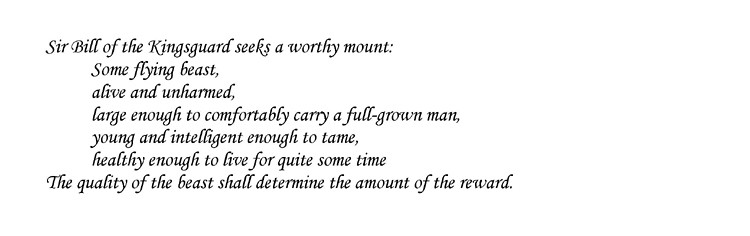
Then I slapped the maps and the bounties on the table. There was much WTF-ing at the mysterious substitution cipher bounty and the childish scrawl of Sir Bigglesworth asking adventurers to return mermaids for his pet elephant to eat.

They decided to head for the ruins in search of the tomb of Gus Dreadworm. On the way up the mountain, they encountered some friendly dogs. Exploring the ruins, they encountered some friendly little drakes.

The bard rolled Bardic Knowledge and recalled that there are two sections of the Disreputable City that might contain relevant information: the Temple District, at the center of the city, and the Tyrant's Ward, abutting the Temple District.

They decided to go to the Tyrant's Ward and search for the ancestral home of the Counts Rogan, descended from the Third Count Rogan, who adventured with Gus Dreadworm. I didn't have the palace/mansion designed, but I drew on my extensive recollection of building dozens or scores of castles, palaces, and mansions of all sorts in Blades of Avernum to design it on the fly. An exterior wall, a courtyard, an inner keep. Inside the door, two arrow slits leading to adjacent rooms. At the other end of the main hall, the throne room and two side doors. Inside the throne room, fancy chairs and a side door leading to what was once a bedroom.

Now, each area has a random creature table, set up by me in advance, with great care. Each encounter has a chance to be a monster wandering in from some adjacent (or, more rarely, not-so-adjacent) area. Justin Alexander plays this up as a major font of creativity - if you roll goblins in the kobold-controlled area, that Means Something. The goblins are obviously scouting kobold territory for invasion, or maybe they're a merchant party. What matters is that you take that seemingly peculiar thing and turn it into a perfectly sensible, coherent datum about the world.

So when I rolled a huge centipede from the cold iron mine in the bedroom of the ancestral palace of the Rogans (notably, past a door somewhat too small for it to easily fit through), that was an excuse to come up with a super-awesome, coherent explanation. And I completely flubbed it. I gibbered some pointless nonsense about a centipede getting in when it was young and then growing big on rats and exploring adventurers. That was an epic failure.

Anyway, huge centipedes have reach, so when the duskblade tried to get close enough to hit it, it bit him into unconsciousness. Then when the bard tried to get close enough to the duskblade to stabilize him, it bit him into unconsciousness, too. Then the fighter and the psion managed to kill the centipede. The duskblade managed to stabilize on his own, one round from death. The bard had no such luck, and died.

Then the players of the bard and the psion had to go, but a new player wandered in and picked up Laurence the druid.

So they went back to town, rested up a bit, and headed back to the ruins again. They poked around in the palace again, and discovered that there was, in fact, a gelatinous cube behind one of the arrow slits. They managed to kill it with hit and run tactics, though it paralyzed half the party. (I made sure to give Gregorius Domus the Resurgence spell, which allows a second chance at a saving throw against that sort of effect, in case that came up again.) Then they gathered up the buttload of copper coins the gelatinous cube dropped. Then they left.

---

The second session went both better and worse.

The duskblade was back, but all the other players were different. They picked Ko-Joou the monk, Katyra the psion again, and Gregorius Domus the healingest healer ever to heal a healed thing.

The healer's player saw the substitution cipher and decided it needed to be solved. He rolled well enough on his Decipher Script to figure out which way the paper should be oriented.

They asked around with Gather Information, and learned that a (relatively) high-level adventuring party entered the Caves of Burning and only one of them came out, badly burned. Then they overheard a couple of adventurers (estimated at level 3 or so) scoffing at the lack of challenge in the Cold Iron Mines. They asked the more experienced adventurers if they knew of any creatures in the mines other than centipedes, and were told that one of them had spotted some scorch marks on a wall, but that was about it.

So they headed to the mines. The psion tormented the poor commoner who let them into the mine. I have discovered that if you hand a player an evil character, they will play it as pettily evil as possible. That's not a complaint so much as it is an observation, though it makes me want even more to play a subtle, big-picture evil character in a campaign, just to demonstrate that it can be done.

They explored the mines for awhile and the "is there an encounter in this room?" die kept coming up "no", which was weird. Then I rolled a pair of domovois from the Cave of Burning. To set up the random table for the Cave of Burning, I had picked out pretty much all the fire creatures and demons of a certain level range. But domovois are apparently chaotic good, helpful creatures, dwarf-looking house elves who help with forges and mines. This one I didn't flub: these domovois weren't from the Cave of Burning at all, they'd been working with the miners. They got caught inside the mine when it got infested with centipedes, and hadn't been able to get out since.

The party "convinced" the domovois to help take down some centipedes, and took the lift down to the second level, where they finally encountered some Small centipedes.

The monk's character had to leave, so the monk ran off, then the others came upon another Huge centipede, and managed to kill it. Then they went home, because two of them had taken dexterity damage and it was late.

---

Some Things I've Learned So Far:

The mine is far too complex in terms of fiddly bits and 45-degree tunnels, it's a massive pain in the ass to copy it accurately from my computer screen to the battlemat. I did expect the mine to be the worst in this regard, and it should also be the first section the players actually "solve", so hopefully I won't need to deal with it forever. If I have to do it too much more, there'll start being cave-ins. Shoddy workmanship. Centipedes nibbling the bracing. You know how it is. Either way, I think I'm going to start just describing the connections between rooms, and draw only the rooms which turn out to contain combat encounters. A practice which I'll reuse for the irregular Stank Cave, and which is probably a good policy in general (if the players see you've drawn something on the map, they don't feel as much compulsion to listen if you describe it).

I need more landmarks. As things keep happening, landmarks will naturally start accumulating (a Huge centipede carapace in one area, the remains of a campfire in another, the body of an engineer in the palace, etc), but there need to be more to start with, at least to break up the monotony when there's a long string of no monsters.

I need to just ignore the "Is there an encounter in this room?" die if it says the same thing more than two or three times in a row.

Sunday, May 8, 2011

Pre-Generated Characters, Part 2

Let's consider the basic process of making a new pre-gen from scratch.

I noticed in the last party that nobody had much charisma at all. I would like to now tally up the stats of all the pre-gens I've provided to determine whether I'm favouring some stats over others. If I am, I should add a new character with stats arranged deliberately to shift the averages slightly.

It turns out that the original roster of pre-gens averaged out to:
STR: 11.7
DEX: 13
CON: 12.7
INT: 13
WIS: 11.5
CHA: 10.9

The current roster:
STR: 11.8
DEX: 12.9
CON: 12.8
INT: 13.1
WIS: 11.2
CHA: 11

I seem to have a bias in favour of intelligence, dexterity, and constitution and against charisma, wisdom, and strength. What uses charisma, wisdom, and strength but not intelligence, dexterity, or constitution? Because there's already a paladin, it would seem to be cleric time.

What LA+0 races have a positive charisma, wisdom, and strength and a non-positive intelligence, dexterity, and constitution? Nothing in particular, let's just go with human.

So let's arrange the stats in reverse order of how much I seem to like them: int < dex < con < str < wis < cha. Since this is 30 point buy, let's arrange them in an 8/10/12/14/15/16 pattern. So what kind of cleric do we want? Well, what's the array of alignments in the current lineup?
LG: 2
NG: 1
CG: 1
LN: 2
N: 1
CN: 2
LE: 3
NE: 1
CE: 0
There are never to be any chaotic evil characters in the party, that's the worst alignment. The last party wound up picking most of the evil characters, so I think I'd like to shift away from adding any more evil options, so NE is out. One of the PCs one player made was neutral, so we should pick between NG and CG.

What NG and CG deities do we have to choose from? Kord, Pelor, Valkur, Corellon Larethian, Deep Sashelas, or Garl Glittergold. Half of those are elf or engineer gods, so let's pick between Kord, Pelor, and Valkur. The cleric in my last campaign was a cleric of Kord, the standard cleric that you think of when you think of a cleric is a cleric of Pelor, and clerics of Valkur were and are semi-prominent NPCs in this world, so the "Have I done this before?" metric is a wash. Let's go with Pelor, but aim for concentrating on radiance and sunniness rather than healing (after all, we've already got the healingest healer ever to heal a healed thing). So let's go with the Sun and Glory domains.

Consult the list of Traits! What jumps out at me? Passionate, certainly. Nothing else particularly fits this sun/glory cleric, so let's select Passionate. What flaws do we want? I'm overusing Shaky and Noncombatant, so let's leave those out. Slow, Frail, and Vulnerable are too overwhelming handicaps. This character seems reasonably willpowerful and fortitudinous, so let's do Poor Reflexes and Pathetic. But what stat shall he be pathetic at? Int, Dex, or Con? Well, 8 Int is all well and good, but 6 would probably be just too dumb; it might seem like I'm parodying ultra-religious types (Who certainly deserve to be parodied, but I'm kind of trying to steer away from that kind of controversy in my games). 8 Dex or 10 Con? Let's bump the Con down to make for a less unbalanced array.

I'm trying to give these pre-gens a wide array of Knowledge skills, because those get rolled a lot in my campaigns. So one rank each in the four Knowledge skills that are cleric class skills (arcana, history, religion, and the planes). And then one each in Heal, Diplomacy, Concentration, and Spellcraft. This character has too few skill points to specialize.

Clerics are proficient in heavy armor. The heaviest armors are too expensive (not that I took that into account for Jen Varakas), so let's go for Masterwork Half-plate. This character doesn't have a dexterity modifier anyway. Let's give him Pelor's favoured weapon: the mace. I'm tempted to make it a Large mace (wielded two-handed), but I've been overusing Monkey Grip with these characters, so let's just make it a normal mace and give him a shield.

Let's glance through Book of Exalted Deeds, that may have some un-terrible radiance-related feats. Eh, not really, not unless we want to do some Vows, but we already have Bob Har-Johnson with his Vow of Chastity. Aha, Complete Divine has stuff. Since this is the only cleric, and thus the only domain caster, let's concentrate on his domains. And since this is the Sun/Glory cleric, let's also concentrate on his turning.

Oo, Disciple of the Sun allows you to spend two turn attempts to destroy instead of turn. (A little redundant with the Sun domain, which allows you to do that 1/day for free.) And this character is definitely a disciple of the sun! So that's one. Let's also add Extra Turning, so he can more easily afford to spend attempts doing that.

I'm also tempted to go with Domain Spontaneity, allowing you to spend turn/rebuke attempts to convert a prepared spell into a domain spell. But that's not really as useful, especially because the Sun domain isn't that useful and the Glory domain pretty much consists of spells that do the same thing turn undead does (ie, take down undead). So let's not bother.

What else might have sun-related spells? Oh hey, Sandstorm, the desert book. Huh, access to the Fire or Sun domain allows Light of Aurifar, which deals 2d6 damage to any undead you turn. Overlaps with Disciple of the Sun, perhaps. May add an element of decision: "Are these undead weak enough that I could kill it with 2d6 damage, or should I spend an extra turn attempt to kill it outright?" Yes, let's go for it, regardless of the reference in the feat's name to a god that isn't Pelor.

So this character is pretty much awesome at killing undead and not necessarily particularly awesome at anything else. That's fine. To play this up to the max, let's go with Bane Magic (Undead), which adds an automatic 2d6 extra damage to spells when used against undead creatures.

Before we open up spellforge and pick spells, this character needs a name. Let's look at the wiktionary page for "radiant". Unfortunately, the only translation provided is Finnish, so let's look for other words. Sun, that's got lots of translations to pick from. Aurinko, Eguzki, Mo'sojko, Seqineq, Saule, Xyp, Kham, Jua. Let's call this character, then, Saul Aurinko.

Now, spells! Let's pick out all the sunniest and undead-killingest spells, with the caveat that they should actually be a little useful. So, Light, Virtue, Purify Food and Drink, Detect Undead, and Ray of Hope, with Disrupt Undead for the domain spell. (Yes, 1d6 damage to one undead is crap compared to the massive horrors Saul can inflict with his turning, but what if he uses up all his 10 daily turn attempts? It's more useful than Endure Elements. Unless they choose to go to the Cave of Burning, in which case the player can switch it in advance.)

And... we're done! With the side benefit that now the players can potentially a.) deal effectively with undead (a massive gap in their capabilities) and b.) heal without having to resort to the healingest healer ever to heal a healed thing.

Wednesday, May 4, 2011

Pre-Generated Characters, Part 1

I must confess, I've never actually played in a one-shot adventure. The idea of not playing a continuing campaign just doesn't appeal to me. So I have no idea how other people construct their pre-gen characters, and I had to work entirely from my own brain.

(Ironically, I've also never played in an ongoing campaign that actually concluded in anything like a satisfactory manner - all but one have just fallen apart and stopped happening after 1d6 sessions. The one brought Ludgeblatt Curdlegut from level 3 to level 8 before fizzling out unsatisfactorily.)

I decided on a few ground rules: each pre-gen character would, of course, obey all the same rules as any other PC. Each one would have a trait and two flaws. Each one would be conceptually weird. They should be playable, but not optimized, ideally choosing races with a -2 (or at most a +0) to their class's primary stat.

---

Let's meet the cast of characters:

Ruddo "Happy" Nackle of Garzak, the male CG engineer bard. Feats to make him extra-bardish: Dash, Extra Music, Obscure Lore, Easygoing, Inattentive, Noncombatant. Spells known: Ghost Sound, Mage Hand, Message, Prestidigitation. This character unfortunately died in the first session.

Ko-Joou, the LG female human monk. Super-monkish: Combat Reflexes, Dodge, Mobility, Improved Initiative, Polite. Shaky, because ranged weapons are too unlike punching. Weak Will, perhaps to make this monk a little more easily duped than one's common perception of a monk.

"Kib" Kibstellischa, the LE female mind flayer, using the Savage Species monster class progression. This was one of two pre-gens for whom I actually wrote any background: "Kib was a perfectly normal mind flayer youth, until one day her Elder Brain instructed her to travel to te nation of Gus and become an adventurer there, for reasons entirely beyond her comprehension. Once there, she was given a special dispensation by the High Priest of Quasxthe, and carries papers signed by King Terek II instructing his people to leave her be." I didn't really have a definite concept for this character, so she kind of has a little of everything - Dash, Master of Knowledge, Mind over Body, Nightsighted, Inattentive, Poor Reflexes, a longspear.

Katyra the Mind, the female LE half-elf telepath psion. Powers: Psionic Charm, Mind Thrust, and Missive. I gave her the Psionic Talent feat three times, so she's got a vast pool of power points.

Laurence Tepp-Stewart, the male N mongrelfolk druid. Mongrelfolk, as you'll recall, can now take any heritage feats they otherwise qualify for, without regard to class. This one is descended from a green dragon, and has Draconic Heritage, Skin, and Wings. He also has a crocodile Animal Companion named Reskfarb. The player didn't like my spell selection, and completely switched them out, which is entirely fine.

Bob Har-Johnson, the male LG mongrelfolk paladin. I mentioned this, one of the players asked "I didn't think mongrelfolk could be paladins." It was pointed out that anything can be anything. The only really interesting thing about this character is the Vow of Chastity. I'm trying to go for some feats and flaws that, while not exactly bad, nobody in their right mind would actually take.

Gobbo, the male NE mongrelfolk favored soul of Maglubiyet, god of goblins. This is a kind of barbarian cleric, with Inflict spells and Blade of Blood and the Illiterate trait.

Zyess the Ultra-Violent, the male CN elf barbarian. Power attack, Cleave, Monkey Grip, Large greataxe, Reckless, Shaky, Weak Will.

Jen Varakas, the NG female human fighter. This was the other character I wrote a bit of background for: "Niece of Bob Varakas, mayor of Shell." Yes, you may recall a Bob Varakas from the first session of my first campaign. One of my players certainly did. Jen is a tank, with Heavy Plate Armor, a Heavy Steel Shield, Improved Shield Bash, and Shield Specialization. She's also got Exotic Weapon Proficiency (Bastard Sword), Weapon Focus (Bastard Sword), and Monkey Grip, so she's got a Large Bastard Sword that does a hefty 2d8+3 per hit. Of course, she also has 8 wisdom, Passionate (+1 Fort, -1 Will), and Weak Will (-3 Will), so her Will save was -5 to start with. One of the first creatures they faced was an allip, from which the party failed to run. Her Wisdom is currently permanently drained to a total of 2 until somebody with the capacity to cast Restoration can be found.

Boltnuts the CN warforged rogue. Two-weapon Fighting (he uses a rapier and a short sword), Mithral Body, Dishonest, Weak Will, Meager Fortitude.

Marcus Crudus, LN male human warmage.

Thoradd "Blue" Calladagan of Garzak, LE engineer Blue Dragon Shaman. This character was created to replace "Happy", who died in the first session.

Wervan "Chickens" Yurgar of the Surface Holdings, CG male engineer sorcerer. This was mostly an experiment in the Chicken Infested flaw, which I have decided to allow. Chicken Infested was originally a joke feat from an April Fool's edition of Dragon Magazine, where every time you try to draw a weapon or pull an item out of a container, you have a 50% chance of drawing a live chicken instead. This is popularly held to lead to ridiculous abuse, but that's a misreading of the rules: it's a free action to draw a spell component, and it's a free action (with Quick Draw) to draw a weapon. A chicken is neither a spell component nor a weapon, so it's always a move action to draw one. Anyway, "Chickens" is, of course, Chicken Infested. And his familiar is Rembrandt von Cluckington, a chicken (use a raven, but change its fly speed to Glide 20). He is constantly surrounded with chickens. He mostly fights by chucking Alchemist's Fire, which may well make him legitimately unplayable - he has a 50% chance of being unable to deal damage. If I ever need to play a DMPC in this game, this will probably be who I'll go with. I wouldn't inflict him on anyone else.

Dr. Gregorius Domus, the LN human archivist. My players complained that I had neglected (entirely innocently, really) to include a healer in the pregens, so I inflicted upon them the healingest healer ever to heal a healed thing. He has a quarterstaff, all the spells in his prayer book are healing spells of some description. Recall that archivists cast with intelligence, so that's his highest stat; charisma and dexterity are his lowest. He is 49, and thus gets the middle age bonuses and penalties. He is 6'2", with blue eyes and brown hair. He has Iron Will, Skill Focus (Heal), Augment Healing, Master of Knowledge, Abrasive, Poor Reflexes, Slow, and a great many scrolls and potions of healing. If you haven't gotten the reference yet, consult this handy link.